


Association between the attentional network efficiency and change of direction speed ability in young male Indian footballers
- PMID: 39944152
- PMCID: PMC11813905
- DOI: 10.3389/fspor.2025.1529252
Association between the attentional network efficiency and change of direction speed ability in young male Indian footballers
Abstract
Introduction: Interactions between cognitive functions and sports-specific motor actions are crucial for strategic sports performance. Change of direction speed (CODS) is an essential motor ability required for rapid positional maneuvering in football. Although CODS lacks perceptual judgment and anticipatory elements of higher-level cognition, its connection with fundamental cognitive abilities cannot be undermined. The attentional networks is the basis of the fundamental cognitive abilities controlling complex behavior. The present study aimed to investigate the association between CODS ability and the efficiency of alerting, orienting, and executive components of the attentional networks, and decision-making in footballers.
Methods: Seventy-eight male footballers (age: 15.4 ± 0.87 years, BMI: 19.4 ± 1.98 kg/m2) during pre-season completed a battery of field tests comprising Illinois agility test (IAT), 30 m sprint, standing broad jump, and Yo-Yo test. Attentional network components and decision-making ability were tested in the participants with computerized Attentional Network Test-Interactions (ANT-I) and choice reaction time (CRT) tasks in the laboratory set-up. A 2(alerting) ×3 (orienting) ×2 (executive) repeated measures ANOVA tested interactions between the attentional network components. Partial correlation was conducted between the physical (field tests) and cognitive test scores adjusted for age and BMI.
Results: CODS ability measured with IAT was significantly correlated [r = +0.507 (large), p < 0.05] with the executive control network only, nor with alerting [r = -0.039 (trivial), p > 0.05] and orienting [r = + 0.051 (trivial), p > 0.05] networks and neither the CRT task performance [r = -0.011 (trivial), p > 0.05].
Discussion: A strong positive association between executive control and preplanned CODS indicates better interference control by the attentional network. The later may be a factor for faster CODS execution in young footballers. Hence, it may be concluded that better CODS ability is possibly an outcome of innate competence in executive control of the attentional network in young male footballers. These findings attempted to fill the knowledge gap by highlighting the importance of the attentional network functions in modulating CODS ability. The outcomes can benefit football training by implementing ANT-I test in sports-specific settings and for screening purposes. However in the future, a large-scale study including female footballers is required to strengthen this claim further.
Keywords: CODS; attentional networks; cognition; executive control; football.
© 2025 Chatterjee, Dasgupta and Dutta.
Conflict of interest statement
The authors declare that the research was conducted in the absence of any commercial or financial relationships that could be construed as a potential conflict of interest.
Figures
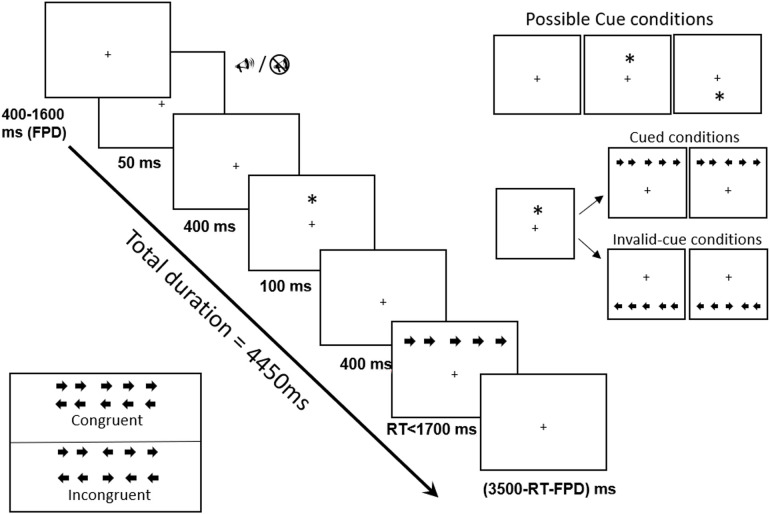
 : tone;
  ; no tone); then any three orienting conditions (no-cue, cue, invalid-cue) [see illustration at the top right corner]; and finally the reaction time window (RT) with two congruency levels [see illustration at bottom left corner for 4 possible combinations of congruent and incongruent flankers]. Cue and invalid cue is provide with “*”.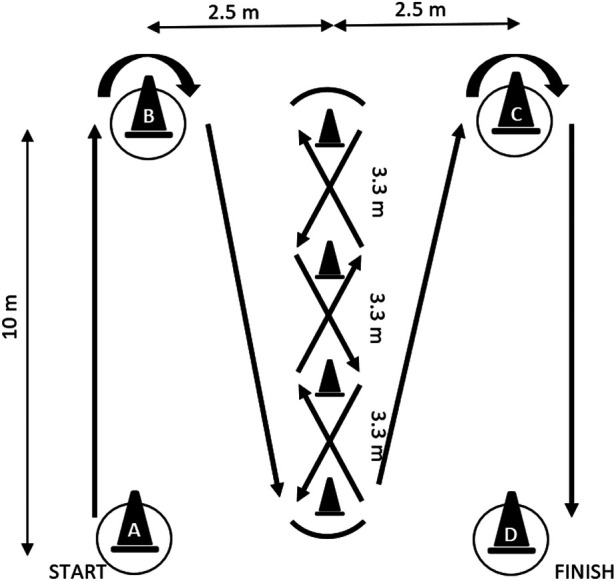
References
-
- Koch P, Krenn B. Executive functions in elite athletes—comparing open-skill and closed-skill sports and considering the role of athletes’ past involvement in both sport categories. Psychol Sport Exerc. (2021) 55:101925. 10.1016/j.psychsport.2021.101925 - DOI
LinkOut - more resources
Full Text Sources
Research Materials
Miscellaneous
