


Phylogenetic Relationships of Three Ramaria Species Based on Mitochondrial Genome Analysis
- PMID: 39944906
- PMCID: PMC11815223
- DOI: 10.1002/ece3.70901
Phylogenetic Relationships of Three Ramaria Species Based on Mitochondrial Genome Analysis
Abstract
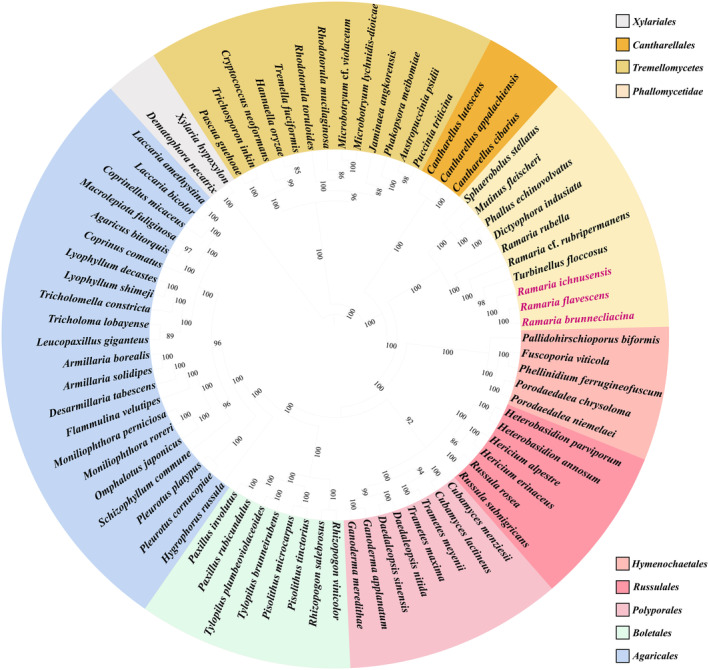
Ramaria has been a remarkable genus throughout the history of macrofungi. However, there is a lack of information on this genus of macrofungi. This study determined the order of nucleotides in the mitochondrial genomes (mitogenomes) of three Ramaria species, followed by a detailed investigation of the obtained genetic information. Circular mitogenomes of Ramaria brunnecliacina, R. ichnusensis, and R. flavescens had sizes of 78,960, 61,851, and 81,282 bp, respectively. The genomes exhibited variations in genetic content, gene length, tRNA, and codon usage. Ramaria mitogenomes demonstrated variable evolutionary rates across several protein-coding genes. The results revealed significant gene rearrangements in Ramaria mitogenomes, including gene displacement and tRNA duplication. Utilizing Bayesian inference and maximum likelihood methods on a comprehensive set of conserved mitochondrial proteins, we generated a well-supported phylogenetic tree for Basidiomycota. This analysis revealed that R. brunneciacina and R. flavescens are closely related, while confirming the paraphyletic nature of the Ramaria genus and its genetic affinity with other species of the subclass Phallomycetidae. This study presents a basic structure for understanding the evolutionary dynamics, genetic makeup, and taxonomy categorization of this significant fungal community.
Keywords: Ramaria species; clavarioid fungi; evolution; mitochondrial genome; phylogenetic analysis.
© 2025 The Author(s). Ecology and Evolution published by John Wiley & Sons Ltd.
Conflict of interest statement
The authors declare no conflicts of interest.
Figures




References
-
- Adams, K. L. , and Palmer J. D.. 2003. “Evolution of Mitochondrial Gene Content: Gene Loss and Transfer to the Nucleus.” Molecular Phylogenetics and Evolution 29: 380–395. - PubMed
-
- Aprotosoaie, A. C. , Zavastin D. E., Mihai C. T., et al. 2017. “Antioxidant and Antigenotoxic Potential of Ramaria largentii Marr & D. E. Stuntz, a Wild Edible Mushroom Collected From Northeast Romania.” Food and Chemical Toxicology 108: 429–437. - PubMed
-
- Araujo, D. S. , De‐Paula R. B., Tome L. M. R., et al. 2021. “Comparative Mitogenomics of Agaricomycetes: Diversity, Abundance, Impact and Coding Potential of Putative Open‐Reading Frames.” Mitochondrion 58: 1–13. - PubMed
-
- Archibald, J. M. 2015. “Endosymbiosis and Eukaryotic Cell Evolution.” Current Biology 25, no. 19: R911–R921. - PubMed
LinkOut - more resources
Full Text Sources
