


Female Soccer Players' In-Season Weekly Training Load and Intensity: Comparison between National League's Top and Bottom-Half Ranked Teams
- PMID: 39944977
- PMCID: PMC11812167
- DOI: 10.5114/jhk/189657
Female Soccer Players' In-Season Weekly Training Load and Intensity: Comparison between National League's Top and Bottom-Half Ranked Teams
Abstract
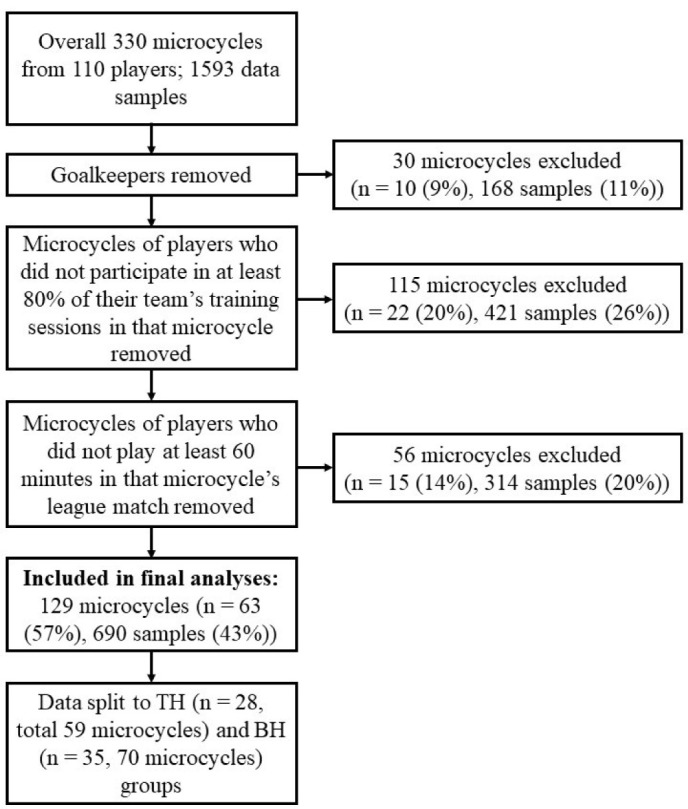
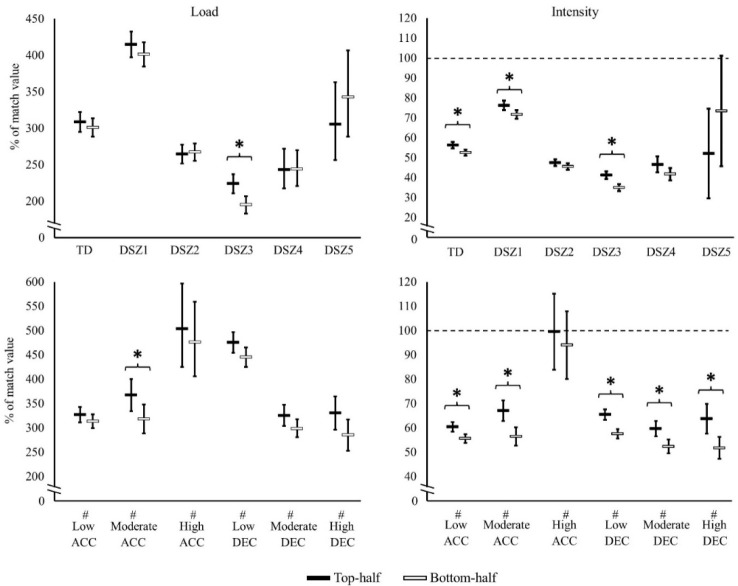
This study aimed to (1) quantify national-level female soccer players' accumulated microcycle (weekly) training load (accumulated absolute value) and intensity (value relative to duration), (2) investigate possible differences in training load and intensity between teams in the league's top- and bottom-half. Sixty-three females from six teams in the highest league participated in the study. Participants were divided into top-half (TH, n = 28) and bottom-half (BH, n = 35) groups based on their team's league ranking. Players' external and internal training load and intensity were monitored in all on-field training sessions and league matches during a three-week observation period (690 data samples) using the Polar Team Pro system. There were no differences between groups in the number of weekly training sessions or total duration. Accumulated external and internal load were highly similar between groups. Instead, the TH group reached significantly higher values than the BH group in multiple external intensity variables, such as total distance per minute and the number of low-, moderate- and high-intensity accelerations per minute (p = 0.004-0.001). There were no differences in the mean heart rate between groups. The TH group's training external intensity was also closer to match intensity in multiple variables, such as total distance and the number of low- and moderate-intensity accelerations and decelerations compared to the BH group (p = 0.029-0.001). These findings suggest that more successful teams achieved higher external intensity for the same internal response, and their average external training intensity was closer to match demands. Thus, it seems plausible that TH players had better physical qualities and their training prepared them better for matches than BH.
Keywords: external load; internal load; microcycle; soccer; women.
Copyright: © Academy of Physical Education in Katowice.
Conflict of interest statement
The authors declare no conflict of interest.
Figures
References
-
- Chamera, T, Pronczuk, M, Smok, P, Drozd, M, Michalczyk, M, & Maszczyk, A. The effects of resistance training on jumping and selected power variables of the lower limbs in female soccer players. Balt J Health Phys Act. 2023;15(3): Article7. 10.29359/BJHPA.15.3.07 - DOI
-
- Coppalle, S., Ravé, G., Moran, J., Salhi, I., Abderrahman, A. Ben, Zouita, S., Granacher, U., & Zouhal, H. (2021). Internal and external training load in under-19 versus professional soccer players during the in-season period. International Journal of Environmental Research and Public Health, 18(2), 1–10. 10.3390/ijerph18020558 - DOI - PMC - PubMed
-
- Diaz-Seradilla, E., Rodríguez-Fernández, A., Rodríguez-Marroyo, J. A., Castillo, D., Raya-González, J., & Vicente, J. G. V. (2022). Inter- and intra-microcycle external load analysis in female professional soccer players: A playing position approach. PLoS ONE, 17(3), e0264908. 10.1371/journal.pone.0264908 - DOI - PMC - PubMed
LinkOut - more resources
Full Text Sources