


Immediate heart rate changes in late preterm infants receiving resuscitation in the delivery room
- PMID: 39948353
- PMCID: PMC12343917
- DOI: 10.1038/s41372-025-02220-5
Immediate heart rate changes in late preterm infants receiving resuscitation in the delivery room
Abstract
Objectives: Assess heart rate (HR) trends in the minutes following delivery in late preterm infants 34-36 6/7 weeks with spontaneous respirations and compare trends in infants with delayed transition requiring interventions and assess the direct potential impact of these interventions on HR changes.
Design: Prospective observational single center study in 20 late preterm infants born via cesarean section utilizing the NeoBeat which uses dry electrode technology to obtain blinded HR measures in infants with spontaneous respirations versus infants requiring interventions i.e.: positive pressure ventilation, continuous positive airway pressure or suctioning.
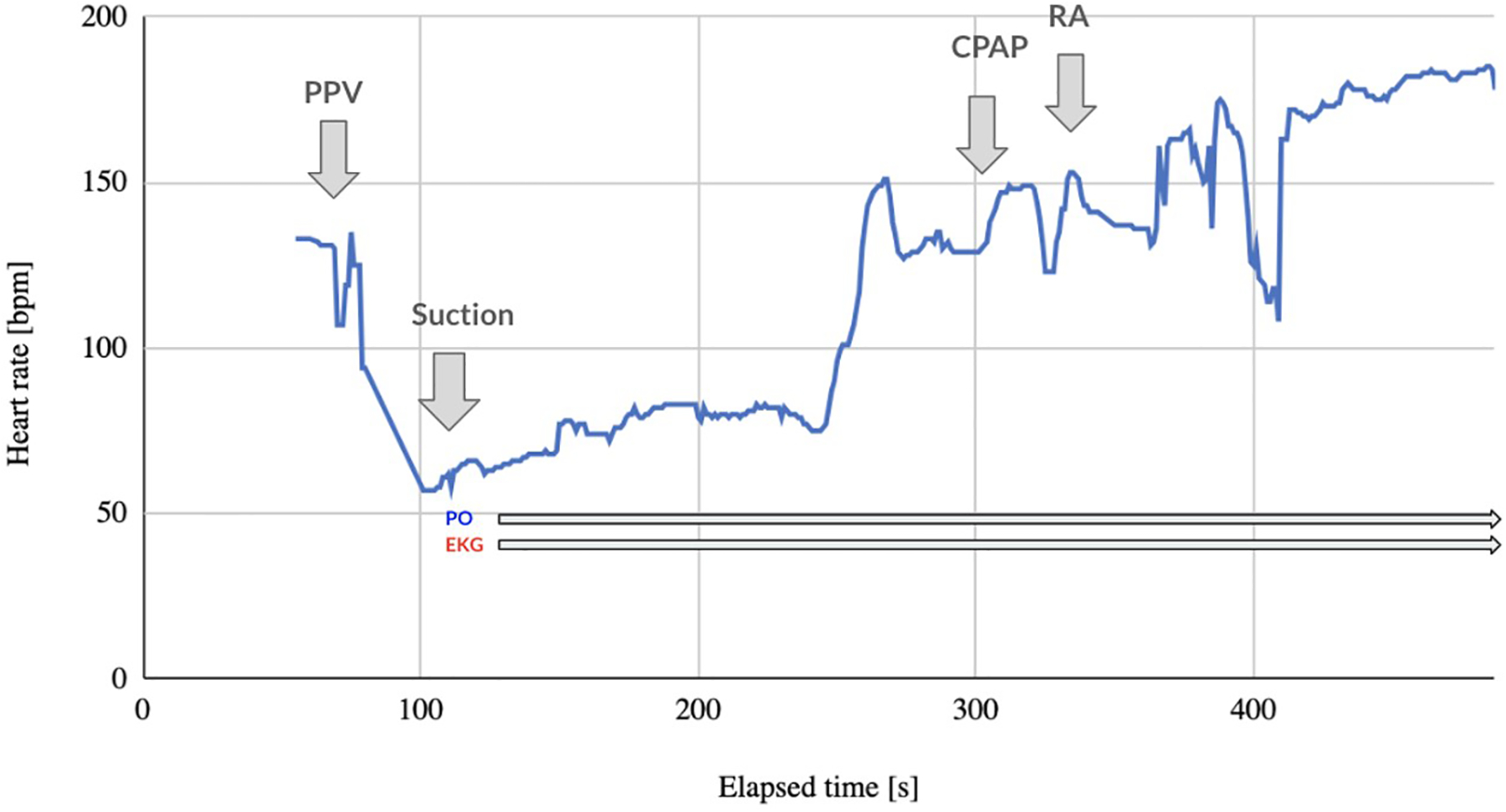
Results: Initial HR in spontaneously breathing infants (n = 8) was higher versus those requiring interventions, differences that persisted through five minutes. Iatrogenic bradycardia ranging from 65 to 90 beats/minute was induced by interventions in five(42%) of 12 infants.
Conclusions: Initial HR in spontaneously breathing late preterm infants was significantly higher compared to infants who received interventions. Respiratory interventions induced sudden unanticipated bradycardia in many cases.
© 2025. The Author(s), under exclusive licence to Springer Nature America, Inc.
Conflict of interest statement
Competing interests: The authors declare no competing interests. Ethical approval: This study was approved by the Weill Cornell Institutional Review Board (FWA # 00000093. Consent was obtained from the parent prior to delivery.
Figures



References
-
- Wyckoff MH, Greif R, Morley PT, Ng KC, Olasveengen TM Singletary EM et al. 2022 International Consensus on Cardiopulmonary Resuscitation and Emergency Cardiovascular Care Science With Treatment Recommendations: Summary From the Basic Life Support; Advanced Life Support; Pediatric Life Support; Neonatal Life Support; Education, Implementation, and Teams; and First Aid Task Forces. Circulation. 2022. Dec 20;146(25):e483–e557. - PubMed
-
- Textbook of Neonatal Resuscitation(8th edition) Weiner Gary M., Zaichkin Jeanette Editors American Academy of Pediatrics, & American Heart Association.
-
- Bush JB; Cooley V; Perlman J; Chang C NeoBeat offers rapid newborn heart rate assessment. Arch. Dis. Child. Fetal Neonatal Ed 2021, 106, 550–552 - PubMed
-
- Linde JE, Schulz J, Perlman JM, Oymar K, Francis F, Normal Newborn Heart Rate in the First Five Minutes of Life Assessed by Dry-Electrode Electrocardiography. Neonatology, 2016,110(3), 231–237 - PubMed
Publication types
MeSH terms
Grants and funding
LinkOut - more resources
Full Text Sources
Medical
