


Montreal Cognitive Assessment vs the Mini-Mental State Examination as a Screening Tool for Patients With Genetic Frontotemporal Dementia
- PMID: 39951678
- PMCID: PMC11837847
- DOI: 10.1212/WNL.0000000000213401
Montreal Cognitive Assessment vs the Mini-Mental State Examination as a Screening Tool for Patients With Genetic Frontotemporal Dementia
Abstract
Background and objectives: With upcoming clinical trials targeting preclinical stages of genetic frontotemporal dementia (FTD), early detection through cognitive screening is crucial. The Mini-Mental State Examination (MMSE) and Montreal Cognitive Assessment (MoCA) have potential as screening instruments for early-stage genetic FTD. However, no comparative evaluation has been performed. We aimed to compare MMSE and MoCA performance among presymptomatic, prodromal, and symptomatic pathogenic variant carriers to analyze which screening test has superior discriminative abilities.
Methods: We used cross-sectional and longitudinal data from 2 longitudinal genetic FTD cohort studies in the Netherlands and the United Kingdom, collected between 2021 and 2024. Participants were either presymptomatic, prodromal, or symptomatic pathogenic variant carriers or healthy controls (first-degree family members without pathogenic variants for FTD). Grouping was based on the global CDR-plus-NACC-FTLD score. Participants were assessed with both MoCA and MMSE. Statistical analyses compared total and subscores between groups and evaluated predictive and classification accuracy of both tests.
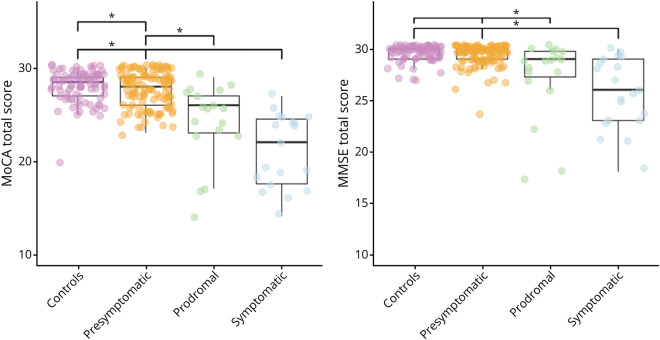
Results: A total of 243 participants (mean age 49.9 ± 13.1 years, mean education 14.5 ± 3.0 years, 56% female), 157 of whom were pathogenic variant carriers (MAPT, GRN, C9orf72, TARDBP, and TBK1) and 86 controls, were included. Carriers were classified as presymptomatic (n = 119), prodromal (n = 18), or symptomatic (n = 20). Both MoCA [F(3,239) = 16.565, p < 0.001] and MMSE [F(3,239) = 13.529, p < 0.001] total scores differed significantly between groups, with controls (median MoCA 28.5, 95% CI 28.0-29.0; median MMSE 30, 95% CI 30.0-30.0) outperforming prodromal (median MoCA 26, 95% CI 23.0-27.0; median MMSE 29, 95% CI 27.5-29.5) and symptomatic (median MoCA 20.5, 95% CI 17.0-24.0; median MMSE 26, 95% CI 23.5-29.0) carriers. MoCA distinguished between presymptomatic carriers and controls (median MoCA 28, 95% CI 27.0-29.0), but MMSE did not. MoCA demonstrated superior discriminative ability compared with MMSE (MoCA area under the curve [AUC] = 0.87, 95% CI 0.81-0.94; MMSE AUC = 0.80, 95% CI 0.72-0.89).
Discussion: Its higher sensitivity and better discriminative power make MoCA a more valuable tool for cognitive screening in upcoming clinical trials targeting preclinical FTD. Future studies should aim for larger sample sizes from additional study centers.
Conflict of interest statement
The authors report no relevant disclosures. Go to
Figures


References
Publication types
MeSH terms
Substances
LinkOut - more resources
Full Text Sources
Miscellaneous
