


Variability of the Penn upper motor neuron score in amyotrophic lateral sclerosis: need for a revised score
- PMID: 39954119
- PMCID: PMC11829849
- DOI: 10.1007/s00415-025-12895-7
Variability of the Penn upper motor neuron score in amyotrophic lateral sclerosis: need for a revised score
Abstract
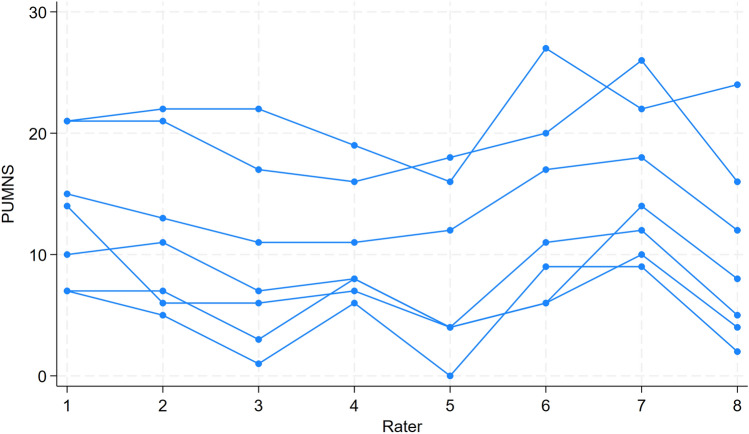
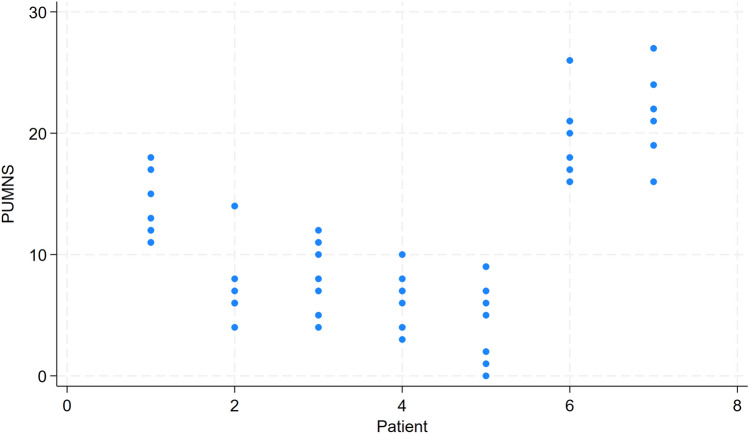
There is a need for a consensus on a clinical scale for evaluating upper motor neuron (UMN) burden in amyotrophic lateral sclerosis (ALS) to improve consistency in clinical diagnosis, research and monitoring of disease progression. The Penn upper motor neuron score (PUMNS) is the most commonly published scale, however, the reliability of the scale has only been evaluated in a single study involving two raters. The objective of this study was to evaluate the inter-rater reliability of the PUMNS in ALS patients among multiple raters, and to discuss an updated UMN score including the signs with the highest inter-rater reliability. This study included seven ALS patients (mean age: 71 ± 11.5, six males, one female). Each patient was evaluated with the PUMNS by eight raters from different centers blinded to previous observations. The intra-class correlation coefficient (ICC) was calculated to assess the inter-rater reliability of the total PUMNS. The inter-rater reliability of the binary subscores was assessed with Gwet's AC1 coefficient. The inter-rater agreement for the total PUMNS yielded an ICC of 0.81 (95% CI 0.56;0.96). Items with the highest inter-rater reliability included Hoffman's sign, Babinski's sign, clonus and deep tendon reflexes, while the facial reflex (Gwet's AC1 -0.038 (95% CI -0.25,0.18)) and crossed adduction (0.18 (95% CI (-0.32,0.67)) had the lowest inter-rater reliability. In conclusion, PUMNS demonstrated good inter-rater reliability overall, while some of the subscores had poor inter-rater reliability. Based on this, we call for an updated UMN score to enhance diagnostic accuracy and research consistency in ALS.
Keywords: Diagnosis; Motor neuron disease; Reliability; Upper motor neuron.
© 2025. The Author(s).
Conflict of interest statement
Declarations. Conflicts of interest: The authors declare that they have no conflict of interest. Ethical approval: All participants signed an informed consent before entering the study, and the study was carried out in accordance with the Declaration of Helsinki II. The project received approval from the Regional Scientific Ethical Committee (1–10-72–201-23) and the Danish Data Protection Agency.
Figures
References
-
- Dharmadasa T, Pavey N, Tu S, Menon P, Huynh W, Mahoney CJ, Timmins HC, Higashihara M et al (2024) Novel approaches to assessing upper motor neuron dysfunction in motor neuron disease/amyotrophic lateral sclerosis: IFCN handbook chapter. Clin Neurophysiol 163:68–89. 10.1016/j.clinph.2024.04.010 - DOI - PubMed
MeSH terms
Grants and funding
LinkOut - more resources
Full Text Sources
Medical
Miscellaneous
