


Intersensory attention deficits in schizophrenia relate to ongoing sensorimotor beta oscillations
- PMID: 39962042
- PMCID: PMC11832887
- DOI: 10.1038/s41537-025-00571-8
Intersensory attention deficits in schizophrenia relate to ongoing sensorimotor beta oscillations
Erratum in
-
Author Correction: Intersensory attention deficits in schizophrenia relate to ongoing sensorimotor beta oscillations.Schizophrenia (Heidelb). 2025 Feb 28;11(1):33. doi: 10.1038/s41537-025-00588-z. Schizophrenia (Heidelb). 2025. PMID: 40021670 Free PMC article. No abstract available.
Abstract
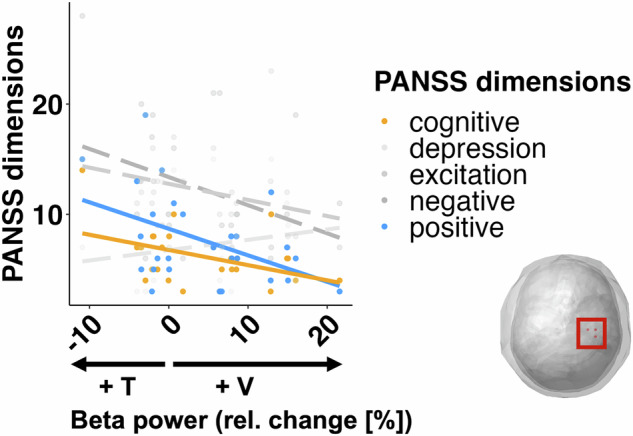
This study tested whether intersensory attention deficits in people with schizophrenia (SZ) relate to aberrant ongoing oscillations in sensory cortices. Electroencephalography (EEG) was recorded while individuals with schizophrenia (N = 27) and healthy controls (HC; N = 27) performed a visual-tactile target detection task. Ongoing alpha (8-12 Hz) and lower beta (13-20 Hz) band oscillations in visual and sensorimotor cortices were examined. Behavioral data suggested an intersensory attention deficit in patients. EEG data revealed stronger alpha-band oscillations for tactile vs. visual attention conditions in the visual cortex of both study groups. In the sensorimotor cortex contralateral to the tactile stimulation site, patients showed an additional intersensory attention effect in ongoing beta-band oscillations, which was negatively related to cognitive and positive symptoms of the PANSS. Our findings extend previous results from unisensory attention research and suggest that deficits in intersensory attention and alterations in sensorimotor beta oscillations are related to schizophrenia symptomatology.
© 2025. The Author(s).
Conflict of interest statement
Competing interests: The authors declare no competing interests.
Figures


References
Grants and funding
LinkOut - more resources
Full Text Sources
