


"A Biomarker-Based Scoring System to Assess the Presence of Obstructive Coronary Artery Disease in Patients With Myocardial Infarction"
- PMID: 39967413
- PMCID: PMC11836528
- DOI: 10.1002/clc.70090
"A Biomarker-Based Scoring System to Assess the Presence of Obstructive Coronary Artery Disease in Patients With Myocardial Infarction"
Abstract
Aims: Approximately 10% of patients with myocardial infarction present with non-obstructive coronary arteries (MINOCA), whose characteristics differ from those with obstructive coronary lesions (MICAD). Inflammation plays a key role in myocardial infarction. This study aims to develop a biomarker-based index for accurate differentiation between MINOCA and MICAD.
Methods: A prospective, observational cohort study including 111 patients admitted for myocardial infarction: 46 with MINOCA and 65 with MICAD. Blood samples were collected within the first 24 h to measure high-sensitivity C-reactive protein, interleukin-6, asymmetric dimethylarginine, and peak high-sensitivity troponin T. The association of these biomarkers with MICAD risk was analyzed using logistic regression. Scoring systems were developed using optimization algorithms to predict the diagnosis before coronary angiography, applied to both individual biomarkers and a combined index.
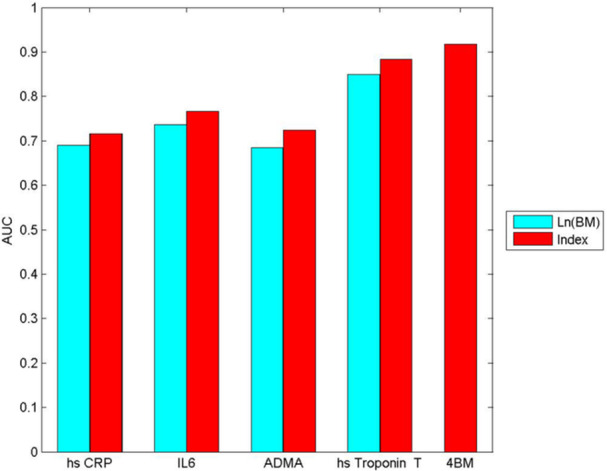
Results: Patients had a mean age of 67 years (SD 13.3), with a male predominance (68.5%). Higher levels of IL-6 and high-sensitivity troponin T were significantly associated with increased MICAD risk (OR: 1.58; 95% CI: 1.01-2.46, and OR: 2.27; 95% CI: 1.61-3.26, respectively). As score increases, interleukin-6 and high-sensitivity troponin T increase the likelihood of MICAD classification, while higher asymmetric dimethylarginine levels reduce it. Each one-point increase in the combined index multiplies MICAD risk by six (OR:6.16, 95%CI: 2.72-13.95; p < 0.001). While individual indexes improved the diagnostic performance of biomarkers, the combined index demonstrated superior accuracy (AUC: 0.918).
Conclusions: A biomarker-based scoring system was developed, achieving superior discriminatory capacity for differentiating MINOCA from MICAD compared to the individual analysis of biomarkers in absolute values or independent indexes.
Keywords: MICAD; MINOCA; biomarkers; diagnosis; endothelial dysfunction; index; inflammation; myocardial infarction; score.
© 2025 The Author(s). Clinical Cardiology published by Wiley Periodicals, LLC.
Conflict of interest statement
The authors declare no conflicts of interest.
Figures
References
-
- Pasupathy S., Air T., Dreyer R. P., Tavella R., and Beltrame J. F., “Systematic Review of Patients Presenting With Suspected Myocardial Infarction and Nonobstructive Coronary Arteries,” Circulation 131 (2015): 861–870. - PubMed
-
- Byrne R. A., Rossello X., Coughlan J. J., et al., ESC Scientific Document Group ., “ESC Guidelines for the Management of Acute Coronary Syndromes,” European Heart Journal 2023, no. 44 (2023): 3720–3826. - PubMed
Publication types
MeSH terms
Substances
Grants and funding
LinkOut - more resources
Full Text Sources
Medical
Research Materials
