


Social frailty and its association with cognitive trajectories in older adults: a prospective cohort study
- PMID: 39972471
- PMCID: PMC11837587
- DOI: 10.1186/s13195-025-01687-w
Social frailty and its association with cognitive trajectories in older adults: a prospective cohort study
Abstract
Background: Social frailty, a multidimensional construct encompassing various social behaviors, resources, and needs, significantly impacts cognitive health in older adults. Despite existing studies linking specific social factors to cognitive function, the association between social frailty and long-term cognitive trajectories remains underexplored. This study aims to evaluate the longitudinal association between social frailty and trajectory of cognitive function in dementia-free older adults.
Methods: This prospective cohort study used data from the National Health and Aging Trends Study (NHATS). Social frailty was assessed using the Makizako Social Frailty Index. According to the presence of social components, individuals were categorized into social frailty (≥ 2), pre-social frailty (1), and robust (0), respectively. Cognitive function was annually evaluated through memory, orientation, and executive function tests from 2011 to 2018. Mixed-effects linear models were employed to assess the associations between social frailty and changes in global and domain-specific cognitive function, adjusting for relevant covariates.
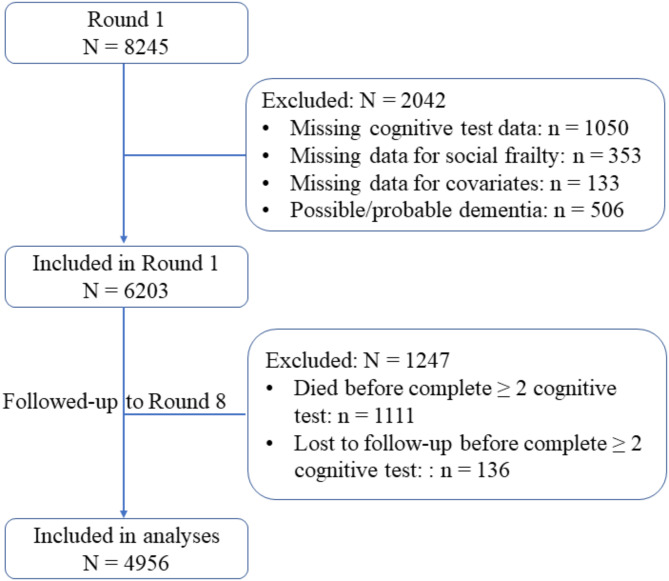
Results: In this study, 4956 dementia-free older adults (mean age 76.57 [7.41]) with complete at least 2 times of cognitive tests were included. Compared with the robust, social frailty was associated with significantly faster decline in global cognitive function (β = -0.041, 95% CI [-0.047, -0.036] z score per year) and domain-specific cognitive function (βmemory = -0.045, 95% CI [-0.055, -0.036] z score per year; βorientation = -0.027, 95% CI [-0.034, -0.020] z score per year; βexecutive = -0.042, 95% CI [-0.053, -0.032] z score per year) over the follow-up. Additionally, pre social frailty was associated with significantly faster decline in global cognitive function (β = -0.016, 95% CI [-0.021, -0.012] z score per year), memory function (β= -0.045, 95% CI [-0.055, -0.036] z score per year), and orientation function (β= -0.027, 95% CI [-0.034, -0.020] z score per year) over the follow-up.
Conclusions: Social frailty is associated with faster decline in cognition in older adults, underscoring the necessity for enhanced social support and engagement to mitigate cognitive deterioration in vulnerable populations.
Keywords: Cognitive trajectory; Cohort study; Older adults; Social frailty.
© 2025. The Author(s).
Conflict of interest statement
Declarations. Ethics approval and consent to participate: This study uses publicly available, nonidentifiable data and was approved by the John Hopkins University institutional review board. Informed consent was obtained by NHATS investigators from all participants or their proxy respondents. Our analysis of publicly available, de-identified data was considered exempt from institutional review board review. Consent for publication: Not applicable. Competing interests: The authors declare no competing interests. Sponsor’s role: None.
References
MeSH terms
Grants and funding
LinkOut - more resources
Full Text Sources
Medical
