


This is a preprint.
Heterochronous laminar maturation in the human prefrontal cortex
- PMID: 39975178
- PMCID: PMC11838308
- DOI: 10.1101/2025.01.30.635751
Heterochronous laminar maturation in the human prefrontal cortex
Abstract
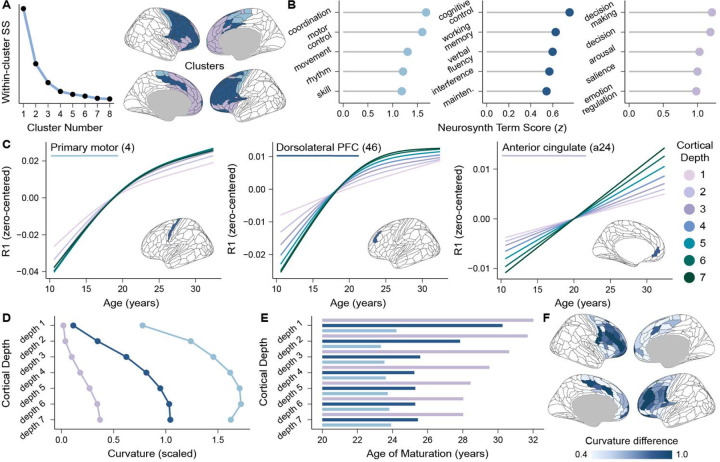
The human prefrontal cortex (PFC) exhibits markedly protracted developmental plasticity, yet whether reductions in plasticity occur synchronously across prefrontal cortical layers is unclear. Animal studies have shown that intracortical myelin consolidates neural circuits to close periods of plasticity. Here, we use quantitative myelin imaging collected from youth (ages 10-32 years) at ultra-high field (7T) to investigate whether deep and superficial PFC layers exhibit different timeframes of plasticity. We find that myelin matures along a deep-to-superficial axis in the PFC; this axis of maturational timing is expressed to a different extent in cytoarchitecturally distinct regions along the frontal cortical hierarchy. By integrating myelin mapping with electroencephalogram and cognitive phenotyping, we provide evidence that deep and superficial prefrontal myelin dissociably impact timescales of neural activity, task learning rates, and cognitive processing speed. Heterochronous maturation across deep and superficial layers is an underrecognized mechanism through which association cortex balances cognitively-relevant increases in circuit stability and efficiency with extended neuroplasticity.
Conflict of interest statement
Competing Interests The authors declare no competing interests.
Figures




References
-
- Buckner R. L. & Krienen F. M. The evolution of distributed association networks in the human brain. Trends Cogn Sci 17, 648–665 (2013). - PubMed
Publication types
Grants and funding
LinkOut - more resources
Full Text Sources
Miscellaneous
