


Perceptions and Earliest Experiences of Medical Students and Faculty With ChatGPT in Medical Education: Qualitative Study
- PMID: 39977012
- PMCID: PMC11888024
- DOI: 10.2196/63400
Perceptions and Earliest Experiences of Medical Students and Faculty With ChatGPT in Medical Education: Qualitative Study
Abstract
Background: With the rapid development of artificial intelligence technologies, there is a growing interest in the potential use of artificial intelligence-based tools like ChatGPT in medical education. However, there is limited research on the initial perceptions and experiences of faculty and students with ChatGPT, particularly in Saudi Arabia.
Objective: This study aimed to explore the earliest knowledge, perceived benefits, concerns, and limitations of using ChatGPT in medical education among faculty and students at a leading Saudi Arabian university.
Methods: A qualitative exploratory study was conducted in April 2023, involving focused meetings with medical faculty and students with varying levels of ChatGPT experience. A thematic analysis was used to identify key themes and subthemes emerging from the discussions.
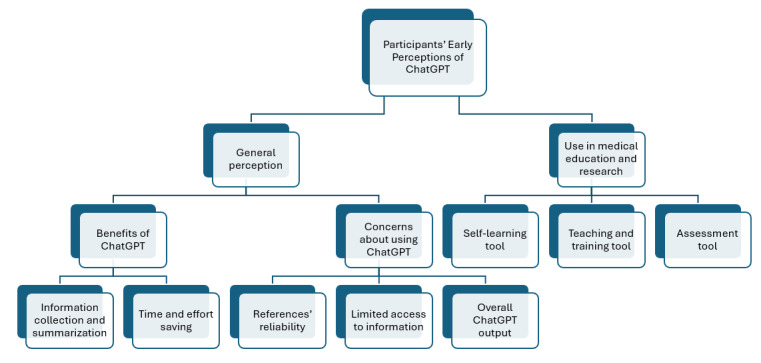
Results: Participants demonstrated good knowledge of ChatGPT and its functions. The main themes were perceptions of ChatGPT use, potential benefits, and concerns about ChatGPT in research and medical education. The perceived benefits included collecting and summarizing information and saving time and effort. However, concerns and limitations centered around the potential lack of critical thinking in the information provided, the ambiguity of references, limitations of access, trust in the output of ChatGPT, and ethical concerns.
Conclusions: This study provides valuable insights into the perceptions and experiences of medical faculty and students regarding the use of newly introduced large language models like ChatGPT in medical education. While the benefits of ChatGPT were recognized, participants also expressed concerns and limitations requiring further studies for effective integration into medical education, exploring the impact of ChatGPT on learning outcomes, student and faculty satisfaction, and the development of critical thinking skills.
Keywords: AI; AI-based tools; ChatGPT; Saudi Arabia; artificial intelligence; chatbot; faculty; knowledge; learning; medical education; medical students; perceptions; qualitative study; satisfaction; thematic analysis; universities.
©Noura Abouammoh, Khalid Alhasan, Fadi Aljamaan, Rupesh Raina, Khalid H Malki, Ibraheem Altamimi, Ruaim Muaygil, Hayfaa Wahabi, Amr Jamal, Ali Alhaboob, Rasha Assad Assiri, Jaffar A Al-Tawfiq, Ayman Al-Eyadhy, Mona Soliman, Mohamad-Hani Temsah. Originally published in JMIR Medical Education (https://mededu.jmir.org), 20.02.2025.
Conflict of interest statement
Conflicts of Interest: None declared.
Figures
References
-
- Fazlollahi AM, Bakhaidar M, Alsayegh A, Yilmaz R, Winkler-Schwartz A, Mirchi N, Langleben I, Ledwos N, Sabbagh AJ, Bajunaid K, Harley JM, Del Maestro RF. Effect of artificial intelligence tutoring vs expert instruction on learning simulated surgical skills among medical students: a randomized clinical trial. JAMA Netw Open. 2022;5(2):e2149008. doi: 10.1001/jamanetworkopen.2021.49008. https://europepmc.org/abstract/MED/35191972 2789268 - DOI - PMC - PubMed
-
- Fazlollahi AM, Yilmaz R, Winkler-Schwartz A, Mirchi N, Ledwos N, Bakhaidar M, Alsayegh A, Del Maestro RF. AI in surgical curriculum design and unintended outcomes for technical competencies in simulation training. JAMA Netw Open. 2023;6(9):e2334658. doi: 10.1001/jamanetworkopen.2023.34658. https://europepmc.org/abstract/MED/37725373 2809667 - DOI - PMC - PubMed
-
- Simsek-Cetinkaya S, Cakir SK. Evaluation of the effectiveness of artificial intelligence assisted interactive screen-based simulation in breast self-examination: an innovative approach in nursing students. Nurse Educ Today. 2023;127:105857. doi: 10.1016/j.nedt.2023.105857.S0260-6917(23)00151-X - DOI - PubMed
-
- Sheng B, Chen X, Li T, Ma T, Yang Y, Bi L, Zhang X. An overview of artificial intelligence in diabetic retinopathy and other ocular diseases. Front Public Health. 2022;10:971943. doi: 10.3389/fpubh.2022.971943. https://europepmc.org/abstract/MED/36388304 - DOI - PMC - PubMed
MeSH terms
LinkOut - more resources
Full Text Sources
Miscellaneous
