. 2025 Feb 20;15(1):6188.
doi: 10.1038/s41598-024-75005-z.

MRI-based analysis of thigh intramuscular fat and its associations with age, sex, and BMI using data from the osteoarthritis initiative data

Affiliations

MRI-based analysis of thigh intramuscular fat and its associations with age, sex, and BMI using data from the osteoarthritis initiative data

Gabby B Joseph et al. Sci Rep. .

Abstract

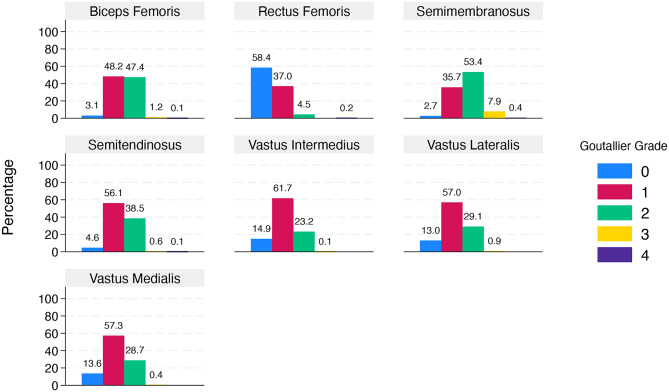
The degree of thigh intramuscular fat in individuals without OA is fundamental for distinguishing natural variations in intramuscular fat from pathological changes. The goals of this study were to estimate the degree of thigh intramuscular fat in individuals without radiographic OA or frequent pain and assess the associations of age, sex, and BMI with the degree of intramuscular fat. Individuals without knee or hip radiographic OA, without total knee/hip arthroplasty, and without frequent knee/hip pain were selected from the OAI database (n = 710). Goutallier Grades (GGs) of the quadriceps and hamstring muscles were assessed based on 3 T MR images on a scale from 0 (normal muscle) to 4 (more fat than muscle). The associations between demographic variables and GG outcomes were evaluated using mixed effects models. The most prevalent GGs among the muscles were Grades 1 and 2; Grade 4 was infrequent (< 1%). Greater BMI (p < 0.001) and age (p < 0.001) were each associated with greater GG. Women had greater GG than men (greatest difference in the vastus medialis: coeff. = 0.214, p < 0.001). At lower BMI, women had greater intramuscular fat than men; at higher BMI, men had greater intramuscular fat than women (p = 0.029 for BMI-sex interaction). While individuals without radiographic OA or frequent pain generally had low thigh intramuscular fat, higher BMI and age were associated with greater intramuscular fat, and GGs were greater in women than men. The relationship between BMI and intramuscular fat was sex-dependent. Thus, demographic variables must be considered when evaluating intramuscular fat.

Keywords: Age; BMI; Goutallier grade; MRI; Sex; Thigh intramuscular fat.


Conflict of interest statement

Declarations. Competing interests: The authors declare no competing interests. Ethics approval and consent to participate: This study utilizes data from the Osteoarthritis Initiative. The study protocol, amendments, and informed consent documentation were approved by the institutional review boards of all participating centers.

Figures

Fig. 1
Fig. 1
Participant Selection from the OAI database. The ‘*’ designates that hips were classified as “definite RHOA” (modified Croft grade was ≥ 2 and/or grade ≥ 1 femoral or grade ≥ 2 acetabular osteophytes plus definite JSN and/or grade ≥ 2 femoral osteophytes regardless and/or superolateral JSN ≥ 2 or superomedial JSN ≥ 3). Hips were classified as “possible RHOA” when other individual or combinations of indefinite individual radiographic features (IRFs) were present and otherwise considered “normal.” Note that participants with missing data for radiographic hip/knee OA, knee/hip pain, total knee/hip replacement, and rheumatoid arthritis were also excluded. KL Kellgren Lawrence.
Fig. 2
Fig. 2
Distribution of goutallier grades among various muscles. The grades range from 0 to 4, with different colors representing each grade.
Fig. 3
Fig. 3
The graphs illustrate the associations between BMI and age with GG. In the graphs on the top row, the red color family designates the quadriceps, and the blue color family designates the hamstrings. The graph (bottom row) demonstrates statistically significant interactions between BMI and sex on GG grade (p = 0.029), suggesting that the effects of BMI on GG grade vary by sex. Error bars represent 95% CIs.
Fig. 4
Fig. 4
Row 1: men vs. women. Representative MR images of right thighs from 65-year-old man (a) and a 61-year-old woman (b), both with a of BMI = 34 kg/m2 are shown. Note the abundance of fatty streaks in all muscle groups, particularly in the hamstrings in (b) compared to (a). GGs in (b) ranged from 2–3 for all muscles, while GGs in (a) ranged from 0–1 for all muscles. Row 2: normal weight vs. obese. Representative MR images of right thighs from a 58-year-old man with BMI = 19 kg/m2 (c) and 60-year-old man with BMI = 36 kg/m2 (d) are shown. Despite similar ages in both men, higher GGs, ranging between 1 and 3, were recorded in the participant with higher BMI (d) compared to the lean participant (c) with GGs ranging between 0 and 1. Row 3: younger vs. older. Representative MR Images of right thighs from a 48-year-old woman with BMI = 32 kg/m2 (e) and a 71-year-old woman with BMI = 31 kg/m2 (f) are shown. Note the higher abundance of fatty streaks within all muscle compartments in (f), representing increased intramuscular fat with older age. GGs ranged between 0–1 in (e) and 0–3 in (f).

References

    1. Mohajer, B. et al. Role of thigh muscle changes in knee osteoarthritis outcomes: osteoarthritis initiative data. Radiology.305(1), 169–178 (2022). - PMC - PubMed
    1. Taniguchi, M. et al. A higher intramuscular fat in vastus medialis is associated with functional disabilities and symptoms in early stage of knee osteoarthritis: a case–control study. Arthritis Res. Ther.25(1), 61 (2023). - PMC - PubMed
    1. Kumar, D. et al. Association of Quadriceps adiposity with an increase in knee cartilage, meniscus, or bone marrow lesions over three years. Arthritis Care Res.73(8), 1134–1139 (2021). - PMC - PubMed
    1. Taniguchi, M. et al. Enhanced echo intensity in vastus medialis is associated with worsening of functional disabilities and symptoms in patients with knee osteoarthritis: a 3 years longitudinal study. Rheumatol. Int.43(5), 953–960 (2023). - PMC - PubMed
    1. Pedroso, M. G., de Almeida, A. C., Aily, J. B., de Noronha, M. & Mattiello, S. M. Fatty infiltration in the thigh muscles in knee osteoarthritis: a systematic review and meta-analysis. Rheumatol. Int.39(4), 627–635 (2019). - PubMed