


Whole Genome Variable Number Tandem Repeat Analysis in Alzheimer Disease
- PMID: 39980902
- PMCID: PMC11839231
- DOI: 10.1212/NXG.0000000000200241
Whole Genome Variable Number Tandem Repeat Analysis in Alzheimer Disease
Erratum in
-
Erratum: Whole Genome Variable Number Tandem Repeat Analysis in Alzheimer Disease.Neurol Genet. 2025 Jun 25;11(4):e200274. doi: 10.1212/NXG.0000000000200274. eCollection 2025 Aug. Neurol Genet. 2025. PMID: 40621101 Free PMC article.
Abstract
Background and objectives: Investigation into different allelic variants may yield new associative genes to predict late-onset Alzheimer disease (LOAD). Variable number tandem repeats (VNTRs) are important polymorphic components of the genome; however, they have been previously overlooked because of their complex genotyping. New software can now determine differing lengths of VNTRs; however, this has not been tested in a large case-control population.
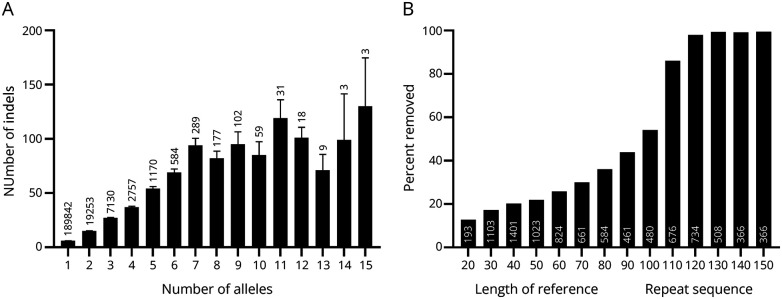
Methods: We used VNTRseek to genotype over 200,000 tandem repeats in 9,501 cases and controls from the Alzheimer's Disease Sequencing Project. We first identified limiting factors of this analysis and then examined the association of VNTRs with AD diagnosis in a subset of non-Hispanic White participants.
Results: We found that VNTRs were highly associated with areas of the genome with a high number of previously identified variants. From our case-control analysis, we identified 9 VNTRs with a repeat allele length associated with LOAD including VNTRs on DSC3, NR2E3, CCNY, PKP4, GRAP, and MAP6.
Discussion: We were able to show the feasibility of this new type of analysis in large-scale whole-genome sequencing data and identify promising VNTRs that are associated with LOAD.
Copyright © 2025 The Author(s). Published by Wolters Kluwer Health, Inc. on behalf of the American Academy of Neurology.
Conflict of interest statement
The authors report no relevant disclosures. Go to Neurology.org/NG for full disclosures.
Figures

References
Grants and funding
- RC2 HL102419/HL/NHLBI NIH HHS/United States
- N01 HC085080/HL/NHLBI NIH HHS/United States
- R01 AG054076/AG/NIA NIH HHS/United States
- U54 HG003067/HG/NHGRI NIH HHS/United States
- U01 AG016976/AG/NIA NIH HHS/United States
- U01 HL096902/HL/NHLBI NIH HHS/United States
- R01 HL105756/HL/NHLBI NIH HHS/United States
- U24 AG041689/AG/NIA NIH HHS/United States
- N01 HC055222/HL/NHLBI NIH HHS/United States
- U01 AG049508/AG/NIA NIH HHS/United States
- R01 AG020098/AG/NIA NIH HHS/United States
- R01 HL070825/HL/NHLBI NIH HHS/United States
- R01 AG023629/AG/NIA NIH HHS/United States
- N01 HC085081/HL/NHLBI NIH HHS/United States
- U01 AG049505/AG/NIA NIH HHS/United States
- U01 HL096812/HL/NHLBI NIH HHS/United States
- U54 AG052427/AG/NIA NIH HHS/United States
- R01 NS017950/NS/NINDS NIH HHS/United States
- R01 AG015928/AG/NIA NIH HHS/United States
- U24 AG021886/AG/NIA NIH HHS/United States
- U01 HL080295/HL/NHLBI NIH HHS/United States
- N01 HC085082/HL/NHLBI NIH HHS/United States
- U01 AG049507/AG/NIA NIH HHS/United States
- U01 HL096917/HL/NHLBI NIH HHS/United States
- U01 AG052411/AG/NIA NIH HHS/United States
- U01 AG032984/AG/NIA NIH HHS/United States
- U01 HL130114/HL/NHLBI NIH HHS/United States
- N01 HC085086/HL/NHLBI NIH HHS/United States
- N01 HC085083/HL/NHLBI NIH HHS/United States
- U54 HG003273/HG/NHGRI NIH HHS/United States
- R01 AG049607/AG/NIA NIH HHS/United States
- UF1 AG047133/AG/NIA NIH HHS/United States
- U01 AG057659/AG/NIA NIH HHS/United States
- N01 HC025195/HL/NHLBI NIH HHS/United States
- R01 AG033193/AG/NIA NIH HHS/United States
- N01 HC085079/HL/NHLBI NIH HHS/United States
- U01 AG052410/AG/NIA NIH HHS/United States
- U01 HL096814/HL/NHLBI NIH HHS/United States
- R01 AG033040/AG/NIA NIH HHS/United States
- U54 HG003079/HG/NHGRI NIH HHS/United States
- U01 AG052409/AG/NIA NIH HHS/United States
- U01 HL096899/HL/NHLBI NIH HHS/United States
- U01 AG049506/AG/NIA NIH HHS/United States
LinkOut - more resources
Full Text Sources
Miscellaneous