


Triglyceride-glucose index as a superior marker of insulin resistance for predicting long-term major adverse cardiovascular events following coronary artery bypass grafting in China
- PMID: 39987346
- PMCID: PMC11846878
- DOI: 10.1038/s41598-025-87967-9
Triglyceride-glucose index as a superior marker of insulin resistance for predicting long-term major adverse cardiovascular events following coronary artery bypass grafting in China
Abstract
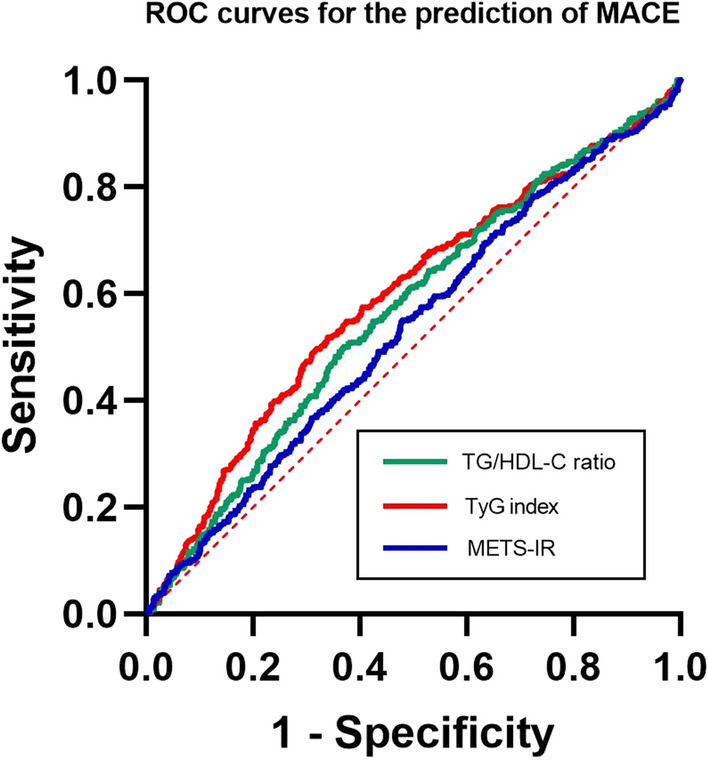
Insulin resistance (IR) has emerged as a risk factor for coronary artery disease (CAD), but there are currently insufficient data on the association of non-insulin-based IR indexes [triglyceride to high-density lipoprotein cholesterol (TG/HDL-C) ratio, triglyceride and glucose (TyG) index, and metabolic score for IR (METS-IR)] with the postoperative prognosis in patients undergoing coronary artery bypass grafting (CABG). Therefore, the present study aimed to examine the predictive power of the above non-insulin-based IR indexes for postoperative prognosis of CABG patients, and to further compare the predictive power of the three indexes. This study included 1472 consecutive CABG patients from June 2014 to January 2019. These patients were divided into two groups based on major adverse cardiovascular events (MACE): without MACE (n = 1136) and with MACE (n = 336). Formulas were used to calculate TyG index, TG/HDL-C, and METS-IR. The Cox regression was done. The study examined how TyG index, TG/HDL-C, and METS-IR improved model performance. Net reclassification improvement (NRI) and integrated discrimination improvement (IDI) were used to evaluate this. The evaluation of model goodness-of-fit was conducted by employing the Akaike information criterion (AIC), Bayesian information criterion (BIC), and χ2 likelihood ratio test. During follow-up, 336 patients experienced the MACE. The associations of TyG index, TG/HDL-C, and METS-IR with MACE were significant. Patients with higher TyG index were at higher risk of MACE (Kaplan-Meier analysis: log-rank P < 0.001; Cox regression: HR = 2.077; 95% CI 1.549-2.784, P < 0.001). The TyG index had the highest area under the curve (AUC) value of 0.593 (95% confidence interval [CI]: 0.557-0.629). The addition of the TyG index yielded a significant improvement in prognostic prediction and model fit [continuous NRI (95% CI): 0.274 (0.1533-0.395), P < 0.001; IDI (95% CI): 0.01(0.0042-0.0159), P < 0.001; AIC: 4662.01; BIC: 4738.35; likelihood ratio test: P < 0.001). The study highlights the prognostic significance of the TyG index, TG/HDL-C, and METS-IR in individuals with CABG. Among these markers, the TyG index had the most robust capacity for predicting MACE. It resulted to be a valuable marker for risk classification and long-term outcome prediction.
Keywords: Coronary artery bypass grafting; Major adverse cardiovascular events; Metabolic score for insulin resistance; Triglyceride and glucose index; Triglyceride to high-density lipoprotein cholesterol ratio.
© 2025. The Author(s).
Conflict of interest statement
Declarations. Competing interests: The authors declare no competing interests. Ethics approval and consent to participate: The Ethics Review Committees of Shandong Provincial Hospital, The Second Hospital of Shandong University, and Qilu Hospital of Shandong University waived the requirement for obtaining informed consent because of the study’s retrospective character. All methods were performed in accordance with the Declaration of Helsinki.
Figures


References
-
- Letsou, G. V., Musfee, F. I., Zhang, Q., Loor, G. & Lee, A. D. Stroke and mortality rates after off-pump vs. pump-assisted/no-clamp coronary artery bypass grafting. J. Cardiovasc. Surg. (Torino)63(6), 742–748 (2022). - PubMed
MeSH terms
Substances
LinkOut - more resources
Full Text Sources
Medical
Miscellaneous
