. 2025;9(2):280-292.
doi: 10.1038/s41550-024-02424-3. Epub 2024 Nov 28.

Efficient formation of a massive quiescent galaxy at redshift 4.9

Affiliations

Efficient formation of a massive quiescent galaxy at redshift 4.9

Anna de Graaff et al. Nat Astron. 2025.

Abstract

Within the established framework of structure formation, galaxies start as systems of low stellar mass and gradually grow into far more massive galaxies. The existence of massive galaxies in the first billion years of the Universe, as suggested by recent observations, seems to challenge this model, as such galaxies would require highly efficient conversion of baryons into stars. An even greater challenge in this epoch is the existence of massive galaxies that have already ceased forming stars. However, robust detections of early massive quiescent galaxies have been challenging due to the coarse wavelength sampling of photometric surveys. Here we report the spectroscopic confirmation with the James Webb Space Telescope of the quiescent galaxy RUBIES-EGS-QG-1 at redshift z = 4.90, 1.2 billion years after the Big Bang. Deep stellar absorption features in the spectrum reveal that the stellar mass of the galaxy of 1011 M formed in a short 200 Myr burst of star formation, after which star formation activity dropped rapidly and persistently. According to current galaxy formation models, systems with such rapid stellar mass growth and early quenching are too rare to plausibly occur in the small area probed spectroscopically with JWST. Instead, the discovery of RUBIES-EGS-QG-1 implies that early massive quiescent galaxies can be quenched earlier or exhaust gas available for star formation more efficiently than assumed at present.

Keywords: Early universe; Galaxies and clusters.


Conflict of interest statement

Competing interestsThe authors declare no competing interests.

Figures
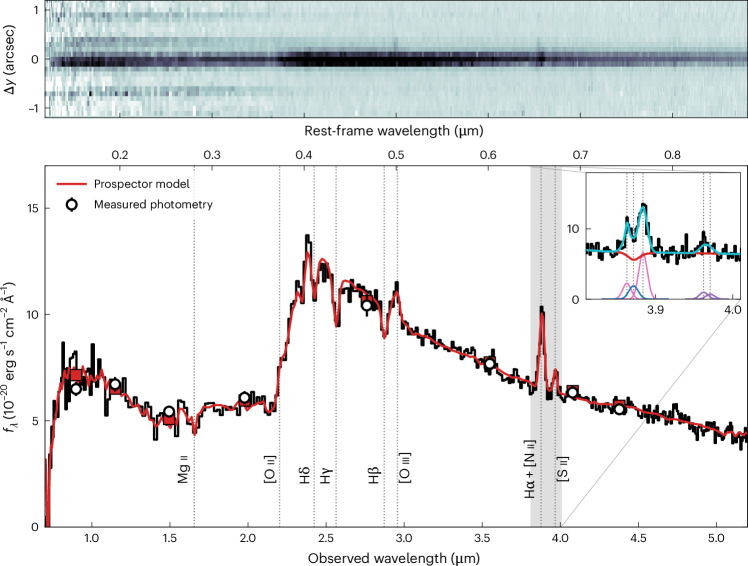
Fig. 1
Fig. 1. JWST/NIRSpec PRISM spectrum of the massive quiescent galaxy RUBIES-EGS-QG-1 at a redshift of z = 4.8976.
The 1D spectrum (flux density fλ; bottom panel) shows deep Balmer absorption lines, like those of post-starburst galaxies at lower redshifts, which implies a lack of star formation in its recent history. Inset, medium-resolution (NIRSpec G395M) spectrum around the wavelength of Hα. Both spectra were calibrated to the measured photometry (error bars on the photometric data points reflect 1σ measurement uncertainties) using Prospector. The presence of the emission-line doublets [O iii], [N ii] and [S ii] and the minimal inferred infilling of the Hα absorption line are consistent with AGN activity. The 2D spectrum (top panel) shows the spatial distribution of the emission in the cross-dispersion direction (Δy). In addition to the compact massive quiescent galaxy, we identify the [O III] and Hα emission of a faint companion source that is offset by approximately +0.2 arcsec and -600 km s−1 (rest-frame velocity).
Fig. 2
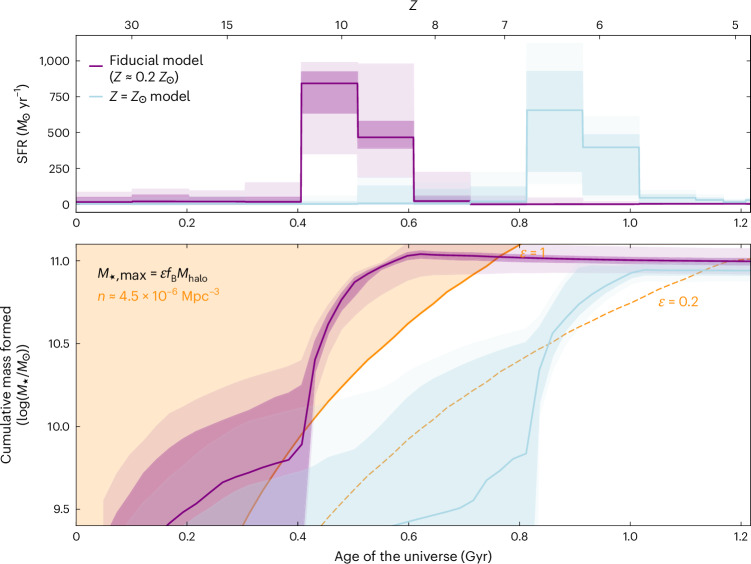
Fig. 2. History of stellar mass growth in RUBIES-EGS-QG-1.
Top, Star formation history inferred from the modelling to the PRISM spectrum and photometry for the fiducial (free-metallicity) model (purple) and the fixed-solar-metallicity model (blue). Dark (light) shaded regions indicate the 1σ (2σ) confidence intervals of the posterior distributions. Bottom, Cumulative mass history inferred from the star formation history of the two models. Marked in orange is the maximum stellar mass (M*,max) formed for the halo mass (Mhalo) of a typical halo at the observed number density of massive quiescent galaxies at z > 4 (ref. ), assuming a universal baryon-to-total matter ratio (fB) and different baryon-to-stellar conversion factors (ε). This indicates that a short burst (~300 Myr) of star formation with high efficiency of ε > 0.2 is required to form RUBIES-EGS-QG-1, corresponding to an efficiency at or greater than the peak of the stellar–halo mass relation.
Fig. 3
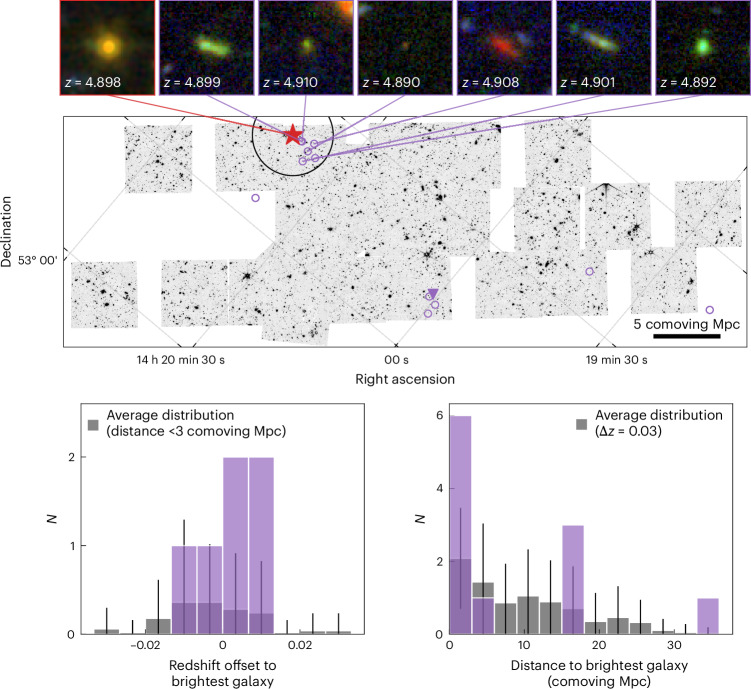
Fig. 3. Spatial clustering of spectroscopically confirmed sources at z ≈ 4.90 around RUBIES-EGS-QG-1.
Middle, There are 13 sources (circles) at approximately the same redshift as the quiescent galaxy (red star), six of which are nearby neighbours. The submillimetre galaxy, the brightest source among the group of four at a projected distance of 16 comoving Mpc, is indicated by a purple triangle. The background image shows the NIRCam F444W mosaic of the EGS field. Bottom, Grey histograms show the mean projected spatial clustering (within redshift ranges Δz = 0.03) and redshift clustering (within apertures of radius <3 Mpc) for galaxies in the redshift range 4 < z < 6 with robust redshifts from JWST spectroscopy. Error bars show the standard deviation. RUBIES-EGS-QG-1 clearly resides in an overdense environment, forming the highest redshift known overdensity hosting a massive quiescent galaxy. Top, False-colour images (created from NIRCam F150W, F277W and F444W images) of RUBIES-EGS-QG-1 and its six nearby neighbours.

References

    1. Labbé, I. et al. A population of red candidate massive galaxies 600 Myr after the Big Bang. Nature616, 266–269 (2023). - PubMed
    1. Behroozi, P. & Silk, J. The most massive galaxies and black holes allowed by ΛCDM. Mon. Not. R. Astron. Soc.477, 5382–5387 (2018).
    1. Boylan-Kolchin, M. Stress testing ΛCDM with high-redshift galaxy candidates. Nat. Astron.7, 731–735 (2023). - PMC - PubMed
    1. Xiao, M. et al. Accelerated formation of ultra-massive galaxies in the first billion years. Nature635, 311–315 (2024). - PubMed
    1. Glazebrook, K. et al. A massive, quiescent galaxy at a redshift of 3.717. Nature544, 71–74 (2017). - PubMed

LinkOut - more resources