Review
. 2025 Jan 17;36(1):102457.
doi: 10.1016/j.omtn.2025.102457. eCollection 2025 Mar 11.

Advanced delivery systems for gene editing: A comprehensive review from the GenE-HumDi COST Action Working Group

Affiliations
Review

Advanced delivery systems for gene editing: A comprehensive review from the GenE-HumDi COST Action Working Group

Alessia Cavazza et al. Mol Ther Nucleic Acids. .

Abstract

In the past decade, precise targeting through genome editing has emerged as a promising alternative to traditional therapeutic approaches. Genome editing can be performed using various platforms, where programmable DNA nucleases create permanent genetic changes at specific genomic locations due to their ability to recognize precise DNA sequences. Clinical application of this technology requires the delivery of the editing reagents to transplantable cells ex vivo or to tissues and organs for in vivo approaches, often representing a barrier to achieving the desired editing efficiency and safety. In this review, authored by members of the GenE-HumDi European Cooperation in Science and Technology (COST) Action, we described the plethora of delivery systems available for genome-editing components, including viral and non-viral systems, highlighting their advantages, limitations, and potential application in a clinical setting.

Keywords: COST; European Cooperation in Science and Technology; GenE-HumDi; MT: Delivery Strategies; base editors; delivery systems; genome editing; regulatory guidelines.


Conflict of interest statement

The authors disclose being members of the GenE-HumDi COST Action CA21113. A.C. has licensed medicinal products and receives patents and royalties from Danaus Pharmaceuticals. A.C. is inventor on a patent for MEGA gene editing off-target detection (WO/2023/079285). P.R. has licensed medicinal products and receives funding and equity from Rocket Pharmaceuticals, Inc.; patents and royalties, and research and consulting funding.

Figures

None
Graphical abstract
Figure 1
Figure 1
Structure of viral and viral-like methods used as gene-editing delivery agents (A) Virus-like particles (VLPs) can be used to deliver therapeutic proteins and nucleic acids and are devoid of viral genetic material, rendering them non-infectious, non-integrative, and non-replicative. (B) Integrase-defective lentiviral vectors (IDLVs) contain therapeutic nucleic acids with an incomplete retroviral genome, making them able to transduce cells while being non-integrative and non-replicative. (C) Adeno-associated viral vectors (AAVs) can transfer therapeutic nucleic acids in a single-stranded DNA-derived genome; they are non-integrative and non-replicative. (D) Adenoviral vectors (AdVs) deliver therapeutic nucleic acids in a double-stranded DNA-derived genome; they transduce cells, are non-integrative, and are replication defective. Created with Biorender.com.
Figure 2
Figure 2
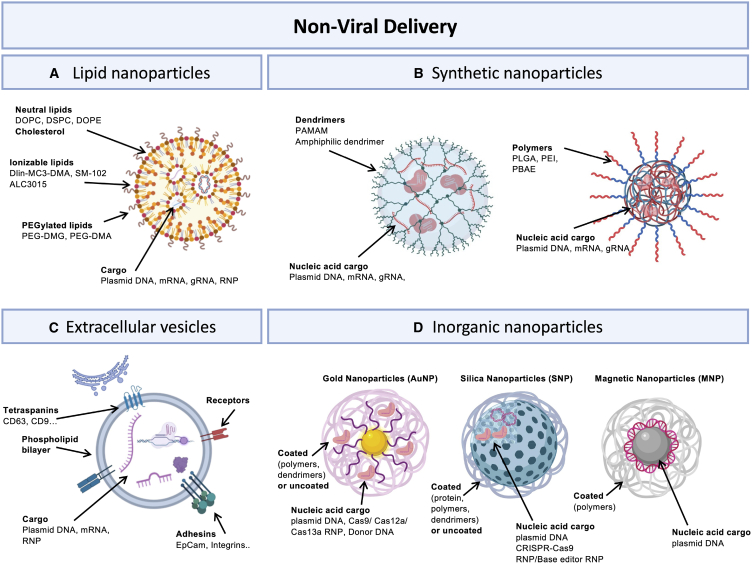
Schematic of non-viral methods for delivering gene-editing tools The CRISPR-Cas system can be delivered in various forms: DNA, mRNA/sgRNA, or ribonucleoprotein (RNP). Non-viral delivery methods include (A) Lipid nanoparticles (LNPs): efficient carriers that encapsulate and protect gene-editing tools, facilitating their cellular uptake. (B) Extracellular vesicles (EVs): naturally occurring particles that transport genetic material between cells, offering a biocompatible delivery system. (C) Synthetic carriers (such as dendrimers and polymers): engineered molecules designed to improve the stability and delivery efficiency of gene-editing tools. (D) Inorganic nanoparticles (including gold, silica, and magnetic particles): robust delivery platforms that can be functionalized for targeted delivery and controlled release of gene-editing agents. Created with Biorender.com.
Figure 3
Figure 3
Overview of selected ongoing gene-editing clinical trials for various diseases For each example, the official name of the clinical trial, ClinicalTrials.gov ID, and gene-editing delivery method are provided when available. An asterisk (∗) indicates ex vivo cell treatment performed before infusion or transplantation.
Figure 4
Figure 4
Ex vivo and in vivo approaches for HSPC gene editing Ex vivo protocols involve multiple steps: HSPC mobilization, collection via peripheral blood stem cell apheresis, isolation and culture, gene-editing tool delivery, and reinfusion of edited HSPCs into the patient after myeloablative conditioning. In ex vivo approaches, gene-editing tools are typically delivered by electroporation as mRNA or RNP. For HDR-based strategies, a DNA donor template is delivered via electroporation (e.g., as ssODN) or viral delivery (using AAVs or Integration-deficient lentiviral vectors). In contrast, in vivo strategies simplify the treatment process by directly injecting gene-editing tools intravenously or into the bone, resulting in the editing of HSPCs either mobilized in circulation or in situ in the bone marrow. Various delivery tools for in vivo approaches are currently under preclinical development, including AdVs, VLPs, and non-viral polymeric (e.g., PLGA) or lipid nanoparticles.

References

    1. Wang J.Y., Doudna J.A. CRISPR technology: A decade of genome editing is only the beginning. Science. 2023;379 - PubMed
    1. Jinek M., Chylinski K., Fonfara I., Hauer M., Doudna J.A., Charpentier E. A programmable dual-RNA-guided DNA endonuclease in adaptive bacterial immunity. Science. 2012;337:816–821. - PMC - PubMed
    1. Komor A.C., Kim Y.B., Packer M.S., Zuris J.A., Liu D.R. Programmable editing of a target base in genomic DNA without double-stranded DNA cleavage. Nature. 2016;533:420–424. - PMC - PubMed
    1. Gaudelli N.M., Komor A.C., Rees H.A., Packer M.S., Badran A.H., Bryson D.I., Liu D.R. Programmable base editing of A∗T to G∗C in genomic DNA without DNA cleavage. Nature. 2017;551:464–471. - PMC - PubMed
    1. Anzalone A.V., Randolph P.B., Davis J.R., Sousa A.A., Koblan L.W., Levy J.M., Chen P.J., Wilson C., Newby G.A., Raguram A., Liu D.R. Search-and-replace genome editing without double-strand breaks or donor DNA. Nature. 2019;576:149–157. - PMC - PubMed

LinkOut - more resources