


Snacktivity™ to Promote Physical Activity in Primary Care, Community Health and Public Health Settings: A Feasibility Randomised Controlled Trial
- PMID: 39994142
- PMCID: PMC12672755
- DOI: 10.1007/s12529-025-10352-3
Snacktivity™ to Promote Physical Activity in Primary Care, Community Health and Public Health Settings: A Feasibility Randomised Controlled Trial
Abstract
Background: A novel 'whole day' approach that could motivate the public to be more physically active is Snacktivity™. The Snacktivity™ approach encourages individuals to accumulate 150 min of physical activity in short 2-5-min 'snacks' of moderate-vigorous intensity physical activity (MVPA) throughout the day/week.
Method: A randomised controlled trial to assess the feasibility/acceptability of a Snacktivity™ intervention and trial processes was conducted. The trial aimed to recruit 80 physically inactive adults from healthcare services and via social media. Participants were randomised to the Snacktivity™ intervention or usual care and followed up at 12 weeks. The intervention was predominately delivered by health professionals within consultations. Assessment of whether the Snacktivity™ intervention and trial methods were acceptable to participants, adherence to Snacktivity™ (assessed by Fitbit) and physical activity (assessed by accelerometer), and retention were considered according to traffic light stop-go progression criteria (green-amber-red).
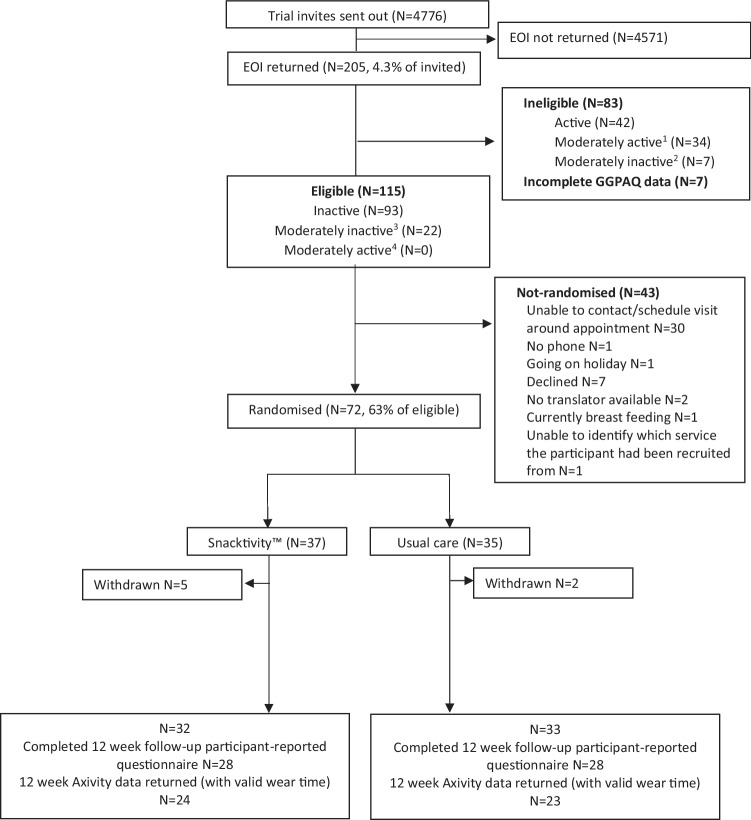
Results: Seventy-two participants (n = 37 Snacktivity™ intervention; n = 35 usual care) were recruited across 14 months (72/80, 90%, (green) 95% CI: 83% to 97%). Snacktivity™ adherence was achieved in 12/37 participants (32%, (red) 95% CI: 17% to 48%). Physical activity adherence was achieved in 17/37 participants (46%, (amber) 95% CI: 30% to 62%). Seven participants (10%, (green) 95% CI: 3% to 17%) withdrew from follow-up and 25/72 (35%, (amber) 95% CI: 24% to 46%) had no accelerometer data at follow-up (retention).
Conclusion: The Snacktivity™ intervention may be feasible and acceptable to implement. Findings can inform subsequent research that seeks to investigate whether Snacktivity™ based approaches are effective in promoting physical activity in the population.
Trial registration: ISRCTN: 64851242. Registration date: 31/01/21.
Keywords: Health; Physical activity; Randomised feasibility trial; Short bouts; Snacktivity™.
© 2025. The Author(s).
Conflict of interest statement
Declarations. Ethics Approval: The study was granted favourable ethical opinion by West Midlands – Edgbaston Research Ethics Committee reference number: 20/WM/0315. All procedures performed in studies involving human participants were in accordance with the ethical standards of the institutional and/or national research committee and with the 1964 Helsinki declaration and its later amendments or comparable ethical standards. Informed Consent: Informed consent was obtained from all individual participants included in the study. Competing Interests: The authors declare no competing interests.
Figures

References
-
- Chief Medical Officers of England, Scotland, Wales, and Northern Ireland. Start Active, Stay Active. A report on physical activity for health from the four home countries’ Chief Medical Officers. Department of Health, 2011. Date accessed 10 February 2013. http://www.dh.gov.uk/en/Publicationsandstatistics/Publications/Publicati.... Accessed 12th Dec 2017.
-
- UK Chief Medical Officer. UK chief medical officers’ physical activity guidelines. Department of Health and Social Care. 2019. https://www.gov.uk/government/publications/physical-activity-guidelines-....
-
- Physical Activity Guidelines Advisory Committee. 2018 Physical Activity Guidelines Advisory Committee Scientific Report. Washington, DC: U.S. Department of Health and Human Services, 2018. https://health.gov/sites/default/files/2019-09/Physical_Activity_Guideli.... Accessed 7 Jan 2024.
Publication types
MeSH terms
Grants and funding
LinkOut - more resources
Full Text Sources
Medical
