. 2025 Feb 24;16(1):1910.
doi: 10.1038/s41467-025-57032-0.

Individual bioenergetic capacity as a potential source of resilience to Alzheimer's disease

Affiliations

Individual bioenergetic capacity as a potential source of resilience to Alzheimer's disease

Matthias Arnold et al. Nat Commun. .

Abstract

Impaired glucose uptake in the brain is an early presymptomatic manifestation of Alzheimer's disease (AD), with symptom-free periods of varying duration that likely reflect individual differences in metabolic resilience. We propose a systemic "bioenergetic capacity", the individual ability to maintain energy homeostasis under pathological conditions. Using fasting serum acylcarnitine profiles from the AD Neuroimaging Initiative as a blood-based readout for this capacity, we identified subgroups with distinct clinical and biomarker presentations of AD. Our data suggests that improving beta-oxidation efficiency can decelerate bioenergetic aging and disease progression. The estimated treatment effects of targeting the bioenergetic capacity were comparable to those of recently approved anti-amyloid therapies, particularly in individuals with specific mitochondrial genotypes linked to succinylcarnitine metabolism. Taken together, our findings provide evidence that therapeutically enhancing bioenergetic health may reduce the risk of symptomatic AD. Furthermore, monitoring the bioenergetic capacity via blood acylcarnitine measurements can be achieved using existing clinical assays.


Conflict of interest statement

Competing interests: A.J.S. is a member of the Scientific Advisory Board of Bayer Oncology and of the Dementia Advisory Board of Siemens Medical Solutions USA, Inc.; A.J.S received in-kind support from Avid Radiopharmaceuticals, a subsidiary of Eli Lilly (PET tracer precursor); A.J.S. received Editorial Office Support as Editor-in-Chief from Springer-Nature Publishing (Brain Imaging and Behavior). P.M.D. has received research grants (through Duke University) from Lilly, Avanir, Bausch, Alzheimer’s Drug Discovery Foundation; P.M.D. has received advisory fees from Verily, Otsuka, Genomind, Cogniciti, Clearview, VitaKey, Neuronix, Neuroglee, and Transposon Therapeutics; P.M.D. owns shares or options in UMethod, Evidation Health, Transposon, Marvel Biome, and Advera Health; P.M.D. serves on the board of Apollo and is a co-inventor (through Duke University) on patents relating to dementia biomarkers, metabolomics, and therapies. R.K.D holds equity in Metabolon Inc. M.A., R.K.D., and G.K. are co-inventors (through Duke University/Helmholtz Zentrum München) on patents on applications of metabolomics in diseases of the central nervous system; M.A., R.K.D., G.K., and J.K. hold equity in Chymia LLC and IP in PsyProtix/atai Life Sciences N.V. that are exploring the potential for therapeutic applications targeting mitochondrial metabolism in treatment-resistant depression. JK is a confounder of iollo, advisor to Everfur, and advisor/part-time employee at ExactRx. The remaining authors declare no competing interests.

Figures

Fig. 1
Fig. 1. Concept of individual bioenergetic capacity mirroring impaired energy metabolism in the brain.
a The three main sources of mitochondrial energy metabolism: glucose, fatty acids, and proteins/amino acids, all of which ultimately feed into the TCA cycle. Common genetic variants in mitochondrial transporters and enzymes are assumed to define the inherited bioenergetic potential of each individual. Our study focuses on fasting individuals, largely removing the effect of dietary glucose and focusing on the fatty acid and protein routes. b Chain length-specific role of acylcarnitines as readouts for the bioenergetic capacity through the functionality, activity, and efficiency of mitochondrial energy metabolism; and examples of previously reported acylcarnitine level changes for AD-related phenotypes. c Integrated concept of bioenergetic capacity as the age-specific result of inherited bioenergetic potential and acquired modifiable metabolic functionality. Hypothetical trajectories for high and low inherited bioenergetic potential are shown, where deviations from the average are determined by modifiable lifestyle factors, such as physical activity, diet, health status, and other factors. Deviations from the overall population average are assumed to confer vulnerability or resilience to AD-related pathology and cognitive decline. AD Alzheimer’s disease, FAs fatty acids, AAs amino acids, CSF cerebrospinal fluid, TCA tricarboxylic acid, β-Ox. beta-oxidation, PDH Pyruvate dehydrogenase complex.
Fig. 2
Fig. 2. Acylcarnitine profiles stratify participants from the ADNI study in groups of different AD pathology.
a Acylcarnitine-based hierarchical clustering, with informative branches highlighted with solid-colored lines. Solid gray lines indicate cluster pairs that showed no significant associations. Clinical and demographic parameters at split points indicate significant differences between the individuals in the left and right subclusters (identified by number labels in the dendrogram) below that respective point. bd Individuals in cluster 2 have lower CSF p-tau levels, higher brain glucose uptake assessed by FDG-PET, and better cognitive function measured by the ADAS-Cog. 13 subscale compared to cluster 3. e, f Further down on the left-hand side of the tree within favorable cluster 2, cluster 6 contains younger individuals with lower (worse) CSF Aβ1-42 compared to cluster 7. gi On the right-hand-side of the tree, within cluster 3, cluster 8 contains a higher number of CSF amyloid-positive (indicated in the legend by “+”) individuals with clinical AD and a higher proportion of females compared to cluster 9. j We investigated factors impacting subgroup division by examining both non-modifiable (acylcarnitine-related SNPs) and modifiable (adjusted acylcarnitine levels) factors. The results reveal a substantial amount (40–60%) of variance explained by genetics-corrected acylcarnitine levels, primarily medium- and long-chain, with overall rather minor contributions from genetic factors. The epistatic interaction between rs17806888 and rs924135, which explained ~32% of the variance between clusters 2 and 3, is a notable exception. Both variants have been reported to significantly influence succinylcarnitine, highlighting a genetic link to the TCA cycle and amino acid-based energy metabolism. Variables marked with * have been centered to zero mean and scaled to unit variance. Abbreviations: CSF cerebrospinal fluid, FDG-PET Fluorodeoxyglucose-Positron Emission Tomography, ADAS-Cog. 13 Alzheimer’s Disease Assessment Scale—Cognitive Subscale 13, BMI body mass index. Box plots display the median (central line), interquartile range (box bounds), whiskers extending to the smallest and largest values within 1.5 times the interquartile range from the quartiles, and notches indicating the 95% confidence interval for the median. Details for each statistical test and the corresponding sample sizes are provided in Supplementary Data 3. All tests were two-sided and raw p values were reported. Source data are provided as a Source Data file.
Fig. 3
Fig. 3. Bioenergetic age as a readout of bioenergetic capacity and determinant of bioenergetic subgroups.
a Principal component (PC) analysis of acylcarnitine profiles shows that the first PC expectedly follows the cluster structure from Fig. 2. b Interestingly, the bioenergetic age predicted for the individuals within the dataset similarly corresponds with this cluster organization. c Individuals in the pathologically healthier cluster 2, although only slightly younger than those in cluster 3 in terms of chronological age, display a significantly reduced bioenergetic age. d Cluster 7, which is chronologically older than cluster 6 but demonstrates favorable disease pathology, presents a bioenergetic age that is younger than their chronological age. This observation suggests that cluster 7 may constitute a resilient subgroup of individuals. e Similar to the previous two examples, individuals characterized by an advanced bioenergetic age exhibit more pronounced Alzheimer’s disease pathology compared to those with a younger bioenergetic age. Box plots display the median (central line), interquartile range (box bounds), whiskers extending to the smallest and largest values within 1.5 times the interquartile range from the quartiles, and notches indicating the 95% confidence interval for the median. Details for each statistical test and the corresponding sample sizes are provided in Supplementary Data 13. All tests were two-sided and raw p values were reported. Source data are provided as a Source Data file.
Fig. 4
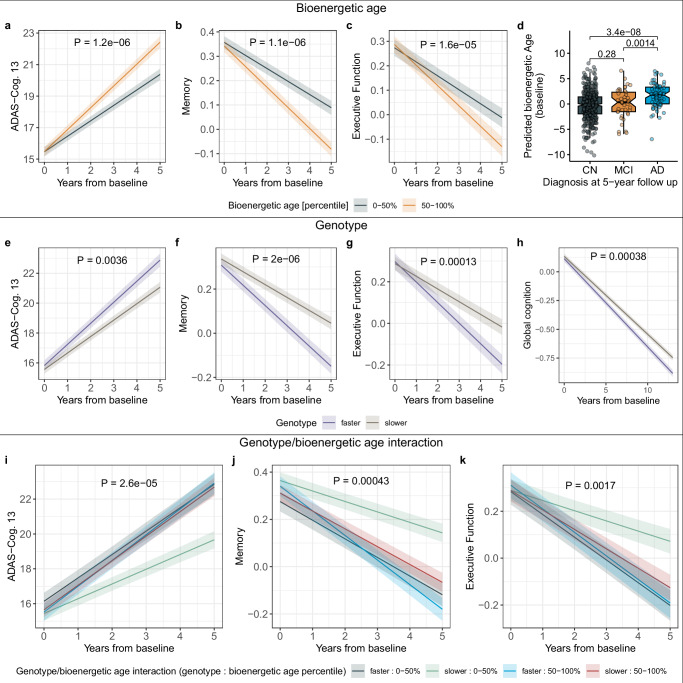
Fig. 4. Bioenergetic age and succinylcarnitine-linked genotypes modulate the rate of cognitive decline.
ac Bioenergetically younger individuals displayed a slower rate of cognitive decline compared to bioenergetically older individuals in the ADNI cohort. Median-split was only applied for visualization, reported P values are for the continuous variable. d Replication in the AGES study, by comparing bioenergetic age at baseline with clinical AD diagnosis after 5 years. eg Individuals with an unfavorable genotype configuration assessed by the combination of two SNPs, rs17806888 and rs924135, showed an accelerated rate of cognitive decline. h Replication of the genetic signal in the ROS/MAP study. ik Interaction analysis: Only individuals with favorable bioenergetic age and favorable genotypes showed a slower cognitive decline. This insinuates that individuals with unfavorable bioenergetic age but favorable genotypes could substantially benefit from targeted intervention. The p values provided represent the contrast between bioenergetic age groups within the favorable (slower) genotype group. Ribbons around linear fits represent ±1 standard error around the estimate. Box plots display the median (central line), interquartile range (box bounds), whiskers extending to the smallest and largest values within 1.5 times the interquartile range from the quartiles, and notches indicating the 95% confidence interval for the median. Details for statistical tests and the corresponding sample sizes/degrees of freedom are provided in Supplementary Data 15 (d) and 16 (ac, ek). All tests were two-sided and raw p values were reported. Source data are provided as a Source Data file.

Update of

References

    1. Mosconi, L. et al. Pre-clinical detection of Alzheimer’s disease using FDG-PET, with or without amyloid imaging. J. Alzheimers Dis.20, 843–854 (2010). - PMC - PubMed
    1. Heiss, W. D. et al. Positron emission tomography findings in dementia disorders: contributions to differential diagnosis and objectivizing of therapeutic effects. Keio J. Med.38, 111–135 (1989). - PubMed
    1. Heiss, W. D., Szelies, B., Kessler, J. & Herholz, K. Abnormalities of energy metabolism in Alzheimer’s disease studied with PET. Ann. N. Y. Acad. Sci.640, 65–71 (1991). - PubMed
    1. Kessler, J., Herholz, K., Grond, M. & Heiss, W. D. Impaired metabolic activation in Alzheimer’s disease: a PET study during continuous visual recognition. Neuropsychologia29, 229–243 (1991). - PubMed
    1. Chatterjee, S. & Mudher, A. Alzheimer’s disease and type 2 diabetes: a critical assessment of the shared pathological traits. Front. Neurosci.12, 383 (2018). - PMC - PubMed

LinkOut - more resources