Review
. 2025 Jan 31;17(2):64.
doi: 10.3390/toxins17020064.

Neurotoxins Acting on TRPV1-Building a Molecular Template for the Study of Pain and Thermal Dysfunctions

Affiliations
Review

Neurotoxins Acting on TRPV1-Building a Molecular Template for the Study of Pain and Thermal Dysfunctions

Florian Beignon et al. Toxins (Basel). .

Abstract

Transient Receptor Potential (TRP) channels are ubiquitous proteins involved in a wide range of physiological functions. Some of them are expressed in nociceptors and play a major role in the transduction of painful stimuli of mechanical, thermal, or chemical origin. They have been described in both human and rodent systems. Among them, TRPV1 is a polymodal channel permeable to cations, with a highly conserved sequence throughout species and a homotetrameric structure. It is sensitive to temperature above 43 °C and to pH below 6 and involved in various functions such as thermoregulation, metabolism, and inflammatory pain. Several TRPV1 mutations have been associated with human channelopathies related to pain sensitivity or thermoregulation. TRPV1 is expressed in a large part of the peripheral and central nervous system, most notably in sensory C and Aδ fibers innervating the skin and internal organs. In this review, we discuss how the transduction of nociceptive messages is activated or impaired by natural compounds and peptides targeting TRPV1. From a pharmacological point of view, capsaicin-the spicy ingredient of chilli pepper-was the first agonist described to activate TRPV1, followed by numerous other natural molecules such as neurotoxins present in plants, microorganisms, and venomous animals. Paralleling their adaptive protective benefit and allowing venomous species to cause acute pain to repel or neutralize opponents, these toxins are very useful for characterizing sensory functions. They also provide crucial tools for understanding TRPV1 functions from a structural and pharmacological point of view as this channel has emerged as a potential therapeutic target in pain management. Therefore, the pharmacological characterization of TRPV1 using natural toxins is of key importance in the field of pain physiology and thermal regulation.

Keywords: TRPV1; agonists; antagonists; pain; thermoregulation; toxins; venoms.


Conflict of interest statement

The authors declare no conflicts of interest.

Figures

Figure 3
Figure 3
Agonist toxins and their binding sites on a mammalian TRPV1 subunit. Each toxin is associated with its venomous or poisonous producer. When they are known or proposed, each amino-acid residue of TRPV1 involved in toxin bindings site is displayed with its protein position (green numbers). For more details, see [25] for RTX (▲), [87] for VaTx (formula image), [92] for DkTx (●), [99] for BmP01 (formula image), [100,101] for RhTx (♦), and [102] for HNTX-XXI (formula image) and HNTX-XXII (formula image). Latoia consocia is from ©Daniel Ruyle. All other images are from Wikimedia commons.
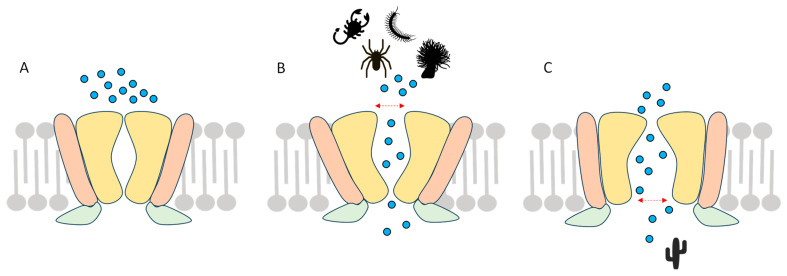
Figure 4
Figure 4
Schematic representation of TRPV1 opening by various agonist toxins. (A) Closed state with cations in the extracellular domain (blue dots). The pore domain is depicted in yellow, S1-S4 transmembrane domains in orange, and the ARD in green. For simplicity, only two subunits are shown. (B) Animal toxins widen the upper pore (red arrow), allowing cations to flow through the channel. (C) Vegetal toxins expand the lower gate through intracellular binding (red arrow).
Figure 1
Figure 1
The mammalian TRPV1 channel. (A) Schematic representation of one TRPV1 subunit with the 6 transmembrane segments (S1-S6), a pore turret (red), a pore helix between S5 and S6, an intracellular N-terminal with an ARD, and an intracellular C-terminal with the highly conserved TRP domain. (B) Schematic representation of TRPV1 homotetramer. The S5-S6 pore helix of each subunit is linked to the adjacent subunit to delineate the channel’s pore. (C) Structure of CAP, the main agonist of TRPV1. See also [12].
Figure 2
Figure 2
Biochemical and 2D structures of some TRPV1-activating (green symbols) and -inhibiting (red symbols) toxins. HNTX-XXI and HNTX-XXII structures were obtained by homology modeling on the template Hainantoxin-XVIII-7 from Haplopelma hainanum (sequence identity 98.44%; GMQE 0.69) and Tau-Liphistoxin Lth1a_1 from Liphistius thaleban (sequence identity 92.11%; GMQE 0.87), respectively, using Swiss-Model server [78]. PDB ID, AlphaFold ID, and Pubchem structures were used in PyMOL 3.0 software or ACD/ChemSketch freeware 2022.1.0 to design all other molecules. N-term-, C-term-, and disulfide-involved amino acids are labeled in green, blue, and red, respectively. RTX (Wikimedia commons), DkTx (PDB 6CUC), BmP01 (PDB 1WM7), RhTx (PDB 2MWA), VaTx1: Vanillotoxin-1 (AF-P0C244-F1), AG489, PnTX3-5 (AF-P81791-F1), APHC2 (AF-COHJK4-F1), HCRG21 (AF-P0DL86-F1), Tst2 (PDB 8SEM).
Figure 5
Figure 5
Antagonist toxins and their binding sites on mammalian TRPV1 subunit. Each toxin is associated with its venomous producer. When they are known or suspected, each TRPV1 residue involved in toxin binding is displayed with their respective position in the protein sequence (red numbers). For more details, see [107] for AG489 (●), [108] for PnTx, [109] for APHC (formula image), and [110] for HCRG21 (▲). All images are from Wikimedia commons.
Figure 6
Figure 6
Schematic representation of toxins binding to mammalian TRPV1 subunit, including agonists (green arrows) and antagonists (red arrows) with their ascertained or hypothesized interacting residues. See text for details.

References

    1. Raja S.N., Carr D.B., Cohen M., Finnerup N.B., Flor H., Gibson S., Keefe F.J., Mogil J.S., Ringkamp M., Sluka K.A., et al. The Revised International Association for the Study of Pain Definition of Pain: Concepts, Challenges, and Compromises. Pain. 2020;161:1976–1982. doi: 10.1097/j.pain.0000000000001939. - DOI - PMC - PubMed
    1. Basbaum A.I., Bautista D.M., Scherrer G., Julius D. Cellular and Molecular Mechanisms of Pain. Cell. 2009;139:267–284. doi: 10.1016/j.cell.2009.09.028. - DOI - PMC - PubMed
    1. Garland E.L. Pain Processing in the Human Nervous System. Prim. Care Clin. Off. Pract. 2012;39:561–571. doi: 10.1016/j.pop.2012.06.013. - DOI - PMC - PubMed
    1. Moore C., Gupta R., Jordt S.-E., Chen Y., Liedtke W.B. Regulation of Pain and Itch by TRP Channels. Neurosci. Bull. 2018;34:120–142. doi: 10.1007/s12264-017-0200-8. - DOI - PMC - PubMed
    1. Jardín I., López J.J., Diez R., Sánchez-Collado J., Cantonero C., Albarrán L., Woodard G.E., Redondo P.C., Salido G.M., Smani T., et al. TRPs in Pain Sensation. Front. Physiol. 2017;8:392. doi: 10.3389/fphys.2017.00392. - DOI - PMC - PubMed

Publication types

LinkOut - more resources
