. 2025 Apr 1;328(4):R460-R469.
doi: 10.1152/ajpregu.00234.2024. Epub 2025 Feb 25.

Exercise pressor reflex function is augmented in rats with chronic kidney disease

Affiliations

Exercise pressor reflex function is augmented in rats with chronic kidney disease

Han-Kyul Kim et al. Am J Physiol Regul Integr Comp Physiol. .

Abstract

Cardiovascular responses to exercise are exaggerated in patients with chronic kidney disease (CKD). Enhanced sympathetic activation is thought to play a role with the exercise pressor reflex (EPR), a reflex originating in contracting muscle, modulating this response. Previous studies suggest an overactive EPR in patients with CKD as indicated by muscle sympathetic overactivation during static handgrip exercise. However, the role of the EPR could not be fully elucidated due to experimental constraints inherent to humans. The purpose of this study was to specifically test EPR function in a CKD animal model. Male Sprague-Dawley rats were assigned to a diet containing 0.25% adenine to induce CKD or a control diet. Mean arterial pressure (MAP) and renal sympathetic nerve activity (RSNA) responses to activation of the EPR, including its functional components, the mechanoreflex and metaboreflex, were assessed in decerebrate, unanesthetized animals after feeding 10-14 wk. Plasma creatinine was significantly higher in CKD rats compared with controls (1.80 ± 0.78 vs. 0.34 ± 0.02 mg·dL-1, P = 0.017). MAP and RSNA responses to muscle contraction (i.e., EPR activation) were potentiated in CKD rats compared with controls (Δ = 36 ± 19 vs. 17 ± 8 mmHg, P = 0.014 and Δ = 159 ± 62 vs. 64 ± 54%, P = 0.004, respectively). Similarly, the pressor and sympathetic responses to passive muscle stretch (i.e., mechanoreflex stimulation) were significantly higher in CKD than in control animals. Intra-arterial capsaicin administration (i.e., metaboreflex activation) induced an augmented pressor response in CKD rats, compared with controls. Our findings suggest that the EPR, stimulated by the mechanoreflex and metaboreflex, is exaggerated in CKD.NEW & NOTEWORTHY The current investigation identifies that activation of the exercise pressor reflex (EPR) by hindlimb muscle contraction generates exaggerated pressor responses in a chronic kidney disease (CKD) animal model. This hypertensive response is accompanied by sympathetic overactivation during EPR stimulation, with both the muscle mechanoreflex activated by passive muscle stretch and the muscle metaboreflex stimulated by intra-arterial capsaicin administration, contributing to the heightened pressor effect. These findings suggest augmented EPR, mechanoreflex, and metaboreflex function in CKD.

Keywords: blood pressure; chronic kidney disease; exercise pressor reflex; sympathetic nerve activity.


Conflict of interest statement

DISCLOSURES

No conflicts of interest, financial or otherwise, are declared by the authors.

Figures

Figure 1.
Figure 1.. Characteristics of arterial blood pressure (ABP), raw and normalized renal sympathetic nerve activity (RSNA, %), and developed muscle tension in response to activation of the exercise pressor reflex during a 30-second electrically induced static hindlimb muscle contraction in a representative control and adenine-induced chronic kidney disease (CKD, gray shading) animal.
Figure 2.
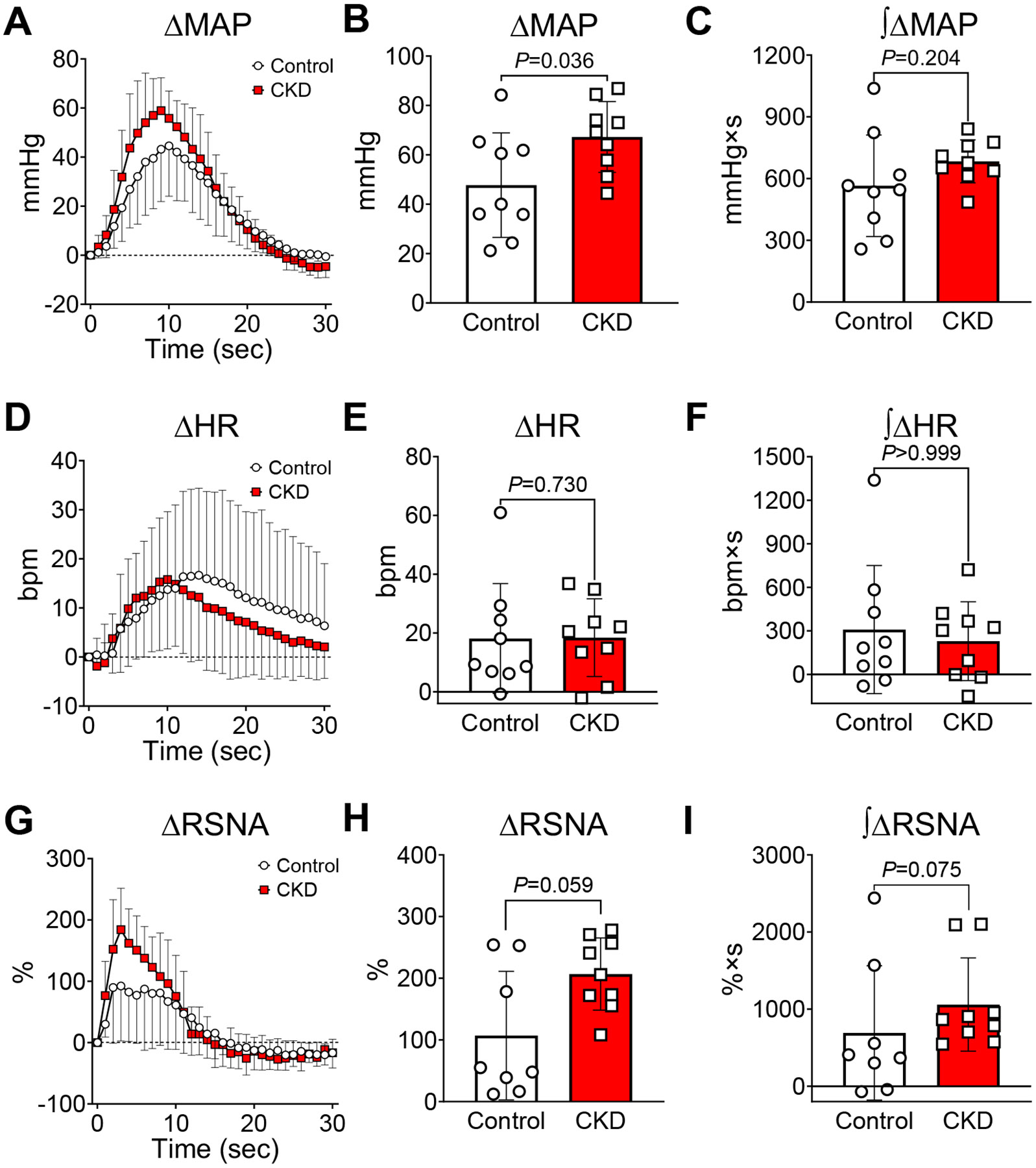
Figure 2.. Summary data showing cardiovascular and sympathetic responses to activation of the exercise pressor reflex (EPR) during a 30-second electrically induced static hindlimb muscle contraction in control and adenine-induced chronic kidney disease (CKD) rats.
Time course of changes in mean arterial pressure (MAP; A), heart rate (HR; D), renal sympathetic nerve activity (RSNA; G), and developed muscle tension (J) in response to activation of the EPR. Peak MAP (B), HR (E), RSNA (H), and muscle tension (K) responses to EPR activation. Integrated changes in MAP (C), HR (F), RSNA (I), and muscle tension (L) in response to stimulation of the EPR presented as area under the curve (AUC) over 30-second. MAP, HR, and developed muscle tension: control, n=9 and CKD, n=10; RSNA: control, n=8; CKD, n=9. Values are mean ± SD. Data were analyzed by two-tailed Student’s unpaired t-test or Mann-Whitney U nonparametric test.
Figure 3.
Figure 3.. Characteristics of arterial blood pressure (ABP), raw and normalized renal sympathetic nerve activity (RSNA, %), and developed muscle tension in response to activation of the mechanoreflex during a 30-second passive hindlimb muscle stretch in a representative control and adenine-induced chronic kidney disease (CKD, gray shading) animal.
Figure 4.
Figure 4.. Summary data showing cardiovascular and sympathetic responses to activation of the mechanoreflex during a 30-second passive hindlimb muscle stretch in control and adenine-induced chronic kidney disease (CKD) rats.
Time course of changes in mean arterial pressure (MAP; A), heart rate (HR; D), renal sympathetic nerve activity (RSNA; G), and developed muscle tension (J) in response to activation of the mechanoreflex. Peak MAP (B), HR (E), RSNA (H), and muscle tension (K) responses to mechanoreflex activation. Integrated changes in MAP (C), HR (F), RSNA (I), and muscle tension (L) in response to stimulation of the mechanoreflex presented as area under the curve (AUC) over 30-second. MAP, HR, and developed muscle tension: control, n=9 and CKD, n=9; RSNA: control, n=8; CKD, n=9. Values are mean ± SD. Data were analyzed by two-tailed Student’s unpaired t-test or Mann-Whitney U nonparametric test.
Figure 5.
Figure 5.. Characteristics of arterial blood pressure (ABP) as well as raw and normalized renal sympathetic nerve activity (RSNA, %) responses during selective activation of chemically sensitive metaboreceptors by injecting capsaicin into the right iliac artery in a representative control and adenine-induced chronic kidney disease (CKD, gray shading) animal.
Figure 6.
Figure 6.. Summary data showing cardiovascular and sympathetic responses to activation of the metabolically sensitive component of the EPR during intra-arterial administration of capsaicin in control and adenine-induced chronic kidney disease (CKD) rats.
Time course of changes in mean arterial pressure (MAP; A), heart rate (HR; D), and renal sympathetic nerve activity (RSNA; G) in response to activation of the metaboreflex. Peak MAP (B), HR (E), and RSNA (H) responses to metaboreflex activation. Integrated changes in MAP (C), HR (F), and RSNA (I) in response to stimulation of the metaboreflex presented as area under the curve (AUC) over 30-second. MAP and HR: control, n=9 and CKD, n=9; RSNA: control, n=8; CKD, n=9. Values are mean ± SD. Data were analyzed by two-tailed Student’s unpaired t-test or Mann-Whitney U nonparametric test.

References

    1. Go AS, Chertow GM, Fan D, McCulloch CE, and Hsu CY. Chronic kidney disease and the risks of death, cardiovascular events, and hospitalization. N Engl J Med 351: 1296–1305, 2004. - PubMed
    1. Park J, Quyyumi AA, and Middlekauff HR. Exercise pressor response and arterial baroreflex unloading during exercise in chronic kidney disease. J Appl Physiol (1985) 114: 538–549, 2013. - PMC - PubMed
    1. Thompson S, James M, Wiebe N, Hemmelgarn B, Manns B, Klarenbach S, Tonelli M, and Alberta Kidney Disease N. Cause of Death in Patients with Reduced Kidney Function. J Am Soc Nephrol 26: 2504–2511, 2015. - PMC - PubMed
    1. Kirkman DL, Bohmke N, Carbone S, Garten RS, Rodriguez-Miguelez P, Franco RL, Kidd JM, and Abbate A. Exercise intolerance in kidney diseases: physiological contributors and therapeutic strategies. Am J Physiol Renal Physiol 320: F161–F173, 2021. - PMC - PubMed
    1. Macdonald JH, Fearn L, Jibani M, and Marcora SM. Exertional fatigue in patients with CKD. Am J Kidney Dis 60: 930–939, 2012. - PubMed

MeSH terms

LinkOut - more resources