


Monitoring phage infection and lysis of surface-immobilized bacteria by QCM-D
- PMID: 39998644
- PMCID: PMC11961536
- DOI: 10.1007/s00216-025-05803-5
Monitoring phage infection and lysis of surface-immobilized bacteria by QCM-D
Abstract
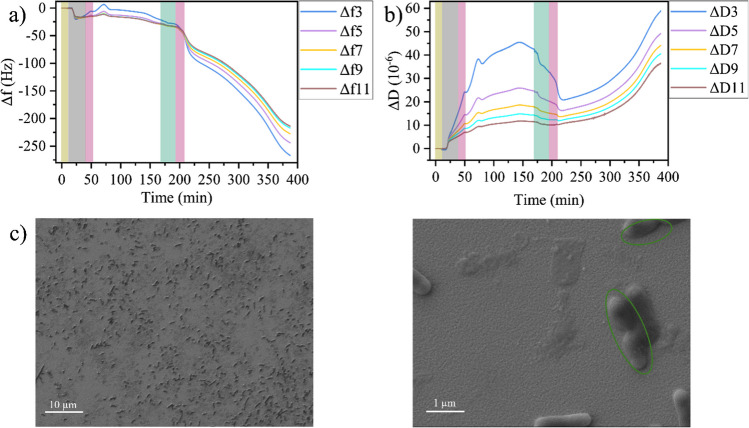
While being a promising approach for the treatment of infections caused by drug-resistant, pathogenic bacteria, the clinical implementation of phage therapy still faces several challenges. One of these challenges lies in the high strain-specificity of most bacteriophages, which makes it necessary to screen large phage collections against the target pathogens in order to identify suitable candidates for the formulations of personalized therapeutic phage cocktails. In this work, we evaluate the potential of quartz crystal microbalance with dissipation monitoring (QCM-D) to identify and detect phage infection and subsequent lysis of bacteria immobilized on the surfaces of the QCM-D sensors. Using lytic Escherichia coli phage T7 as a model, we show that phage infection of E. coli cells results in various unique alterations in the behaviors of the frequency (Δf) and dissipation (ΔD) signals, which are not observed during exposure of the E. coli strain to non-infectious Bacillus subtilis phage phi29 at similar concentration. To aid future phage screening campaigns, we furthermore identify a single measurement parameter, i.e., the spread between the different overtones of ΔD, that can be used to detect phage-induced lysis. For T7 infection of E. coli, this is achieved within 4 h after inoculation, including immobilization and growth of the bacteria on the sensor surface, as well as the completed phage propagation cycle. Given the commercial availability of highly automated multichannel systems and the fact that this approach does not require any sensor modifications, QCM-D has the potential to become a valuable tool for screening medium-sized phage collections against target pathogens.
Keywords: Escherichia coli; Bacteriophages; Infection; Phage therapy; Quartz crystal microbalance with dissipation monitoring; T7.
© 2025. The Author(s).
Conflict of interest statement
Declarations. Conflict of interest: The authors declare no competing interests.
Figures




References
-
- Su Y, Zhang W, Liang Y, Wang H, Liu Y, Zheng K, Liu Z, Yu H, Ren L, Shao H, Sung YY, Mok WJ, Wong LL, Zhang Y-Z, McMinn A, Wang M. Identification and genomic analysis of temperate Halomonas bacteriophage vB_HmeY_H4907 from the surface sediment of the Mariana Trench at a depth of 8,900 m. Microbiol Spectr. 2023;11(5):e0191223. 10.1128/spectrum.01912-23. - PMC - PubMed
-
- Hu M, Xing B, Yang M, Han R, Pan H, Guo H, Liu Z, Huang T, Du K, Jiang S, Zhang Q, Lu W, Huang X, Zhou C, Li J, Song W, Deng Z, Xiao M. Characterization of a novel genus of jumbo phages and their application in wastewater treatment. iScience. 2023;26(6):106947. 10.1016/j.isci.2023.106947. - PMC - PubMed
-
- Penadés JR, Chen J, Quiles-Puchalt N, Carpena N, Novick RP. Bacteriophage-mediated spread of bacterial virulence genes. Curr Opin Microbiol. 2015;23:171–8. 10.1016/j.mib.2014.11.019. - PubMed
MeSH terms
LinkOut - more resources
Full Text Sources
Molecular Biology Databases
