


Functional Characterization of a Female-Biased Chemoreceptor of the Codling Moth (Cydia pomonella) Responding to Aldehydes and Other Volatile Compounds
- PMID: 40000511
- PMCID: PMC11861427
- DOI: 10.1007/s10886-025-01579-1
Functional Characterization of a Female-Biased Chemoreceptor of the Codling Moth (Cydia pomonella) Responding to Aldehydes and Other Volatile Compounds
Abstract
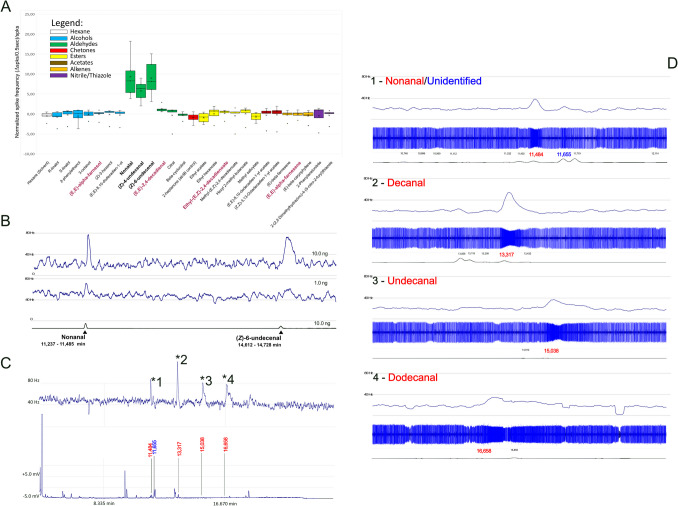
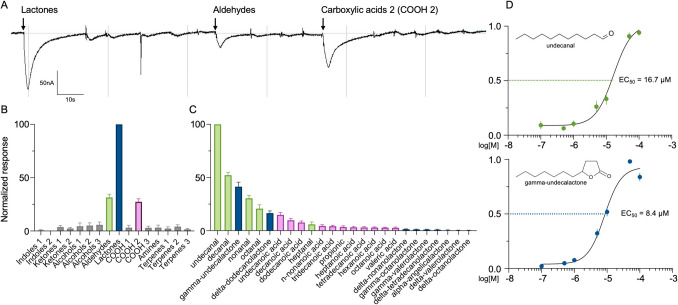
With the advent of semiochemical-based control strategies used to mitigate damage of agricultural pest moths, many studies have focused on the function of male-specific putative pheromone receptors (PRs). In this investigation, we instead isolated, heterologously expressed, and functionally characterized a female-biased candidate PR, CpomOR22, from the codling moth, Cydia pomonella. Using transgenic Drosophila melanogaster for single sensillum recording (SSR) and gas-chromatographic SSR, we tested both synthetic ligands and various apple headspace extracts, identifying saturated and unsaturated aldehydes (nonanal, decanal, undecanal, dodecanal; (Z)-4-undecenal and (Z)-6-undecenal) among the most active ligands. Parallel experiments expressing CpomOR22 in Xenopus oocytes confirmed the binding of nonanal, decanal and undecanal and revealed lactones (γ-undecalactone and δ-dodecalactone) and several carboxylic acids as additional active compounds. The renowned ecological importance of aldehydes for the codling moth and the potential for newly identified ligands, such as lactones, may inform innovative control strategies based on novel semiochemicals to interfere with the female-specific chemosensory systems of this insect.
Keywords: Cydia pomonella chemoreceptors; Xenopus oocytes; Gas-chromatography-coupled SSR (GC-SSR); Heterologous expression; Single sensillum recording (SSR); Transgenic Drosophila melanogaster.
© 2025. The Author(s).
Conflict of interest statement
Declarations. Ethics Statement: Experiments from this study on D. melanogaster were performed in compliance with European law and the SLU institutional guidelines. These animals are insects from the genus Drosophila, and there are no ethical issues or particular restrictions requiring committee-based approval to conduct experiments. Competing Interests: The authors declare no competing interests.
Figures
References
-
- Anderson AR, Wanner KW, Trowell SC, Warr CG, Jaquin-Joly E, Zagatti P, Robertson H, Newcomb RD (2009) Molecular basis of female-specific odorant responses in Bombyx mori. Insect Biochem Mol Biol 39(3):189–197. 10.1016/j.ibmb.2008.11.002 - PubMed
-
- Anisimova M, Gascuel O (2006) Approximate likelihood-ratio test for branches: a fast, accurate, and powerful alternative. Syst Biol 55(4):539–552. 10.1080/10635150600755453 - PubMed
-
- Ansebo L, Coracini MDA, Bengtsson M, Liblikas I, Ramírez M, Borg-Karlson AK, Tasin M, Witzgall P (2004) Antennal and behavioural response of codling moth Cydia pomonella to plant volatiles. J Appl Entomol 128(7):488–493. 10.1111/j.1439-0418.2004.00878.x
-
- Ansebo L, Ignell R, Löfqvist I, Hansson BS (2005) Responses to sex pheromone and plant odours by olfactory receptor neurons housed in sensilla auricillica of the codling moth, Cydia pomonella (Lepidoptera: Tortricidae). J Insect Physiol 51(10):1066–1074. 10.1016/j.jinsphys.2005.05.003 - PubMed
MeSH terms
Substances
Grants and funding
LinkOut - more resources
Full Text Sources
Molecular Biology Databases
Research Materials
Miscellaneous
