


Association of magnesium depletion score with increased stroke incidence and mortality risks in a comprehensive analysis
- PMID: 40000741
- PMCID: PMC11862158
- DOI: 10.1038/s41598-025-91227-1
Association of magnesium depletion score with increased stroke incidence and mortality risks in a comprehensive analysis
Abstract
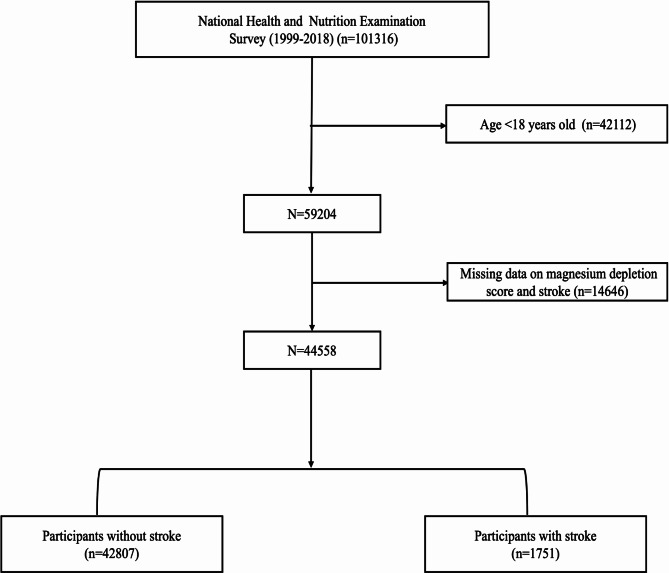
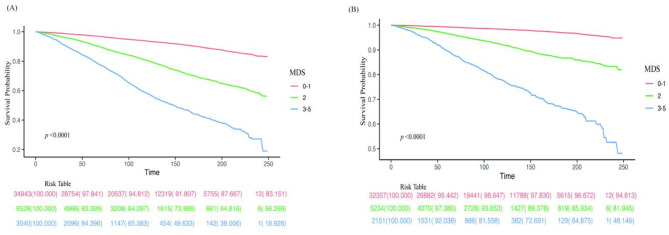
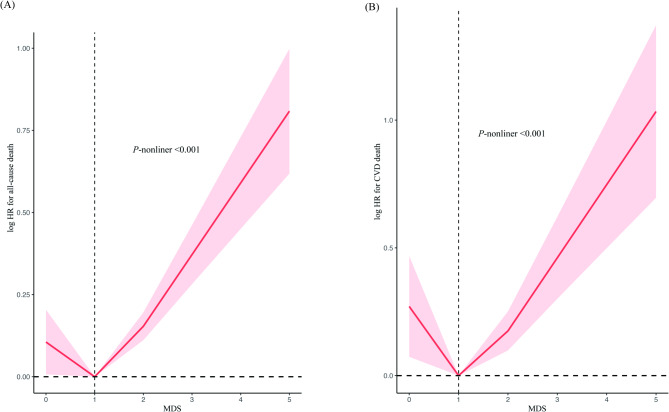
Stroke is a leading cause of morbidity and mortality worldwide, with modifiable risk factors being crucial for prevention efforts. Magnesium, an essential mineral involved in numerous physiological processes, is linked to cardiovascular health. However, the relationship between magnesium status, assessed through the Magnesium Depletion Score (MDS), and stroke risk remains underexplored. This study aims to investigate the association between MDS and stroke incidence, as well as the potential correlation between MDS and all-cause and cardiovascular disease (CVD) mortality among US adults. Furthermore, we explore the mediation role of Life's Essential 8 (LE8) in the relationship between MDS and stroke. Utilizing data from the National Health and Nutrition Examination Survey (NHANES) from 1999 to 2018, we conducted a cross-sectional analysis of 44,588 participants. Participants were divided into three groups based on their MDS levels: none to low (MDS = 0-1), middle (MDS = 2), and high (MDS = 3-5). Multivariable logistic regression models were employed to assess the relationship between MDS and stroke risk, adjusting for multiple confounders. Additionally, Cox regression models and Kaplan-Meier survival curves were used to evaluate the association between MDS and mortality outcomes. Subgroup and mediation analyses were performed to explore the role of LE8 in MDS associations with the risk of stroke. Higher MDS was significantly associated with increased stroke risk in a dose-dependent manner. Participants with high MDS scores (3-5) had an odds ratio (OR) of 1.96 (95% CI 1.55-2.49) for stroke compared to those with low MDS scores (0-1). For all-cause mortality, high MDS was associated with a hazard ratio (HR) of 1.73 (95% CI 1.41-2.09), and for CVD mortality, the HR was 2.01 (95% CI 1.49-2.71). Kaplan-Meier analyses revealed lower survival probabilities with increasing MDS levels. Subgroup analyses revealed that higher MDS was associated with increased stroke risk across age and gender groups, with stronger effects observed in older individuals, males, and those with higher cardiovascular risk factors, while LE8 mediated 26.5% of this relationship. Our findings provide strong evidence that higher MDS is significantly associated with increased stroke risk and higher all-cause and CVD mortality among stroke patients. LE8 plays a significant mediating role in this association.
Keywords: Cardiovascular disease; LE8; Magnesium depletion score; Mortality; NHANES; Stroke.
© 2025. The Author(s).
Conflict of interest statement
Declarations. Competing interests: The authors declare no competing interests. Ethical approval: NHANES is conducted by the Centers for Disease Control and Prevention (CDC) and the National Center for Health Statistics (NCHS). And the NHANES study protocol was reviewed and approved by the NCHS Research Ethics Review Committee. All participants in NHANES provided written informed consent.
Figures
References
-
- Hilkens, N. A., Casolla, B., Leung, T. W. & de Leeuw, F. E. Stroke. Lancet403 (10446), 2820–2836 (2024). - PubMed
-
- Orellana-Urzúa, S., Rojas, I., Líbano, L. & Rodrigo, R. Pathophysiology of ischemic stroke: role of oxidative stress. Curr. Pharm. Des.26 (34), 4246–4260 (2020). - PubMed
-
- Tangvoraphonkchai, K. & Davenport, A. Magnesium and cardiovascular disease. Adv. Chronic Kidney Dis.25 (3), 251–260 (2018). - PubMed
MeSH terms
Substances
LinkOut - more resources
Full Text Sources
Medical
Research Materials
Miscellaneous
