


Efficacy and safety of fasinumab in an NSAID-controlled study in patients with pain due to osteoarthritis of the knee or hip
- PMID: 40001000
- PMCID: PMC11853225
- DOI: 10.1186/s12891-025-08402-8
Efficacy and safety of fasinumab in an NSAID-controlled study in patients with pain due to osteoarthritis of the knee or hip
Abstract
Objective: Osteoarthritis (OA) causes significant musculoskeletal pain. This study assessed the efficacy and safety of fasinumab, an investigational nerve growth factor inhibitor, in patients with moderate-to-severe OA pain of the knee/hip.
Methods: In this Phase 3, randomized, double-blind, placebo- and non-steroidal anti-inflammatory drug (NSAID)-controlled study, patients with OA (Kellgren-Lawrence grade ≥ 2; Western Ontario and McMaster Universities Arthritis Index [WOMAC] pain score ≥ 4) received (2:1:1:1) fasinumab 1 mg every 4 weeks, diclofenac 75 mg twice daily, celecoxib 200 mg daily, or placebo for 24 weeks. Co‑primary endpoints were change in WOMAC pain and physical function scores to Week 24 versus placebo. For safety, joints were imaged in all patients at pre‑specified times, regardless of symptoms.
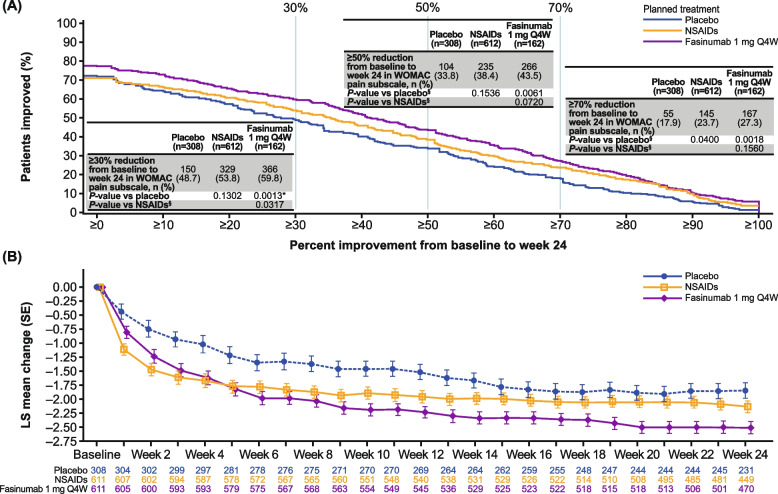
Results: Of 4531 patients screened, 1650 were randomized. At Week 24, greater improvements were observed for fasinumab versus placebo; least-squares mean difference: -0.63 (p = 0.0003) for WOMAC pain and -0.64 (p = 0.0003) for physical function. Improvements were numerically greater for fasinumab versus NSAIDs for physical function (-0.64 versus -0.31; nominal p < 0.05) and pain (-0.63 versus - 0.39; p = NS). Adjudicated arthropathies occurred in 1.6% of placebo-treated, 1.5% of NSAID-treated, and 5.6% of fasinumab-treated patients; joint replacements occurred in 3.6% of placebo-treated, 4.8% of NSAID-treated, and 3.4% of fasinumab-treated patients.
Conclusion: Fasinumab significantly improved WOMAC pain and physical function scores versus placebo in < 24 weeks in difficult-to-treat patients with pain due to OA of the knee/hip. Adjudicated arthropathies were more frequent with fasinumab; there were no differences in the proportions of patients with joint replacements.
Trial registration: Clinicaltrials.gov NCT03304379. Date of first registration: October 2, 2017.
Keywords: Fasinumab; NGF inhibitor; NSAID; Osteoarthritis; Pain.
© 2025. The Author(s).
Conflict of interest statement
Declarations. Ethics approval and consent to participate: The study was conducted in accordance with consensus ethical principles derived from international guidelines, including the Declaration of Helsinki and Council for International Organizations of Medical Sciences International Ethical Guidelines and applicable International Council for Harmonisation Good Clinical Practice Guidelines. The institutional review board or independent ethics committee at each study center reviewed and approved the protocol, protocol amendments, informed consent form, and any other relevant documents (see the Supplementary Appendix for details). All participants provided written informed consent to participate in the study. During routine blinded monitoring, prior to database lock, the sponsor suspected and identified non-compliance with good clinical practice at four sites comprising 219 patients. Patients from these sites were subsequently excluded from the modified full analysis set, as prespecified in the statistical analysis plan (see the Supplementary Appendix for details). Consent for publication: Not applicable. Competing interests: SJD, HG, GPG, and PD are all employees of and shareholders in Regeneron Pharmaceuticals, Inc. who report having three patents pending with Regeneron Pharmaceuticals, Inc. SE, CE, TH, HEH, KCT, JC, YP, LB, NT, GM, and NB are all employees of and shareholders in Regeneron Pharmaceuticals, Inc. GV has served as a consultant for AbbVie, Celgene, GSK, Janssen, Lilly, Merck, Novartis, Pfizer, Sanofi/Regeneron, and UCB; and as an Investigator for AbbVie, Image Analysis, Bristol Myers Squibb, Janssen, Lilly, Merck, MLKCDT, Novartis, Pfizer, and Sanofi/Regeneron. TF owns equity in Clario, Inc, and has received grants or contracts from various pharmaceutical and biotechnology companies developing new drugs to treat osteoarthritis. JDD is an employee of and shareholder in Regeneron Pharmaceuticals, Inc. who reports having two patents pending with Regeneron Pharmaceuticals, Inc. SZ has no conflict of interest to disclose. MF is an employee of Teva Pharmaceuticals; has been funded by Teva Pharmaceuticals for travel and attendance at investigator meetings; and has received and holds stocks or stock options.
Figures
References
-
- Hunter DJ, Bierma-Zeinstra S. Osteoarthritis. Lancet. 2019;393(10182):1745–59. - PubMed
-
- Valdes AM, Stocks J. Osteoarthritis and ageing. Eur Med J. 2018;3(1):116–23.
-
- Kloppenburg M, Berenbaum F. Osteoarthritis year in review 2019: epidemiology and therapy. Osteoarthritis Cartilage. 2020;28(3):242–8. - PubMed
-
- Lee C, Hunsche E, Balshaw R, Kong SX, Schnitzer TJ. Need for common internal controls when assessing the relative efficacy of pharmacologic agents using a meta-analytic approach: case study of cyclooxygenase 2-selective inhibitors for the treatment of osteoarthritis. Arthritis Rheum. 2005;53(4):510–8. - PubMed
Publication types
MeSH terms
Substances
Associated data
LinkOut - more resources
Full Text Sources
Medical
Miscellaneous
