


The Population-Level Surveillance of Childhood and Adolescent Cancer and Its Late Effects in Europe with an Example of an Effective System at the Slovenian Cancer Registry
- PMID: 40002174
- PMCID: PMC11853519
- DOI: 10.3390/cancers17040580
The Population-Level Surveillance of Childhood and Adolescent Cancer and Its Late Effects in Europe with an Example of an Effective System at the Slovenian Cancer Registry
Abstract
Background: The registry-based collection of detailed cancer and late effect (LE) data in childhood and adolescent cancer (CAC) is rarely explored.
Aim: We aimed to provide an overview of CAC registration practices in Europe and share a Slovenian example.
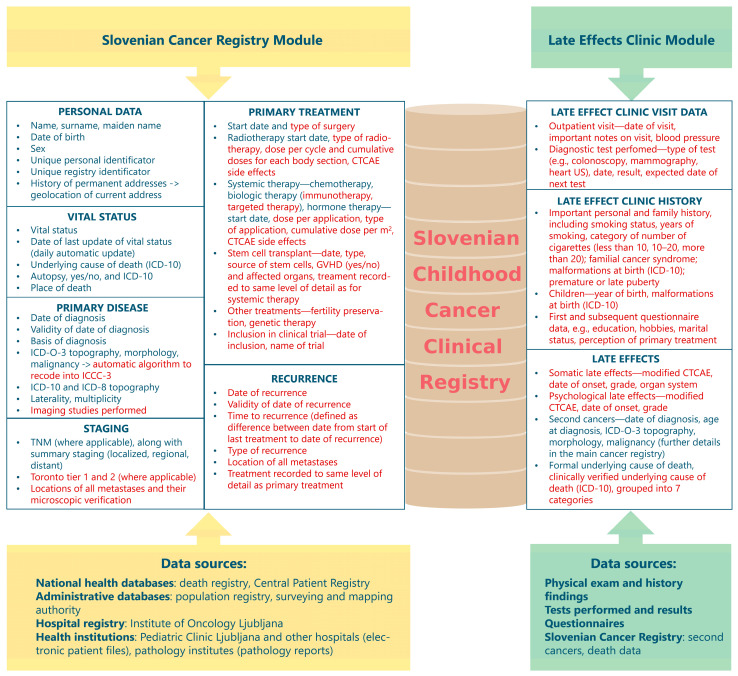
Methods: We distributed a questionnaire among European cancer registries on disease, treatment and LE registration and present the system at the Slovenian Cancer Registry along with an example of retrospectively collected LE data from a cohort of central nervous system tumour survivors from 1983 to 2000. Kaplan-Meier and Cox regression were used to calculate the LE incidence.
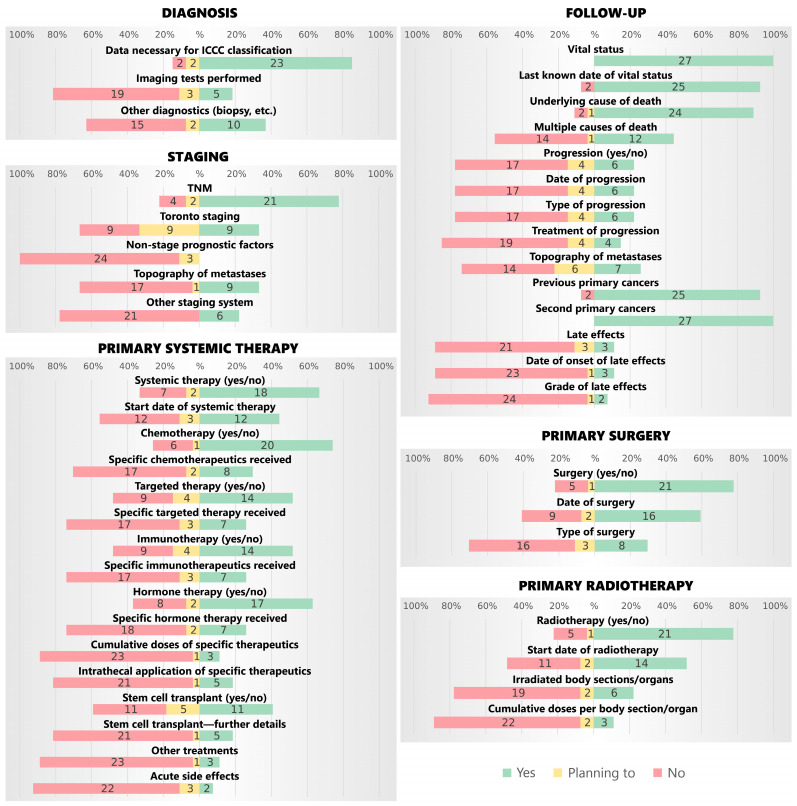
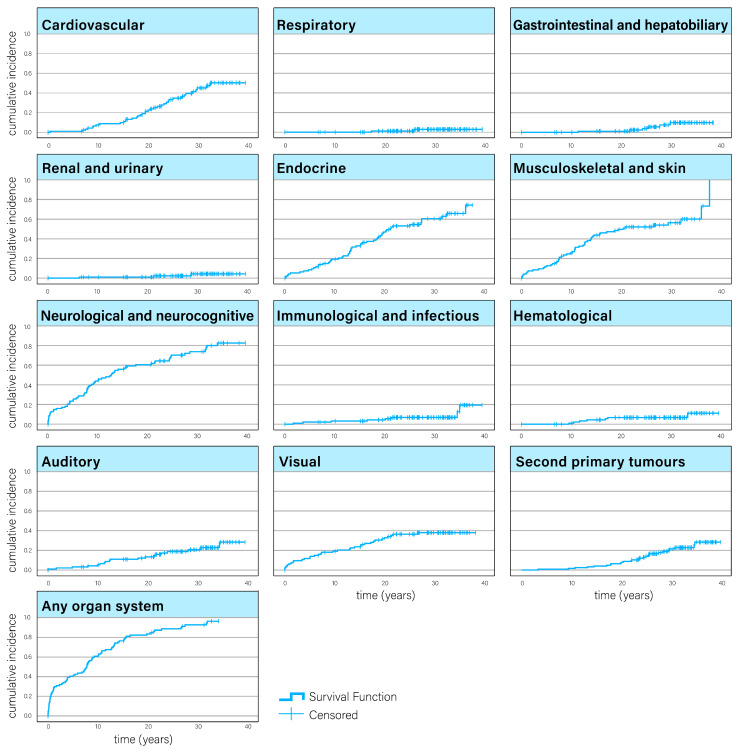
Results: Out of 27 responding registries, over 80% registered cancer type, vital status, death and second primary cancer data. Less than 20% registered cumulative doses of radiation and systemic therapy or progressions. Only three registered LEs. The obstacles in setting up LE collection in registries are a lack of standardization in the variable sets, definitions and methods of collection. In the retrospective cohort, neurological and endocrine LEs were most common. Females had a higher risk of endocrine LEs (HR of 1.89; 95% CI of 1.08-3.31), while patients treated with radiotherapy had higher risks of endocrine (3.47; 1.80-6.69), musculoskeletal and skin LEs (3.16; 1.60-6.26) and second primary cancers (2.85; 1.18-6.75).
Conclusions: Standardization and harmonization are necessary to promote detailed CAC and LE registration.
Keywords: cancer registry; childhood and adolescent cancer; late effects; population-level surveillance; survivors.
Conflict of interest statement
The authors declare no conflicts of interest. The funders had no role in the design of the study; in the collection, analyses or interpretation of data; in the writing of the manuscript; or in the decision to publish the results.
Figures
References
-
- Gatta G., Botta L., Rossi S., Aareleid T., Bielska-Lasota M., Clavel J., Dimitrova N., Jakab Z., Kaatsch P., Lacour B., et al. Childhood Cancer Survival in Europe 1999–2007: Results of EUROCARE-5—A Population-Based Study. Lancet Oncol. 2014;15:35–47. doi: 10.1016/S1470-2045(13)70548-5. - DOI - PubMed
-
- Trama A., Botta L., Foschi R., Ferrari A., Stiller C., Desandes E., Maule M.M., Merletti F., Gatta G. Survival of European Adolescents and Young Adults Diagnosed with Cancer in 2000–07: Population-Based Data from EUROCARE-5. Lancet Oncol. 2016;17:896–906. doi: 10.1016/S1470-2045(16)00162-5. - DOI - PubMed
-
- Steliarova-Foucher E., Fidler M.M., Colombet M., Lacour B., Kaatsch P., Piñeros M., Soerjomataram I., Bray F., Coebergh J.W., Peris-Bonet R., et al. Changing Geographical Patterns and Trends in Cancer Incidence in Children and Adolescents in Europe, 1991–2010 (Automated Childhood Cancer Information System): A Population-Based Study. Lancet Oncol. 2018;19:1159–1169. doi: 10.1016/S1470-2045(18)30423-6. - DOI - PMC - PubMed
Grants and funding
LinkOut - more resources
Full Text Sources
