


The Temperature-Associated Effects of Rift Valley Fever Virus Infections in Mosquitoes and Climate-Driven Epidemics: A Review
- PMID: 40006972
- PMCID: PMC11860320
- DOI: 10.3390/v17020217
The Temperature-Associated Effects of Rift Valley Fever Virus Infections in Mosquitoes and Climate-Driven Epidemics: A Review
Abstract
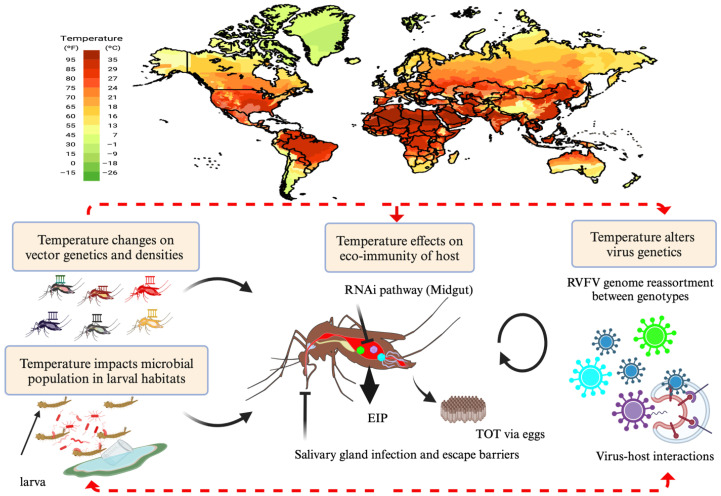
Rift Valley fever virus (RVFV) is a mosquito-borne zoonotic disease within the genus Phlebovirus. Symptoms of the disease in animals range from moderate to severe febrile illness, which significantly impacts the livestock industry and causes severe health complications in humans. Similar to bunyaviruses in the genus Orthobunyavirus transmitted by mosquitoes, RVFV progression is dependent on the susceptibility of the physical, cellular, microbial, and immune response barriers of the vectors. These barriers, shaped by the genetic makeup of the mosquito species and the surrounding environmental temperature, exert strong selective pressure on the virus, affecting its replication, evolution, and spread. The changing climate coupled with the aforementioned bottlenecks are significant drivers of RVF epidemics and expansion into previously nonendemic areas. Despite the link between microclimatic changes and RVF outbreaks, there is still a dearth of knowledge on how these temperature effects impact RVF transmission and vector competence and virus persistence during interepidemic years. This intricate interdependence between the virus, larval habitat temperatures, and vector competence necessitates increased efforts in addressing RVFV disease burden. This review highlights recent advancements made in response to shifting demographics, weather patterns, and conveyance of RVFV. Additionally, ongoing studies related to temperature-sensitive variations in RVFV-vector interactions and knowledge gaps are discussed.
Keywords: Culex and Aedes species; Orthobunyavirus; Phlebovirus; mosquito genetics and immunity; reassortment; temperature effects; transovarial transmission; vector competence; vector-borne diseases.
Conflict of interest statement
The authors declare that the research was conducted in the absence of any commercial or financial relationships that could be construed as a potential conflict of interest.
Figures
References
-
- Reed K.D. Reference Module in Biomedical Sciences. 2nd ed. Elsevier Inc.; Amsterdam, The Netherlands: 2018. Viral zoonoses. - DOI
-
- Kwasiborski A., Collet L., Hourdel V., Vandenbogaert M., Batejat C., Manuguerra J., Vanhomwegen J., Caro V. Molecular Investigation of Rift Valley Fever Outbreak in Mayotte, 2018. 2019. [(accessed on 15 June 2024)]. Available online: https://programme.europa-organisation.com/slides/programme_ricai-2019/CO....
-
- Machalaba C. Impacts of Rift Valley Fever Virus: A One Health approach to Assess Burden and Inform Prevention and Control Options. 2020. [(accessed on 4 June 2024)]. Available online: https://academicworks.cuny.edu/sph_etds/48/
Publication types
MeSH terms
Grants and funding
LinkOut - more resources
Full Text Sources
Medical
