


Proteomic insights into survival strategies of Escherichia coli in perchlorate-rich Martian brines
- PMID: 40011700
- PMCID: PMC11865474
- DOI: 10.1038/s41598-025-91562-3
Proteomic insights into survival strategies of Escherichia coli in perchlorate-rich Martian brines
Abstract
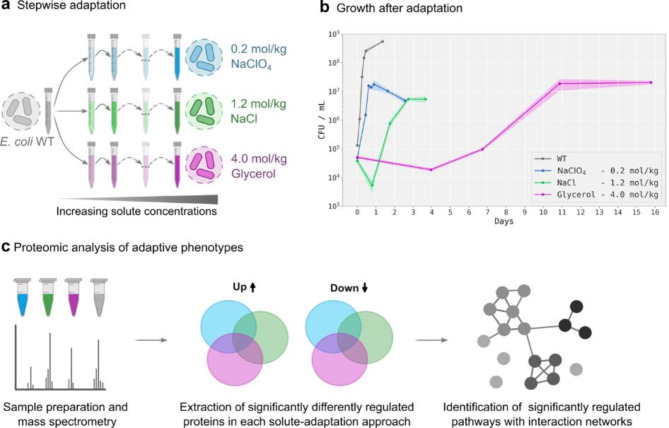
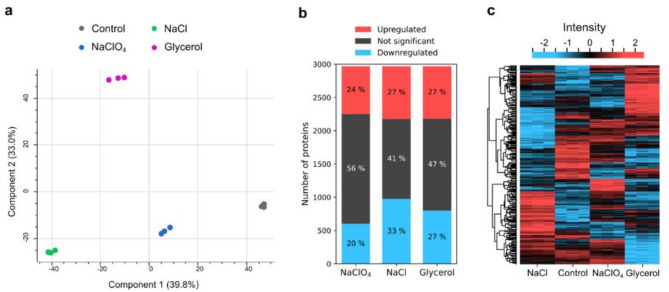
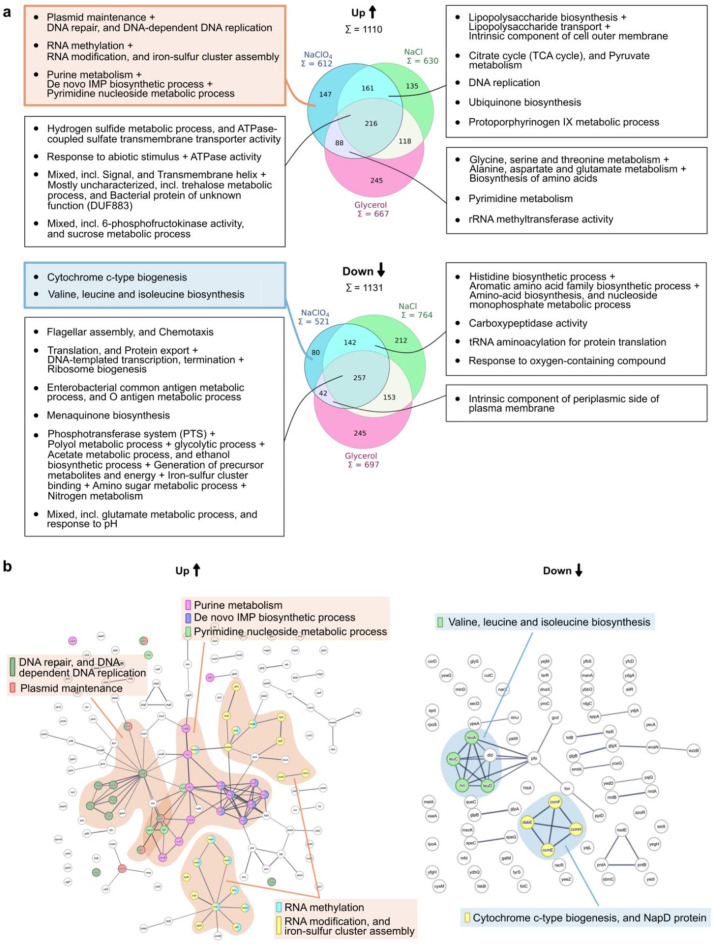
Brines, potentially formed by the deliquescence and freezing point depression of highly hygroscopic salts, such as perchlorates (ClO4-), may allow for the spatial and temporal stability of liquid water on present-day Mars. It is therefore of great interest to explore the microbial habitability of Martian brines, for which our current understanding is, however, still limited. Putative microbes growing in the perchlorate-rich Martian regolith may be harmed due to the induction of various stressors including osmotic, chaotropic, and oxidative stress. We adapted the model organism Escherichia coli to increasing sodium perchlorate concentrations and used a proteomic approach to characterize the adaptive phenotype. Separately, the microbe was adapted to elevated concentrations of sodium chloride and glycerol, which enabled us to distinguish perchlorate-specific adaptation mechanisms from those in response to osmotic, ion and water activity stress. We found that the perchlorate-specific stress response focused on pathways alleviating damage to nucleic acids, presumably caused by increased chaotropic and/or oxidative stress. The significant enrichments that have been found include DNA repair, RNA methylation and de novo inosine monophosphate (IMP) biosynthesis. Our study provides insights into the adaptive mechanisms necessary for microorganisms to survive under perchlorate stress, with implications for understanding the habitability of Martian brines.
Keywords: Adaptation; Brines; Habitability; Mars; Perchlorate; Proteomics.
© 2025. The Author(s).
Conflict of interest statement
Declarations. Competing interests: The authors declare no competing interests.
Figures
References
-
- Nazari-Sharabian, M., Aghababaei, M., Karakouzian, M. & Karami, M. Water on Mars—A literature review. Galaxies8, 40 (2020). - DOI
-
- Haberle, R. M. et al. On the possibility of liquid water on present-day Mars. J. Geophys. Res. Planet106, 23317–23326 (2001). - DOI
-
- Piqueux, S. et al. Widespread shallow water ice on Mars at high latitudes and midlatitudes. Geophys. Res. Lett.46, 14290–14298 (2019). - DOI
MeSH terms
Substances
LinkOut - more resources
Full Text Sources
Molecular Biology Databases
Miscellaneous
