. 2025 Apr;28(4):766-782.
doi: 10.1038/s41593-025-01891-9. Epub 2025 Feb 27.

Astrocytic cannabinoid receptor 1 promotes resilience by dampening stress-induced blood-brain barrier alterations

Affiliations

Astrocytic cannabinoid receptor 1 promotes resilience by dampening stress-induced blood-brain barrier alterations

Katarzyna A Dudek et al. Nat Neurosci. 2025 Apr.

Abstract

Blood-brain barrier (BBB) alterations contribute to stress vulnerability and the development of depressive behaviors. In contrast, neurovascular adaptations underlying stress resilience remain unclear. Here we report that high expression of astrocytic cannabinoid receptor 1 (CB1) in the nucleus accumbens (NAc) shell, particularly in the end-feet ensheathing blood vessels, is associated with resilience during chronic social stress in adult male mice. Viral-mediated overexpression of Cnr1 in astrocytes of the NAc shell results in baseline anxiolytic effects and dampens stress-induced anxiety- and depression-like behaviors in male mice. It promotes the expression of vascular-related genes and reduces astrocyte inflammatory response and morphological changes following an immune challenge with the cytokine interleukin-6, linked to stress susceptibility and mood disorders. Physical exercise and antidepressant treatment increase the expression of astrocytic Cnr1 in the perivascular region in male mice. In human tissue from male donors with major depressive disorder, we observe loss of CNR1 in the NAc astrocytes. Our findings suggest a role for the astrocytic endocannabinoid system in stress responses via modulation of the BBB.


Conflict of interest statement

Competing interests: The authors declare no competing interest.

Figures

Fig. 1
Fig. 1. Increased astrocytic CB1 expression in the NAc shell is associated with stress resilience in male mice.
a, Experimental timeline of 10-day CSDS, SI and tissue collection. b, Individual SI values (left) and representative heatmaps (right) of normalized time spent in the interaction zone during the SI test for male CSDS. c, Quantitative PCR revealed upregulation of Cnr1 gene expression in the NAc of stress RES male mice when compared to unstressed CTRL and SS animals. d, ECS TaqMan array revealed higher Cnr1 gene expression in stressed mice versus CTRL in the NAc but not PFC; the range of color indicates individual differences within a group, with yellow indicating increased expression and blue indicating decreased expression as compared to CTRL. e, Individual SI values (left) and corner time (middle) with representative heatmaps (left). f, Cell-type percentage colocalizing with CB1 protein detected by immunofluorescence. g,i, Increased number of S100β+ cells expressing CB1-encoded protein in RES males as compared to SS and CTRL in the NAc shell (g), but not the NAc core (i). NS, nonsignificant. h,j, Representative images of CB1, S100β and Map2 immunohistochemistry in the NAc after social defeat stress in the shell (h) and core (j). Data represent mean ± s.e.m.; the number of animals or subjects (n) is indicated on graphs. One-way ANOVA or Brown–Forsythe ANOVA test followed by Holm–Šídák’s or Tuckey’s multiple comparison test was applied. For n < 8, the Kruskal–Wallis test followed by Dunn’s multiple comparisons evaluation was used; correlations were evaluated with Pearson’s correlation coefficient; ***P ≤ 0.001, **P ≤ 0.01, *P ≤ 0.05. Panels a, f, j and i created using BioRender.com. Source data
Fig. 2
Fig. 2. Cnr1 overexpression in the mouse NAc astrocytes is anxiolytic and promotes stress resilience.
a, Experimental timeline of NAc shell bilateral injection of AAV-GFAP-Cnr1 or AAV-GFAP-sham viruses and behavioral studies. b, Viral validation with RNAscope confirmed upregulation of Cnr1 in AAV-GFAP-Cnr1-infected astrocytes of male mice. c, Following bilateral injection with AAV-GFAP-Cnr1, mice spend more time in the OF arena center (top). Representative heatmaps of normalized time spent in the center (bottom). d, Bilateral injection with AAV-GFAP-Cnr1 has anxiolytic effect in the EPM with more times open arms entries (top). Representative heatmaps of time spent in the EPM open arms (bottom). e, AAV-GFAP-Cnr1-injected mice start grooming sooner in the ST new environment, indicating decreased anxiety. f, Viral manipulation did not alter sociability. Individual SI ratios (left) and representative heatmaps (right) of normalized time spent in the interaction zone. g, Intra-individual anxiety and motivated behaviors are correlated. h, Experimental timeline of NAc shell bilateral injection of AAV-GFAP-Cnr1 or AAV-GFAP-sham viruses followed by CSDS and behavioral studies. i, Social deficits induced by CSDS are prevented in males injected with the AAV-GFAP-Cnr1 virus according to the time spent in the interaction zone (IZ; left) and representative heatmaps (right). j, RNAscope representative image of AAV-GFAP-Cnr1 expression in NAc shell astrocytes. k,l, Following bilateral injection with the AAV-GFAP-Cnr1, mice spent more time in the EPM open arms (left, representative heatmaps on the right; k) and the OF center (left, representative heatmaps on the right; l). m, Bilateral AAV-GFAP-Cnr1 injection in the NAc shell increased grooming time in the ST (left), suggesting a positive effect on motivated behaviors. It also increased mobility in the FST (right). Data represent mean ± s.e.m.; the number of animals (n) is indicated on graphs. Two-tailed t-test or Mann–Whitney U test was applied (af); correlations were evaluated with Pearson’s correlation coefficient (g); a two-way ANOVA or nonparametric two-way ANOVA on ranks followed by Holm–Šídák’s or Wilcox multiple comparison test was applied (hm); ****P < 0.0001, **P ≤ 0.01, *P ≤ 0.05. Panels a, h and j created using BioRender.com. Source data
Fig. 3
Fig. 3. Downregulation of astrocytic Cnr1 in the NAc shell or neuronal Cnr1 in the NAc does not affect baseline social behaviors or improve avoidance after stress exposure.
a, Experimental timeline of NAc shell bilateral injection of AAV-GFAP-shmir-Cnr1 or AAV-GFAP-scrmb viruses followed by baseline behavioral assessment or CSDS, then behavioral studies. b, Validation of AAV-GFAP-shmir-Cnr1 or AAV-GFAP-scrmb viruses with RNAscope confirmed downregulation of Cnr1 mRNA levels in AAV-GFAP-shmir-Cnr1-infected astrocytes compared to AAV-GFAP-scrmb-injected male mice. RNAscope representative images of AAV-GFAP-scrmb (left) and AAV-GFAP-shmir-Cnr1 (right) viruses. c, Viral manipulation does not alter baseline social behaviors as measured with the SI test. Individual SI values (left) and representative heatmaps (right) of normalized time spent in the interaction zone during the SI test. d, Bilateral AAV-GFAP-shmir-Cnr1, but not AAV-GFAP-scrmb injection in the NAc shell promotes social deficits induced by CSDS in males as depicted by individual SI test values (left), representative heatmaps (middle) and increased percentage of SS animals (right). e, Experimental timeline of NAc core bilateral injection of AAV-hSYN-shmir-Cnr1 or AAV-hSYN-scrmb viruses followed by behavioral studies. f, Validation of AAV-hSYN-shmir-Cnr1 or AAV-hSYN-scrmb viruses with RNAscope confirmed downregulation of Cnr1 mRNA levels in AAV-hSYN-shmir-Cnr1-infected neurons when compared to AAV-hSYN-scrmb-injected mice. RNAscope representative images of AAV-hSYN-scrmb (left) and AAV-hSYN-shmir-Cnr1 (right) viruses. g, Viral manipulation does not alter baseline social behaviors as measured with the SI test. Individual SI values (left) and representative heatmaps (right) of normalized time spent in the interaction zone during the SI test. h, Bilateral AAV-hSYN-shmir-Cnr1 and AAV-hSYN-scrmb injection in the NAc core promotes social deficits induced by CSDS in males as depicted by individual SI test values (left), representative heatmaps (middle) and increased percentage of SS animals (right). Data represent mean ± s.e.m.; the number of animals or subjects (n) is indicated on graphs. Two-way ANOVA or nonparametric two-way ANOVA on ranks followed by Holm–Šídák’s or Wilcox multiple comparison tests was applied; ****P < 0.0001, **P ≤ 0.01, *P ≤ 0.05. Panels a, b, e and f created using BioRender.com. Source data
Fig. 4
Fig. 4. High perivascular CB1 expression favors stress resilience following CSDS in male mice.
a, Experimental timeline of NAc bilateral injection of AAV-shRNA-sham or AAV-shRNA-Cldn5. b, Cnr1 expression is increased in animals with BBB impairment induced by AAV-shRNA-Cldn5 injection. c, Bilateral injection with AAV-shRNA-Cldn5 does not alter astrocytic end-feet coverage of NAc shell vessels (left); however, astrocyte end-feet expressing CB1 are more efficient in covering vessels in AAV-shRNA-Cldn5-injected animals (right). Representative images of astrocytic end-feet coverage for AAV-shRNA-sham (top) and AAV-shRNA-Cldn5-injected animals (bottom). d, Experimental timeline of CSDS, SI test and tissue collection. e, Individual SI values. f, Aqp4 gene expression is decreased in SS male mice versus unstressed CTRL and RES animals (left), correlating with Cldn5 stress-induced expression changes (right). g, Schematic representation of astrocytic end feet and endothelial cells. h, SI values for male CSDS. i, Astrocytic coverage of NAc shell vessels is lower after CSDS for SS mice without reaching significance. j, CSDS induces decreased vessel volume in SS mice only. k, RES mice are characterized by the high number of CB1s colocalizing with NAc shell endothelial cells (left), and it correlates with SIs (right). l, Representative images of CB1, Aqp4 and CD31 expression in the NAc shell after CSDS. m, STED representative image of CB1, Aqp4 and Cd31 in the NAc shell of CTRL mice. Representative image intensity was adjusted with a log scale. n, Experimental timeline of NAc shell bilateral injection of AAV-GFAP-shmir-Cnr1 or AAV-GFAP-scrmb viruses followed by CSDS, SI test and tissue collection. o, AAV-GFAP-shmir-Cnr1 decreases Aqp4 volume in unstressed CTRL and stressed mice. p, Representative images of NAc shell eGFP, Aqp4 and CD31 expression after viral manipulation. Data represent mean ± s.e.m.; the number of animals or subjects (n) is indicated on graphs. Two-tailed t-test was applied for two-group analysis and one-way ANOVA followed by Holm–Šídák’s multiple comparison test for three groups; for n < 8, the Kruskal–Wallis test and Dunn’s multiple comparisons were used; for viral manipulations, a two-way ANOVA or nonparametric two-way ANOVA on ranks followed by Holm–Šídák’s or Wilcox multiple comparison test was applied; ****P ≤ 0.0001, ***P ≤ 0.001, **P ≤ 0.01, *P ≤ 0.05. Panels a, d, g and n created using BioRender.com. Source data
Fig. 5
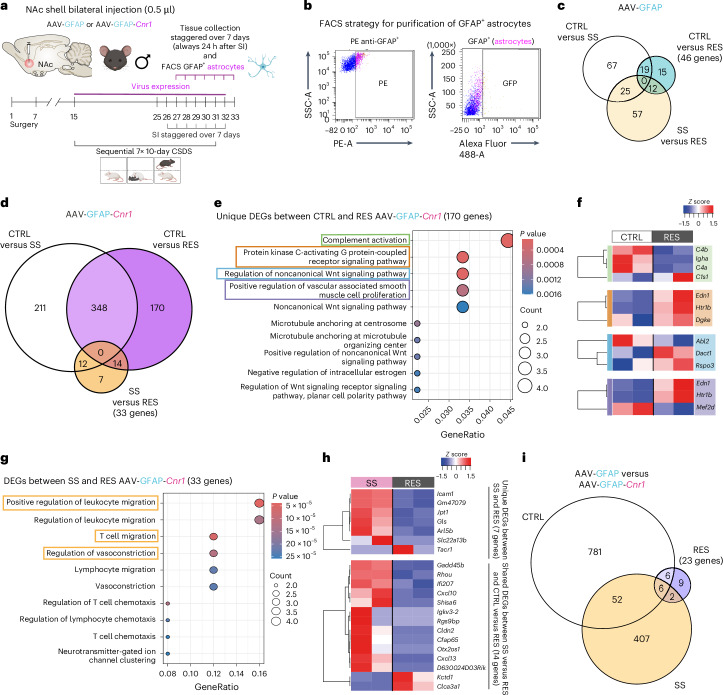
Fig. 5. Upregulation of astrocytic Cnr1 in the NAc shell promotes expression of vascular-related genes and a shift toward a transcriptomic RES profile in stressed male mice.
a, To assess NAc shell astrocyte-specific changes induced by chronic stress and Cnr1 overexpression, AAV-transduced astrocytes were isolated using FACS. Experimental timeline of NAc shell bilateral injection of AAV-GFAP-Cnr1 or AAV-GFAP-sham viruses staggered over a 7-day period, followed by sequential CSDS and FACS isolation of GFP+ astrocytes. b, FACS strategy for purification of AAV-transduced GFP+ astrocytes. c, Venn diagram indicates an overlap of astrocytic gene expression changes between CTRL and RES groups of animals injected with AAV-GFAP-sham. d, Venn diagrams indicate poor overlap of astrocytic gene expression changes between CTRL and RES groups of animals injected with AAV-GFAP-Cnr1. e, Significant biological pathways differently regulated between CTRL and RES groups of animals injected with AAV-GFAP-Cnr1. f, Hierarchical clustering heatmap of CTRL versus RES mice and biological pathways, including the genes regulating vascular function upregulated (red) or downregulated (blue) in the NAc astrocytes transduced with AAV-GFAP-Cnr1. g, Significant biological pathways differently regulated between RES and SS groups of animals injected with AAV-GFAP-Cnr1. h, Hierarchical clustering heatmap including the genes regulating immune response upregulated (red) in SS versus RES in the NAc astrocytes transduced with AAV-GFAP-Cnr1. i, Venn diagrams indicate high similarity of RES mice of AAV-GFAP-Cnr1 and AAV-GFAP-sham-injected groups. Panel a created using BioRender.com. Source data
Fig. 6
Fig. 6. Stress-induced inflammation alters astrocyte morphology along with the expression of Cnr1 and endocannabinoid-related enzymes.
a, Schematic representation of endocannabinoid main enzymes responsible for their synthesis and degradation. AEA is mainly synthesized by NAPE-PLD and metabolized by FAAH. 2-AG is generated by selective enzymes, including DAGLα, and is metabolized by both FAAH and MAGL. b, Experimental timeline of CSDS, SI test and tissue collection. c, Individual SI values following CSDS. d, CSDS decreases NAc 2-AG levels in RES but not in SS males (left). 2-AG levels negatively correlate with SI levels (right). e, In vitro experimental scheme for mouse primary cultured astrocytes treated with pro-inflammatory IL-6 (100 ng μl−1). Acute treatment with IL-6 drives pro-inflammatory response in astrocytes, increasing endocannabinoid gene transcription at 3 h and 6 h time points (n = 3 for all groups). f, Chronic (7 days) but not acute (24 h) treatment with IL-6 results in a decreased volume of GFAP + astrocytes (left). Both acute and chronic treatment led to decreased astrocyte morphology complexity (right). Representative images of astrocytes expressing GFAP untreated (left) and acutely (middle) or chronically (right) treated with IL-6 (100 ng μl−1). UNT, untreated. g, Infection of cultured astrocytes with AAV-GFAP-Cnr1 but not AAV-GFAP-sham decreases pro-inflammatory response at the 6 h time point. h, IL-6 treatment increases expression of Cnr1 gene in AAV-infected astrocytes (n = 3 for all groups). i, Acute IL-6 treatment leads to a loss in Aqp4 and GFAP volume, which is prevented by AAV-GFAP-Cnr1 infection. Representative images of astrocytes treated with IL-6 (100 ng μl−1) or viruses modulating Cnr1 expression and stained for GFAP, Aqp4, eGFP or DAPI. Data represent mean ± s.e.m.; the number of animals or subjects (n) is indicated on graphs. For one-factor analysis, one-way ANOVA followed by Holm–Šídák’s multiple comparison test was applied. For n lower than 8, the Kruskal–Wallis test followed by Dunn’s multiple comparisons evaluation was used. For two-group analysis, two-tailed t-test was applied. For analysis with two factors, two-way ANOVA followed by Holm–Šídák’s multiple comparison test was used; correlations were evaluated with Pearson’s correlation coefficient; ****P < 0.0001, ***P ≤ 0.001, **P ≤ 0.01, *P ≤ 0.05. Panels b, e and g created using BioRender.com. Source data
Fig. 7
Fig. 7. Treatment with 2-AG induces expression of blood vessel-related genes in astrocytes and adaptive changes when challenged by inflammatory cytokine IL-6.
a, In vitro experimental scheme for mouse primary cultured astrocytes treated with pro-inflammatory IL-6 (100 ng μl−1) together with 2-AG (IL-6; 100 μg μl−1) for 3 h. b, Schematic representation of 2-AG enzymes responsible for its degradation to pro-inflammatory and vasoactive compounds. One of the two products of 2-AG metabolism by MAGL is AA, further converted by Cox-2 to prostaglandins, involved in the inflammatory response. c, HPLC–MS/MS analysis of astrocytic endocannabinoidome revealed an increase in 2-AG release, a decrease in AA levels and increased production of pro-inflammatory PGE2 after IL-6 and 2-AG cotreatment. d, Significant biological pathways differently regulated by IL-6 treatment revealed pro-inflammatory response. Adj, adjusted. e, Significant biological pathways differently regulated by 2-AG provide a link with vascular mechanisms. f, Hierarchical clustering heatmap including the genes regulating immune response upregulated (red) in IL-6 group. g, Hierarchical clustering heatmap of 2-AG condition and biological pathways including the genes regulating vascular function upregulated (red). hk, Astrocytes treated with both IL-6 and 2-AG exhibit blunted inflammatory response (h,i), with 2-AG inducing vascular adaptations (j,k). Data represent mean ± s.e.m.; the number of replicates (n) is indicated on graphs; ****P < 0.0001, ***P ≤ 0.001, **P ≤ 0.01, *P ≤ 0.05. Panel a created using BioRender.com. Source data
Fig. 8
Fig. 8. Physical exercise and antidepressant treatment promote stress resilience and increase Cnr1 in the NAc.
a, Experimental timeline of CSDS with physical exercise, SI and tissue collection. b, Individual SI values after CSDS. c, Physical exercise prevents the development of social deficits following CSDS. d, RES animals are characterized by increased daytime running, suggesting a coping strategy when facing CSDS exposure. e, Increased transcription of Cnr1 is observed in RES animals (left) and correlates with the level of physical exercise during daytime (right). f, Representative RNAscope and immunofluorescence images exhibiting increased Cnr1 expression at the BBB (CD31 as endothelial cell marker) in the RES phenotype. g, To assess astrocyte-specific endocannabinoid changes induced by chronic stress in the NAc, astrocytes were isolated using MACS. h, Individual SI values. i, 2-AG level in NAc astrocytes is unchanged. j, Experimental timeline of NAc shell bilateral injection of AAV-GFAP-shmir-Cnr1 or AAV-GFAP-scrmb viruses followed by CSDS with physical exercise and behavioral studies. k, Individual SI values (left), time in the interaction zone (right) and representative heatmaps (bottom). l, Experimental timeline of CSDS followed by an SI test to establish phenotype before antidepressant treatment. A second SI test was performed 24 h before tissue collection. m, Individual SI values (left) and comparison for treatment responders versus nonresponders (right) with representative heatmaps for these cohorts (top). n, Cnr1 mRNA is increased in the NAc of treatment responders only (left), and it correlates with Aqp4 expression (right). o, A loss in AQP4+ cells expressing CNR1 is noted in men with MDD. This alteration was not observed for individuals undergoing treatment. p, Representative RNAscope images. Data represent mean ± s.e.m.; the number of animals or subjects (n) is indicated on graphs. One-way ANOVA or Brown–Forsythe ANOVA test followed by Holm–Šídák’s or Dunnett’s multiple comparison test was applied. Two-way ANOVA or nonparametric two-way ANOVA on ranks followed by Holm–Šídák’s or Wilcox multiple comparison test was applied; for n < 8, the Kruskal–Wallis test followed by Dunn’s multiple comparisons was used; correlations were evaluated with Pearson’s correlation coefficient; ****P < 0.0001, ***P ≤ 0.001, **P ≤ 0.01, *P ≤ 0.05. Panels a, f, g, i, j and l created using BioRender.com. Source data

References

    1. GBD 2019 Diseases and Injuries Collaborators Global burden of 369 diseases and injuries in 204 countries and territories, 1990-2019: a systematic analysis for the Global Burden of Disease Study 2019. Lancet396, 1204–1222 (2020). - PMC - PubMed
    1. Meltzer, H., Vostanis, P., Ford, T., Bebbington, P. & Dennis, M. S. Victims of bullying in childhood and suicide attempts in adulthood. Eur. Psychiatry26, 498–503 (2011). - PubMed
    1. Menard, C. et al. Social stress induces neurovascular pathology promoting depression. Nat. Neurosci.20, 1752–1760 (2017). - PMC - PubMed
    1. Dudek, K. A. et al. Molecular adaptations of the blood–brain barrier promote stress resilience vs. depression. Proc. Natl Acad. Sci. USA117, 3326–3336 (2020). - PMC - PubMed
    1. Dion-Albert, L. et al. Vascular and blood–brain barrier-related changes underlie stress responses and resilience in female mice and depression in human tissue. Nat. Commun.13, 164 (2022). - PMC - PubMed

Substances

LinkOut - more resources