


Feasibility and safety of impact-loading exercise in patients with multiple myeloma-a pilot study
- PMID: 40019520
- PMCID: PMC11870939
- DOI: 10.1007/s00520-025-09287-y
Feasibility and safety of impact-loading exercise in patients with multiple myeloma-a pilot study
Abstract
Purpose: Patients with multiple myeloma (MM) develop osteolytic lesions with fractures, pain, and impaired quality of life. Preclinical data show an anabolic effect of loading exercise in osteolytic lesions of MM. This 6-month pilot study evaluated feasibility and safety of impact-loading exercise in patients with MM after assessment of spinal stability.
Methods: We assigned 20 patients to perform 45 min of guided impact-loading exercise twice a week and home-based training once a week or stretching exercise twice a week. Primary endpoint was assessment of feasibility and safety. Secondary endpoints were assessments of physical performance, quality of life, and bone remineralization.
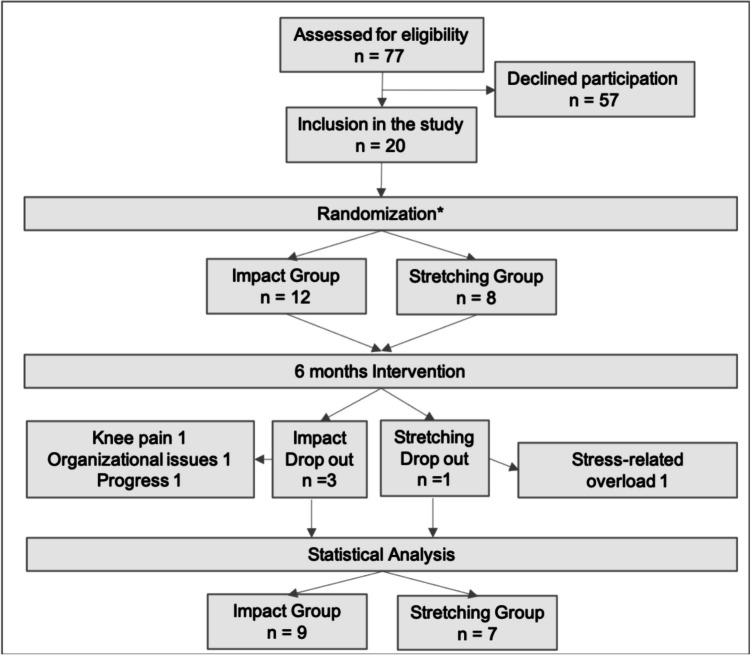
Results: Of 77 eligible patients with MM, 26% accepted participation. In the impact group, 9/12 and in the stretching group 7/8 patients completed training with adherence rates of 65.8 and 81.1%. Ninety percent of the stamping and jumping exercises were performed with increasing intensity from the prescribed training volume of ≥ 100%. Low severity pain events were reported after 32.9% of impact sessions. No serious adverse events were observed. After 6 months, 6-minute walk distance increased in the impact group by 35 m and in the stretching group by 46 m, and chair-rise test improved in the stretching group by 1.7 s. Global health status increased by 24.9% in the impact group, and functional scale by 31.9% in the stretching group based upon EORTC QLQ-C30. No signs of bone remineralization were observed in computed tomography.
Conclusion: Impact training is feasible and appears to be safe in selected MM patients.
Keywords: Bone turnover marker; Feasibility; Impact-loading exercise; Multiple myeloma (MM); Safety.
© 2025. The Author(s).
Conflict of interest statement
Declarations. Ethics approval: The study was conducted in accordance with the Declaration of Helsinki. The protocol was also approved by the Ethics Committee of the University of Würzburg (No. 31/21-am). Consent to participate: Informed consent was obtained from all participants in the study. Competing interests: The authors declare no competing interests.
Figures
References
-
- Malard F, Neri P, Bahlis NJ, Terpos E, Moukalled N, Hungria VTM, Manier S, Mohty M (2024) Multiple myeloma. Nat Rev Dis Primers 10(1):45 - PubMed
-
- Grunz JP, Kunz AS, Baumann FT, Hasenclever D, Sieren MM,Heldmann S, Bley TA, Einsele H, Knop S, Jundt F (2023) Assessing osteolytic lesion size on sequential CT scans is a reliable study endpoint for bone remineralization in newly diagnosed multiple myeloma. Cancers (Basel) 15(15):4008. 10.3390/cancers15154008 - PMC - PubMed
-
- Campbell KL, Winters-Stone KM, Wiskemann J, May AM, Schwartz AL, Courneya KS, Zucker DS, Matthews CE, Ligibel JA, Gerber LH, Morris GS, Patel AV, Hue TF, Perna FM, Schmitz KH (2019) Exercise guidelines for cancer survivors: consensus statement from International Multidisciplinary Roundtable. Med Sci Sports Exerc 51(11):2375–2390 - PMC - PubMed
-
- Emery A, Moore S, Crowe J, Murray J, Peacock O, Thompson D, Betts F, Rapps S, Ross L, Rothschild-Rodriguez D, Arana Echarri A, Davies R, Lewis R, Augustine DX, Whiteway A, Afzal Z, Heaney J, Drayson MT, Turner JE, Campbell JP (2024) The effects of short-term, progressive exercise training on disease activity in smouldering multiple myeloma and monoclonal gammopathy of undetermined significance: a single-arm pilot study. BMC Cancer 24(1):174 - PMC - PubMed
MeSH terms
Grants and funding
LinkOut - more resources
Full Text Sources
Medical
