


Minimally Invasive Approaches for High-Risk and Elderly Patients With Acute Cholecystitis: A Systematic Review of Techniques and Outcomes
- PMID: 40026918
- PMCID: PMC11872040
- DOI: 10.7759/cureus.78271
Minimally Invasive Approaches for High-Risk and Elderly Patients With Acute Cholecystitis: A Systematic Review of Techniques and Outcomes
Retraction in
-
Retraction: Minimally Invasive Approaches for High-Risk and Elderly Patients With Acute Cholecystitis: A Systematic Review of Techniques and Outcomes.Cureus. 2025 Apr 1;17(4):r174. doi: 10.7759/cureus.r174. eCollection 2025 Apr. Cureus. 2025. PMID: 40177225 Free PMC article.
Abstract
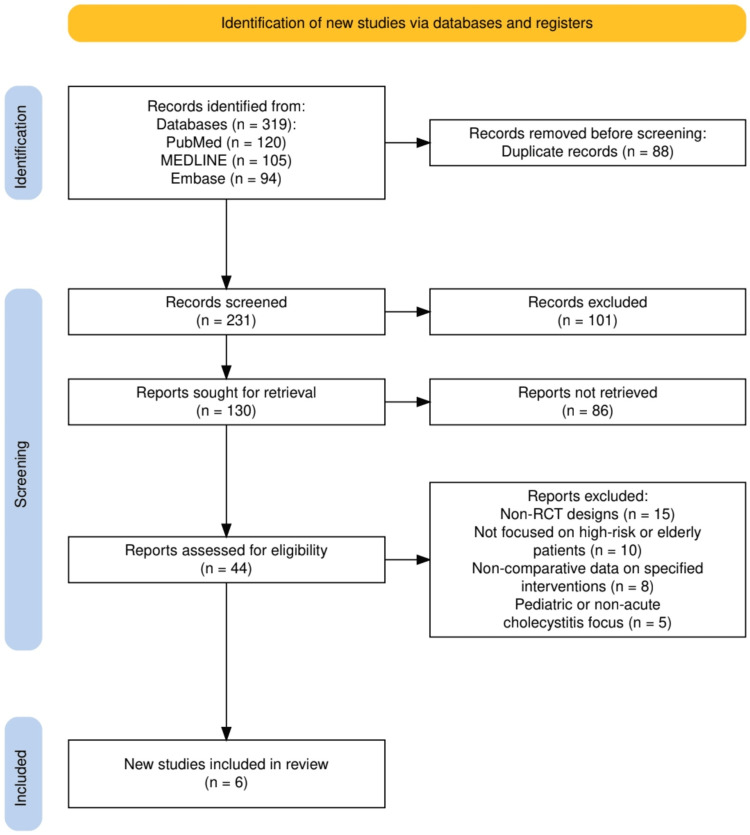
Acute cholecystitis is a prevalent condition marked by gallbladder inflammation, typically due to gallstone obstruction, and poses management challenges, particularly for high-risk and elderly patients. This systematic review compares the efficacy and safety of two minimally invasive approaches: percutaneous drainage methods, such as percutaneous cholecystostomy, and laparoscopic cholecystectomy (LC). A structured search of PubMed, MEDLINE, and Embase was conducted, yielding six randomized controlled trials that met the inclusion criteria. Findings suggest that percutaneous drainage combined with LC offers advantages in reducing operative time, hospital stay, and complication rates, particularly for high-risk patients, compared to LC alone. However, routine postoperative drainage after LC may contribute to prolonged hospital stays and increased postoperative pain without reducing morbidity. Advanced energy devices, such as harmonic scalpels, may further optimize surgical outcomes, though benefits are limited. This review highlights the importance of patient-centered, selective approaches over routine practices, advocating for personalized strategies that prioritize patient safety and recovery. Future research should refine patient selection criteria and evaluate long-term outcomes to establish more precise guidelines for managing acute cholecystitis in vulnerable populations.
Keywords: acute cholecystitis; elderly patients; high-risk patients; laparoscopic cholecystectomy; minimally invasive surgery; patient-centered care; percutaneous cholecystostomy; postoperative drainage; randomized controlled trials.
Copyright © 2025, Abdelmaseeh et al.
Conflict of interest statement
Conflicts of interest: In compliance with the ICMJE uniform disclosure form, all authors declare the following: Payment/services info: All authors have declared that no financial support was received from any organization for the submitted work. Financial relationships: All authors have declared that they have no financial relationships at present or within the previous three years with any organizations that might have an interest in the submitted work. Other relationships: All authors have declared that there are no other relationships or activities that could appear to have influenced the submitted work.
Figures
References
-
- Jones MW, Genova R, O’Rourke MC. StatPearls [Internet] Treasure Island (FL): StatPearls Publishing; 2025. Acute cholecystitis. - PubMed
-
- Laparoscopic cholecystectomy. [ Nov; 2024 ]. 2014. https://www.sciencedirect.com/topics/medicine-and-dentistry/laparoscopic... https://www.sciencedirect.com/topics/medicine-and-dentistry/laparoscopic...
-
- Approaches to cholecystitis: surgical, endoscopic, and percutaneous management. Cherng N, Achebe I, Winkie M, Thomann J, Then E, Marya NB. J Intensive Care Med. 2024 - PubMed
-
- Cholecystectomy (gallbladder removal) [ Nov; 2024 ]. 2023. https://my.clevelandclinic.org/health/procedures/21614-gallbladder-removal https://my.clevelandclinic.org/health/procedures/21614-gallbladder-removal
Publication types
LinkOut - more resources
Full Text Sources
Miscellaneous