[Preprint]. 2025 Aug 1:2025.02.16.638509.
doi: 10.1101/2025.02.16.638509.

Coupled equilibria of dimerization and lipid binding modulate SARS Cov 2 Orf9b interactions and interferon response

Affiliations

Coupled equilibria of dimerization and lipid binding modulate SARS Cov 2 Orf9b interactions and interferon response

Cj San Felipe et al. bioRxiv. .

Update in

Abstract

Open Reading Frame 9b (Orf9b), an accessory protein of SARS-CoV and -2, is involved in innate immune suppression through its binding to the mitochondrial receptor Translocase of Outer Membrane 70 (Tom70). Previous structural studies of Orf9b in isolation revealed a β-sheet-rich homodimer, however, structures of Orf9b in complex with Tom70 revealed a monomeric helical fold. Here, we developed a biophysical model that quantifies how Orf9b switches between these conformations and binds to Tom70, a requirement for suppressing the type 1 interferon response. We used this model to characterize the effect of lipid binding and mutations in variants of concern to the Orf9b:Tom70 equilibrium. We found that the binding of a lipid to the Orf9b homodimer biases the Orf9b monomer:dimer equilibrium towards the dimer by reducing the dimer dissociation rate ~100-fold. We also found that mutations in variants of concern can alter different microscopic rate constants without significantly affecting binding to Tom70. Together our results highlight how perturbations to different steps in these coupled equilibria can affect the apparent affinity of Orf9b to Tom70, with potential downstream implications for interferon signaling in coronavirus infection.


Conflict of interest statement

Competing Interest Statement The Krogan Laboratory has received research support from Vir Biotechnology, F. Hoffmann-La Roche, and Rezo Therapeutics. Nevan Krogan has a financially compensated consulting agreement with Maze Therapeutics. Nevan is the President and is on the Board of Directors of Rezo Therapeutics, and he is a shareholder in Tenaya Therapeutics, Maze Therapeutics, Rezo Therapeutics, GEn1E Lifesciences, and Interline Therapeutics. J.S.F. is a consultant to, shareholder of, and receives sponsored research support from Relay Therapeutics. Michael Grabe is a developer for Berkeley Madonna.

Figures

Figure 1:
Figure 1:. Peptides of Orf9b can be used to model the behavior of monomeric Orf9b to Tom70
A. Initial model of the Orf9b-Tom70 equilibrium. B. (Left) Schematic of SPR binding interaction between Tom70 and Orf9b peptide. (Right) Surface plasmon resonance sensorgram of Orf9b peptide binding to immobilized Tom70 (orange) with model fits (black) showing kinetics and dissociation constant. C. (Left) Schematic of SPR binding interaction between Tom70 and Orf9b-FITC. (Right) Surface plasmon resonance sensorgram of Orf9b-FITC peptide binding to immobilized Tom70 (green) with model fits (black) showing kinetics and dissociation constant. D. (Left) Diagram of Orf9b-Tom70 fluorescent polarization assay. (Right) Model ODE (solid lines) overlaid with Orf9b peptide competition kinetics (circles) and model parameters used to generate results.
Figure 2:
Figure 2:. The Orf9b homodimer can be refolded to eliminate a co-purifying lipid
A. Schematic of Orf9b denaturing purification, refolding, and tag-cleavage process. B. Size exclusion chromatography chromatogram overlay of WT natively folded (black) and WT refolded (blue) Orf9b homodimer. Both proteins purify as a dimer and have identical retention volumes indicating high recovery of refolded Orf9b homodimer. C. Structural overlay of WT Orf9b homodimer (green-PDB 6Z4U) and WT refolded Orf9b homodimer (magenta/gray-PDB 9MZB). D. Zoomed in view of the natively folded Orf9b homodimer central channel. 2Fo-Fc (contoured to 1σ) and Fo-Fc (+/−3σ) density maps show continuous density that supports the placement of a ligand in the dimer central channel. E. Zoomed in view of the refolded Orf9b homodimer central channel: 2Fo-Fc (1σ) and Fo-Fc (+/−3σ) density maps show diffuse peaks within the central channel of the refolded Orf9b homodimer F. Deconvolved native mass spectra of refolded and natively folded Orf9b homodimers in negative-polarity mode. Lipid-bound homodimers are observed only in the natively folded sample. Both preparations display +60 Da and +257 Da adducts of unknown origin.
Figure 3:
Figure 3:. Serial dilution allows for estimation of Orf9b homodimer dissociation constant
A. Size exclusion chromatography overlay of Orf9b homodimer (black) with molecular weight standards (blue). Apo-Orf9b forms two distinct peaks corresponding to the dimer (peak 1) and the monomer (peak 2). B. Coomasie stain of SDS-PAGE gel from peaks 1 and 2 (from figure 3A) showing Orf9b is present in each peak. C. Size exclusion chromatography chromatogram of serially diluted WT lipid-bound Orf9b homodimer showing no monomer species present. D. Size exclusion chromatography chromatogram of serially diluted WT apo-Orf9b showing both homodimer and monomer peaks. Running molecular weight standards further supported our observation that the first peak was the Orf9b homodimer due to its close overlap with a 29kDa standard, however, the monomeric peak eluted after a 6.5kDa standard rather than between the 13.7kDa and 6.5kDA standards as we would expect. We hypothesize that this discrepancy is due to two possibilities: hydrophobic interactions between the monomer and the column could increase the retention volume or monomeric Orf9b has a smaller hydrodynamic radius than expected. E. Nonlinear regression analysis of the fraction of Orf9b in the homodimer versus the total concentration of Orf9b (from figure 3D) injected over the size exclusion column yields a KD of 1.2 ± 0.1uM.
Figure 4:
Figure 4:. Modeling the effect of lipid-binding on Orf9b-Tom70 equilibrium using SPR and FP based assays
A. I. Mathematical model overlay to FP competition kinetic assay using the lipid-bound Orf9b homodimer as the competitor. II. Mathematical model overlay to FP competition kinetic assay using the apo-Orf9b homodimer as the competitor. B. (Left) Schematic diagram of monomeric Orf9b binding to immobilized monomeric Orf9b to determine dimerization rate constants. (Right) Surface plasmon resonance sensorgram of full-length Orf9b binding to full-length Orf9b monomer and their interaction kinetics. Experimental binding curves (blue) were globally fit (black) using a 1:1 binding model. C. (Left) Schematic of full-length apo-Orf9b homodimer in exchange with Orf9b monomers. Monomeric Orf9b binds to immobilized Tom70 to determine rate constants of full-length Orf9b binding to Tom70. (Right) Surface plasmon resonance sensorgram of refolded apo-Orf9b binding to Tom70 and their interaction kinetics. Experimental binding curves (dark blue) were globally fit (black) using a 1:1 binding model. D. Proposed kinetic model of Orf9b-Tom70 equilibrium. Orf9b homodimer dissociates into Orf9b monomers which undergo a conformational change from β-sheet to -helix. -helical Orf9b binds to Tom70. E. Table of model parameters used to model ODE’s to both apo and lipid-bound Orf9b homodimer competition binding kinetics.
Figure 5:
Figure 5:. Truncated and fused Orf9b constructs can destabilize or stabilize the homodimer to modulate Tom70 binding
A. Model of Orf9b homodimer illustrating the Δ91–97 truncation (cyan). Residues 91–97 form 7 hydrogen bonds (7 mediated by backbone backbone interactions) between chains A and B (black dashes) of the homodimer and represent ⅔ of the homodimer binding interface. B. Berkeley Madonna model (solid lines) overlaid experimental data points (circles) for the FP competition kinetic assay using Orf9b Δ91–97. C. AlphaFold model of Orf9b homodimer with a 4xSGG linker (green) fusing the C-terminus of chain A (gray) to the N-terminus of chain B (magenta). D. Fitted model (solid lines) overlaid with experimental data points (circles) for the FP competition kinetic assay using Orf9b 4xSGG fusion construct. E. Model parameters used for solving ODE in Berkeley Madonna for both Δ91–97 and 4xSGG constructs. F. Co-immunoprecipitation between Flag-Tom70 and Strep-Orf9b mutants from HEK293T cells and immunoprecipitation was performed using anti-flag magnetic beads. Representative western blots of whole-cell lysates (WCLs) and eluates after IP are shown. Actin was used as a loading control in WCLs. G. Fold induction of ISRE-reporter activated by 3p-hpRNA upon expression of empty vector, Orf9b WT, Orf9b fused, Orf9b, truncated, and Orf9b S50/53E in HEK293T cells. Fold induction was calculated relative to unstimulated cells.
Figure 6:
Figure 6:. Orf9b mutations in variants of concern modulate equilibrium kinetics with Tom70
A. An AlphaFold model of the full Orf9b homodimer with mutations found in variants of concern shown as red spheres. Resides that fold into the Tom70-binding -helix are highlighted in magenta on one protomer and residues that form the dimer interface are highlighted in pink. B. Berkeley Madonna model (black lines) overlaid on experimental data points (circles) for the FP competition kinetic assay using Lambda, Omicron, and Delta Orf9b variants. C. Table of model parameters used to model experimental data in Fig 6B using Berkeley Madonna. D. Location of point mutations in variants of concern modeled in Pymol: (Left) T60 forms a hydrogen bond with the backbone carbonyl between A68 and F69 of the same chain that is lost in T60A. (Right) Point mutation P10S (red) introduces a serine that forms several hydrogen bonds with R13 and the backbone carbonyl of A11 and L48 within the same chain. Both mutations are mirrored on the opposite protomer. Hydrogen bonds are shown as black dashes. Mutations are modeled in Pymol using point mutation. E. Co-immunoprecipitation of endogenous Tom70 with Strep-tagged of Orf9b from variants of concern in HEK293T cells. F. Fold induction of ISRE-reporter activated by 3p-hpRNA in HEK293T cells expressing empty vector, Orf9b WT, Orf9b from VOC (Delta, Lambda, and Omicron).
Figure 7:
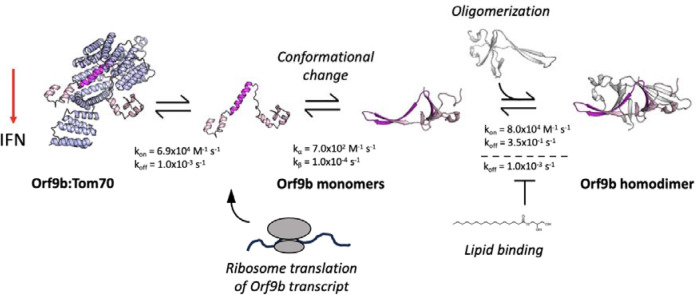
Figure 7:. Proposed model of the Orf9b-Tom70 equilibrium
Orf9b transcripts are translated to produce monomeric Orf9b proteins that can bind to Tom70 leading to a suppression of IFN. Monomeric Orf9b can also undergo a conformational change and bind to a second copy of Orf9b to form the homodimer. The Orf9b homodimer is in equilibrium between free Orf9b monomers and Orf9b monomers bound to Tom70. Upon lipid binding, the homodimer is tightly stabilized and slowly releases monomeric Orf9b.

References

    1. Backes Sandra, Bykov Yury S., Flohr Tamara, Räschle Markus, Zhou Jialin, Lenhard Svenja, Krämer Lena, et al. 2021. “The Chaperone-Binding Activity of the Mitochondrial Surface Receptor Tom70 Protects the Cytosol against Mitoprotein-Induced Stress.” Cell Reports 35 (1): 108936. - PMC - PubMed
    1. Backes Sandra, Hess Steffen, Boos Felix, Woellhaf Michael W., Gödel Sabrina, Jung Martin, Mühlhaus Timo, and Herrmann Johannes M.. 2018. “Tom70 Enhances Mitochondrial Preprotein Import Efficiency by Binding to Internal Targeting Sequences.” The Journal of Cell Biology 217 (4): 1369–82. - PMC - PubMed
    1. Blanco-Melo Daniel, Nilsson-Payant Benjamin E., Liu Wen-Chun, Uhl Skyler, Hoagland Daisy, Møller Rasmus, Jordan Tristan X., et al. 2020. “Imbalanced Host Response to SARS-CoV-2 Drives Development of COVID-19.” Cell 181 (5): 1036–45.e9. - PMC - PubMed
    1. Bouhaddou Mehdi, Memon Danish, Meyer Bjoern, White Kris M., Rezelj Veronica V., Marrero Miguel Correa, Polacco Benjamin J., et al. 2020. “The Global Phosphorylation Landscape of SARS-CoV-2 Infection.” Cell 182 (3): 685–712.e19. - PMC - PubMed
    1. Bouhaddou Mehdi, Reuschl Ann-Kathrin, Polacco Benjamin J., Thorne Lucy G., Ummadi Manisha R., Ye Chengjin, Rosales Romel, et al. 2023. “SARS-CoV-2 Variants Evolve Convergent Strategies to Remodel the Host Response.” Cell 186 (21): 4597–4614.e26. - PMC - PubMed

Publication types

LinkOut - more resources