


Physicochemical and sensory quality of breakfast cereals produced from flour blends of maize and pigeon pea
- PMID: 40028574
- PMCID: PMC11872418
- DOI: 10.1016/j.heliyon.2025.e42612
Physicochemical and sensory quality of breakfast cereals produced from flour blends of maize and pigeon pea
Abstract
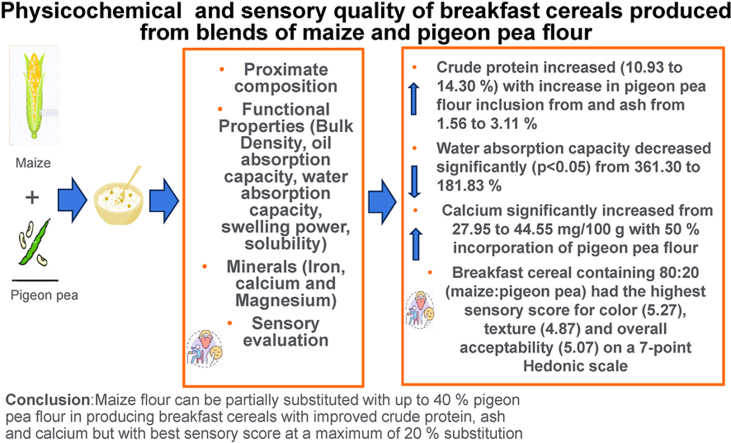
Breakfast cereals offer affordable, quick and convenient meal options. This study examined the proximate, techno-functional, mineral and sensory qualities of breakfast cereals produced from a flour blend of maize and pigeon peas. Maize flour was substituted with pigeon pea flour at 0 %, 10 %, 20 %, 30 %, 40 % and 50 % levels. The composite flours (100 g), sugar (25 g), salt (5 g) and water (50 ml) were mixed to form a paste, baked at 110 °C for 1 h then cooled. The proximate composition, techno-functional properties, minerals and sensory quality were evaluated. With increase in pigeon pea flour incorporation, there were increase in crude protein from 10.93 to 14.30 %, ash from 1.56 to 3.11 % while crude fibre from 1.25 to 3.37 %. In contrast, there was significant (p < 0.05) decrease in water absorption capacity from 361.30 to 181.83 %. With 50 % pigeon pea flour incorporation, calcium significantly increased from 27.95 to 44.55 mg/100g while iron and magnesium decreased from 3.92 to 2.16 mg/100g and 75.07 to 63.16 mg/100g, respectively. Breakfast cereal containing maize:pigeon pea flour in the ratio 80:20 and 70:30 generally had the highest mean sensory scores on a 7-point Hedonic scale. This suggests that maize flour can be substituted with pigeon pea up to 30 % without producing significant changes in the sensory quality.
Keywords: Functional; Mineral; Pigeon pea; Protein; Proximate composition.
© 2025 The Authors.
Conflict of interest statement
The authors declare that they have no known competing financial interests or personal relationships that could have appeared to influence the work reported in this paper.
Figures
References
-
- Betts J.A., Chowdhury E.A., Gonzalez J.T., Richardson J.D., Tsintzas K., Thompson D. Is breakfast the most important meal of the day? Proc. Nutr. Soc. 2016;75(4):464–474. - PubMed
-
- Shah T.R., Prasad K., Kumar P. Maize — a potential source of human nutrition and health: a review. Cogent Food Agric. 2016;54(1):1–9.
-
- Ademosun A.O. Enrichment with citrus peels as a strategy for improving the health benefits and nutritional value of breakfast cereals. A review, Human Nutrition & Metabol. 2024;36 doi: 10.1016/j.hnm.2024.200239. - DOI
-
- Edima-nyah A.P., Ntukidem V.E., Davies E.E. Development and quality evaluation of breakfast cereals from blends of local rice (oryza sativa), african yam beans (Sphenostylis stenocarpa) and coconut (cocos nucifera) flour. Int. J. Food Nutr. Saf. 2019;10(1):42–58.
-
- Dudley J.W. From means to QTL: the Illinois long-term selection experiment as a case study in quantitative genetics. Crop Sci. 2007;47(3):20–31.
LinkOut - more resources
Full Text Sources
Research Materials
Miscellaneous
