


Deep-learning enabled combined measurement of tumour cell density and tumour infiltrating lymphocyte density as a prognostic biomarker in colorectal cancer
- PMID: 40033106
- PMCID: PMC11876445
- DOI: 10.1038/s44276-025-00123-8
Deep-learning enabled combined measurement of tumour cell density and tumour infiltrating lymphocyte density as a prognostic biomarker in colorectal cancer
Abstract
Background: Within the colorectal cancer (CRC) tumour microenvironment, tumour infiltrating lymphocytes (TILs) and tumour cell density (TCD) are recognised prognostic markers. Measurement of TILs and TCD using deep-learning (DL) on haematoxylin and eosin (HE) whole slide images (WSIs) could aid management.
Methods: HE WSIs from the primary tumours of 127 CRC patients were included. DL was used to quantify TILs across different regions of the tumour and TCD at the luminal surface. The relationship between TILs, TCD, and cancer-specific survival was analysed.
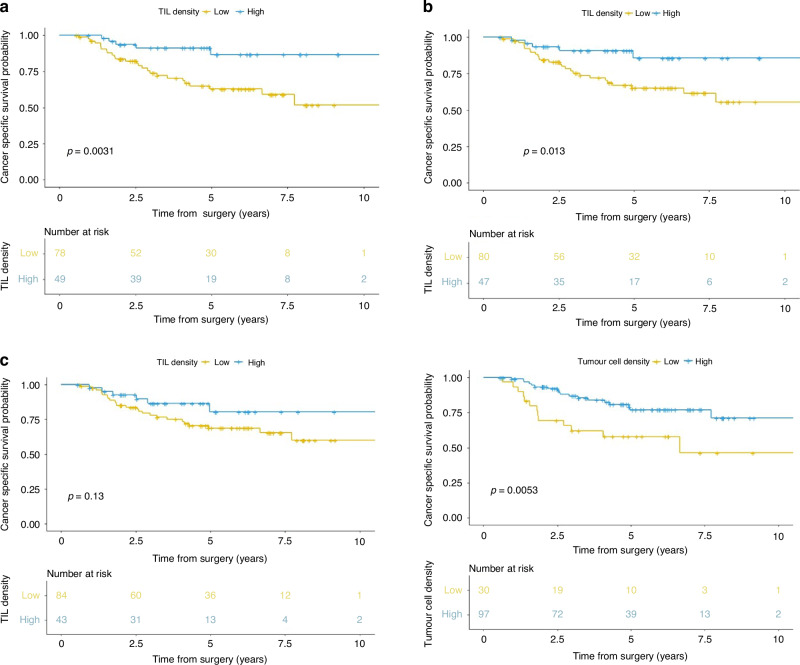
Results: Median TIL density was higher at the invasive margin than the luminal surface (963 vs 795 TILs/mm2, P = 0.010). TILs and TCD were independently prognostic in multivariate analyses (HR 4.28, 95% CI 1.87-11.71, P = 0.004; HR 2.72, 95% CI 1.19-6.17, P = 0.017, respectively). Patients with both low TCD and low TILs had the poorest survival (HR 10.0, 95% CI 2.51-39.78, P = 0.001), when compared to those with a high TCD and TILs score.
Conclusions: DL derived TIL and TCD score were independently prognostic in CRC. Patients with low TILs and TCD are at the highest risk of cancer-specific death. DL quantification of TILs and TCD could be used in combination alongside other validated prognostic biomarkers in routine clinical practice.
© 2025. The Author(s).
Conflict of interest statement
Competing interest: HG received honoraria from Astra Zeneca and Bristol Myers Squibb not related to the study. NW has undertaken paid consultancy for Bristol Myers Squibb, GSK, Astellas, Pfizer and Amgen not related to this study. PQ declares research funding from Roche and honoraria for lectures by Roche, Bayer, Amgen, not related to the study. DM is director and shareholder of HeteroGenius Limited. AW received honoraria from Servier not related to this study. Ethics approval and consent to participate: Ethical approval for the study was provided by North East – York Research Ethics Committee (ref. 08/H0903/62). The study was performed in accordance with local ethics regulation, the need for individual patient consent was waived by the ethics committee. The study was conducted in compliance with the Declaration of Helsinki.
Figures

References
-
- Sung H, Ferlay J, Siegel RL, Laversanne M, Soerjomataram I, Jemal A, et al. Global Cancer Statistics 2020: GLOBOCAN Estimates of Incidence and Mortality Worldwide for 36 Cancers in 185 Countries. CA Cancer J Clin. 2021;71:209–49. - PubMed
-
- Cancer Research UK. Bowel Cancer Statistics 2024. 2024. Available from: https://www.cancerresearchuk.org/health-professional/cancer-statistics/s....
-
- Gray R, Barnwell J, McConkey C, Hills RK, Williams NS, Kerr DJ. Adjuvant chemotherapy versus observation in patients with colorectal cancer: a randomised study. Lancet. 2007;370:2020–9. - PubMed
-
- Brierley JD, Gospodarowicz MK, Wittekind C. TNM classification of malignant tumours (Eighth edition). Oxford, UK: Wiley-Blackwell, 2017.
Grants and funding
LinkOut - more resources
Full Text Sources