[Preprint]. 2025 Feb 17:rs.3.rs-6025759.
doi: 10.21203/rs.3.rs-6025759/v1.

A Large-Scale Genome-wide Association Study of Blood Pressure Accounting for Gene-Depressive Symptomatology Interactions in 564,680 Individuals from Diverse Populations

Songmi Lee  1 Clint L Miller  2 Amy R Bentley  3 Michael R Brown  4 Pavithra Nagarajan  5 Raymond Noordam  6 John Morrison  7 Karen Schwander  8 Kenneth Westerman  9 Minjung Kho  10 Aldi T Kraja  11 Paul S de Vries  4 Farah Ammous  12 Hughes Aschard  13 Traci M Bartz  14 Anh Do  15 Charles T Dupont  16 Mary F Feitosa  8 Valborg Gudmundsdottir  17 Xiuqing Guo  18 Sarah E Harris  19 Keiko Hikino  20 Zhijie Huang  21 Christophe Lefevre  22 Leo-Pekka Lyytikäinen  23 Yuri Milaneschi  24 Giuseppe Giovanni Nardone  25 Aurora Santin  25 Helena Schmidt  26 Botong Shen  27 Tamar Sofer  5 Quan Sun  28 Ye An Tan  29 Jingxian Tang  30 Sébastien Thériault  31 Peter J van der Most  32 Erin B Ware  12 Stefan Weiss  33 Wang Ya Xing  34 Chenglong Yu  35 Wei Zhao  12 Md Abu Yusuf Ansari  36 Pramod Anugu  37 John R Attia  38 Lydia A Bazzano  21 Joshua C Bis  14 Max Breyer  39 Brian Cade  5 Guanjie Chen  3 Stacey Collins  12 Janie Corley  19 Gail Davies  19 Marcus Dörr  40 Jiawen Du  28 Todd L Edwards  41 Tariq Faquih  5 Jessica D Faul  12 Alison E Fohner  14 Amanda M Fretts  42 Srushti Gangireddy  43 Adam Gepner  44 MariaElisa Graff  45 Edith Hofer  46 Georg Homuth  33 Michelle M Hood  47 Xu Jie  34 Mika Kähönen  48 Sharon Lr Kardia  47 Carrie A Karvonen-Gutierrez  47 Lenore J Launer  49 Daniel Levy  50 Maitreiyi Maheshwari  51 Lisa W Martin  52 Koichi Matsuda  53 John J McNeil  35 Ilja M Nolte  32 Tomo Okochi  54 Laura M Raffield  55 Olli T Raitakari  56 Lorenz Risch  57 Martin Risch  58 Ana Diez Roux  59 Edward A Ruiz-Narvaez  60 Tom C Russ  19 Takeo Saito  54 Pamela J Schreiner  61 Rodney J Scott  38 James Shikany  62 Jennifer A Smith  12 Harold Snieder  32 Beatrice Spedicati  25 E Shyong Tai  29 Adele M Taylor  19 Kent D Taylor  18 Paola Tesolin  25 Rob M van Dam  29 Rujia Wang  32 Wei Wenbin  63 Tian Xie  32 Jie Yao  18 Kristin L Young  45 Ruiyuan Zhang  21 Alan B Zonderman  27 Biobank Japan ProjectLifelines Cohort StudyMaria Pina Concas  64 David Conen  65 Simon R Cox  19 Michele K Evans  27 Ervin R Fox  37 Lisa de Las Fuentes  15 Ayush Giri  41 Giorgia Girotto  25 Hans J Grabe  66 Charles Gu  15 Vilmundur Gudnason  17 Sioban D Harlow  47 Elizabeth Holliday  38 Jonas B Jost  67 Paul Lacaze  35 Seunggeun Lee  10 Terho Lehtimäki  23 Changwei Li  21 Ching-Ti Liu  30 Alanna C Morrison  4 Kari E North  45 Brenda Wjh Penninx  24 Patricia A Peyser  47 Michael M Province  8 Bruce M Psaty  14 Susan Redline  5 Frits R Rosendaal  68 Charles N Rotimi  3 Jerome I Rotter  18 Reinhold Schmidt  46 Xueling Sim  29 Chikashi Terao  69 David R Weir  12 Xiaofeng Zhu  70 Nora Franceschini  71 Jeffrey R O'Connell  72 Cashell E Jaquish  73 Heming Wang  5 Alisa Manning  51 Patricia B Munroe  74 Dabeeru C Rao  15 Han Chen  4 W James Gauderman  7 Laura Bierut  75 Thomas W Winkler  76 Myriam Fornage  1
Affiliations

A Large-Scale Genome-wide Association Study of Blood Pressure Accounting for Gene-Depressive Symptomatology Interactions in 564,680 Individuals from Diverse Populations

Songmi Lee et al. Res Sq. .

Abstract

Background: Gene-environment interactions may enhance our understanding of hypertension. Our previous study highlighted the importance of considering psychosocial factors in gene discovery for blood pressure (BP) but was limited in statistical power and population diversity. To address these challenges, we conducted a multi-population genome-wide association study (GWAS) of BP accounting for gene-depressive symptomatology (DEPR) interactions in a larger and more diverse sample.

Results: Our study included 564,680 adults aged 18 years or older from 67 cohorts and 4 population backgrounds (African (5%), Asian (7%), European (85%), and Hispanic (3%)). We discovered seven novel gene-DEPR interaction loci for BP traits. These loci mapped to genes implicated in neurogenesis (TGFA, CASP3), lipid metabolism (ACSL1), neuronal apoptosis (CASP3), and synaptic activity (CNTN6, DBI). We also identified evidence for gene-DEPR interaction at nine known BP loci, further suggesting links between mood disturbance and BP regulation. Of the 16 identified loci, 11 loci were derived from African, Asian, or Hispanic populations. Post-GWAS analyses prioritized 36 genes, including genes involved in synaptic functions (DOCK4, MAGI2) and neuronal signaling (CCK, UGDH, SLC01A2). Integrative druggability analyses identified 11 druggable candidate gene targets, including genes implicated in pathways linked to mood disorders as well as gene products targeted by known antihypertensive drugs.

Conclusions: Our findings emphasize the importance of considering gene-DEPR interactions on BP, particularly in non-European populations. Our prioritized genes and druggable targets highlight biological pathways connecting mood disorders and hypertension and suggest opportunities for BP drug repurposing and risk factor prevention, especially in individuals with DEPR.


Figures

Figure 1
Figure 1. Study overview
Created in BioRender. Lee, S. (2024) BioRender.com/a15i893 A. For each BP trait, association analyses were conducted accounting for SNP × depressive symptomatology (DEPR) interaction effects using two exposures: dichotomous DEPR (dDEPR) and quantitative (qDEPR). For each population group, study-specific results were combined to perform 1df interaction test and 2df joint test. Population-specific meta-analyses were carried out separately for each group: African (AFR), Asian (ASN), European (EUR), and Hispanic (HIS) and subsequently combined for cross-population meta-analyses. B. A total of 16 independent loci were identified through SNP × DEPR interaction effects, including seven novel and nine known loci for BP. C. Gene prioritization was performed using FUMA, gene-based analyses, and xQTL. Druggability analyses of 36 prioritized genes identified 11 druggable gene targets.
Figure 2
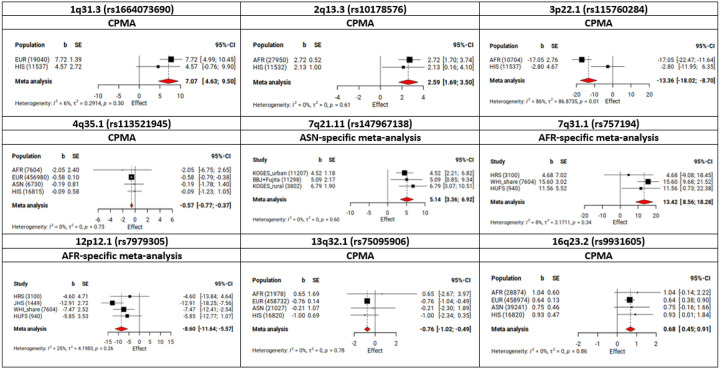
Figure 2. Forest plots of interaction effects at novel and known loci identified in the dDEPR analyses
CPMA, cross-population meta-analyses; AFR, African; ASN, Asian, EUR, European; HIS, Hispanic; b, the interaction effects estimated in the 1df interaction test (Effect is in mmHg); SE, standard error of interaction effects estimated in the 1df interaction test; CI, confidence interval Black squares and error bars represent the effect size and its 95% CI for each population in CPMA or for each study in population-specific meta-analyses. Red diamond represents the overall effect size calculated in the meta-analysis where the center indicates the point estimate and its edges represent 95% CI of the estimate.
Figure 3
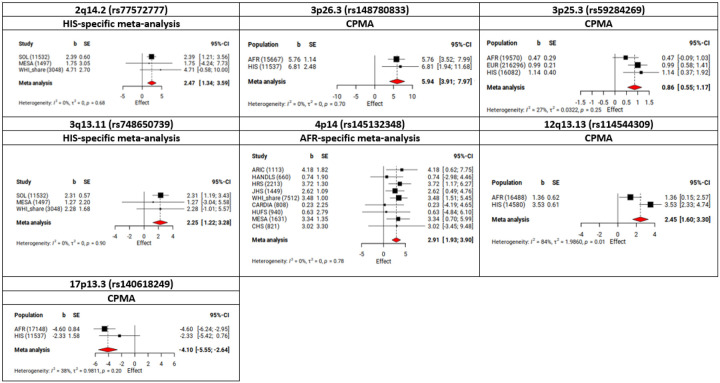
Figure 3. Forest plots of interaction effects at novel and known loci identified in the qDEPR analyses
CPMA, cross-population meta-analyses; AFR, African; ASN, Asian, EUR, European; HIS, Hispanic; b, the interaction effects estimated in the 1df interaction test (Effect is in mmHg); SE, standard error of interaction effects estimated in the 1df interaction test; CI, confidence interval Black squares and error bars represent the effect size and its 95% CI for each population in CPMA or for each study in population-specific meta-analyses. Red diamond represents the overall effect size calculated in the meta-analysis where the center indicates the point estimate and its edges represent 95% CI of the estimate.

References

    1. Lawes CM, Vander Hoorn S, Rodgers A, International Society of H: Global burden of blood-pressure-related disease, 2001. Lancet 2008, 371:1513–1518. - PubMed
    1. Mills KT, Bundy JD, Kelly TN, Reed JE, Kearney PM, Reynolds K, Chen J, He J: Global Disparities of Hypertension Prevalence and Control: A Systematic Analysis of Population-Based Studies From 90 Countries. Circulation 2016, 134:441–450. - PMC - PubMed
    1. Jaeger BC, Chen L, Foti K, Hardy ST, Bress AP, Kane SP, Huang L, Herrick JS, Derington CG, Poudel B, et al.: Hypertension Statistics for US Adults: An Open-Source Web Application for Analysis and Visualization of National Health and Nutrition Examination Survey Data. Hypertension 2023, 80:1311–1320. - PMC - PubMed
    1. Aggarwal R, Chiu N, Wadhera RK, Moran AE, Raber I, Shen C, Yeh RW, Kazi DS: Racial/Ethnic Disparities in Hypertension Prevalence, Awareness, Treatment, and Control in the United States, 2013 to 2018. Hypertension 2021, 78:1719–1726. - PMC - PubMed
    1. Hunter DJ: Gene-environment interactions in human diseases. Nat Rev Genet 2005, 6:287–298. - PubMed

Publication types

LinkOut - more resources