


Geophagia in pregnancy and its association with nutritional status - A prospective cohort study in rural north-eastern Tanzania
- PMID: 40038683
- PMCID: PMC11881378
- DOI: 10.1186/s12966-025-01721-y
Geophagia in pregnancy and its association with nutritional status - A prospective cohort study in rural north-eastern Tanzania
Abstract
Background: Geophagia or soil-eating behavior is common among pregnant women in sub-Saharan Africa, however its relationship with nutritional status demands further investigation. Using a prospective pregnancy cohort from north-eastern Tanzania, we examined the characteristics of geophagia and its association with nutritional status parameters (mid-upper arm circumference (MUAC), vitamin B12, folate, ferritin, and hemoglobin) before conception and throughout the gestational period.
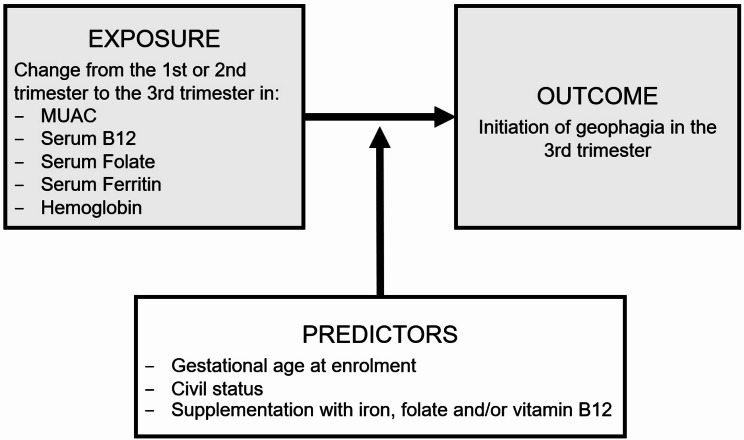
Methods: Pregnant women (n = 530) were interviewed in each trimester regarding their soil-eating habits. Serum concentrations of vitamin B12, folate, ferritin, and hemoglobin, and MUAC were measured before conception and in each trimester. Cross-sectional comparisons between women who ate and did not eat soil were analyzed using Welch's t-test for continuous variables and χ2-test for categorical variables. The association between changes in nutritional status parameters and the initiation of geophagia was investigated using multivariable logistic regression.
Results: The prevalence of geophagia in this cohort was 27% (n = 143) with most women initiating geophagia in the third trimester. Pregnant women that ate soil had significantly lower ferritin (p = 0.001) prior to conception and at concentrations diagnostic of iron deficiency (p = 0.022) compared to women who did not eat soil. Geophagia was associated with lower ferritin (p ≤ 0.001) and lower hemoglobin (p < 0.05) in each trimester and lower folate in the third trimester (p = 0.007). A smaller decline in hemoglobin and folate across the gestational period was associated with reduced odds of initiating geophagia in the third trimester (hemoglobin: OR 0.71, p = 0.008; folate: OR 0.97, p = 0.008). There was no significant association between a change in MUAC, serum B12 or ferritin and the initiation of geophagia during pregnancy.
Conclusions: Prenatal geophagia is closely related to iron and folate status. A greater decrease in hemoglobin and folate is associated with the initiation of geophagia during pregnancy. These findings are particularly relevant to low- and middle-income settings where geophagia is practiced and the prevalence of anemia in pregnancy is high.
Keywords: Anemia; Folate status; Geophagia; Iron status; Mid-upper arm circumference; Pica; Pregnancy; Tanzania; Vitamin B12 status.
© 2025. The Author(s).
Conflict of interest statement
Declarations. Ethics approval and consent to participate: The FOETALforNCD Study received ethical approval from the National Health Research Ethics Committee (NatHREC) of the Tanzania Medical Research Coordinating Committee, which is managed by the National Institute for Medical Research (MRCC) (reference number: NIMR/HQ/R.8a/Vol. IX/1717). Informed consent, written and verbal, was obtained prior to study enrolment and all women were provided medical care and treated according to existing Tanzanian guidelines. All study procedures were performed according to good clinical and laboratory practices and the Declaration of Helsinki. Data sharing procedures met the local National Health Research Ethics Committee (NatHREC) requirements. Consent for publication: Not applicable. Competing interests: The authors declare no competing interests.
Figures



References
-
- Abrahams PW, Parsons JA. Geophagy in the tropics: a literature review. Geographical J. 1996;162(1):63–72. - DOI
-
- Diagnostic. In: Association AP, editor. and Statistical manual of mental disorders. 5 ed. Arlington (VA): American Psychiatric Publishing; 2013.
MeSH terms
Substances
LinkOut - more resources
Full Text Sources
Medical
Research Materials
