


Brazilian guideline for screening and diagnosis of type 2 diabetes: a position statement from the Brazilian Diabetes Society
- PMID: 40038723
- PMCID: PMC11881304
- DOI: 10.1186/s13098-024-01572-w
Brazilian guideline for screening and diagnosis of type 2 diabetes: a position statement from the Brazilian Diabetes Society
Abstract
Background: Patients with type 2 diabetes (T2D) often experience prolonged periods of asymptomatic hyperglycemia, which significantly increases the risk of developing chronic complications related to diabetes. Screening programs for individuals at high risk for T2D provide valuable opportunities not only for early diagnosis but also for detecting intermediate hyperglycemic states, commonly referred to as prediabetes. Interventions aimed at preventing diabetes in this group can successfully delay or even avoid the onset of the disease and its associated burdens. This review is an update of the Brazilian Diabetes Society (Sociedade Brasileira de Diabetes [SBD]) evidence-based guideline for diagnosing diabetes and screening T2D.
Methods: The methodology was previously published and defined by the internal institutional steering committee. The working group drafted the manuscript by selecting vital clinical questions for a narrative review, utilizing MEDLINE via PubMed to identify relevant studies. The review assessed the best available evidence, including randomized clinical trials (RCTs), meta-analyses, and high-quality observational studies related to the diagnosis of diabetes.
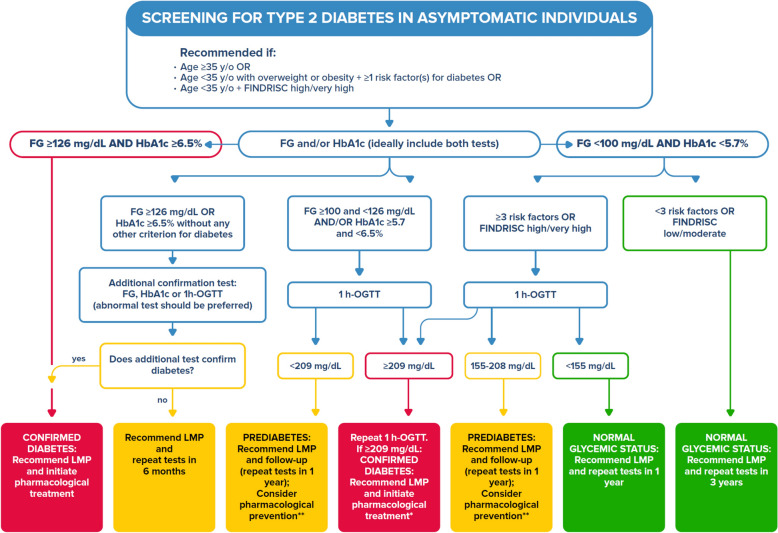
Results and conclusions: Fifteen specific recommendations were formulated. Screening is recommended for adults aged 35 and older or younger individuals with obesity and additional risk factors. For children and adolescents, screening is recommended starting at age ten or the onset of puberty if they are overweight or obese and have additional risk factors. Fasting plasma glucose (FPG) and HbA1c are recommended as initial screening tests. The oral glucose tolerance test (OGTT) is recommended for high-risk individuals with normal HbA1c and FPG or those with prediabetes. The 1-h OGTT is preferred over the 2-h OGTT, as it is both more practical and a superior test. A structured approach to reevaluation intervals is provided.
Keywords: Blood glucose; Diagnosis; Disease prevention; Early diagnosis; Glycated hemoglobin; Oral glucose tolerance test; Practice guidelines: type 2 diabetes mellitus; Prediabetic state.
© 2025. The Author(s).
Conflict of interest statement
Declarations. Ethics approval and consent to participate: Not applicable Consent for publication: Not applicable. Competing interests: MB is Editor-in-Chief of Diabetology & Metabolic Syndrome and BP is Associate Editor of Diabetology & Metabolic Syndrome and have not been involved in managing the peer review for the manuscript. The authors declare no competing interests.
Figures
References
-
- International Diabetes Federation. IDF Diabetes Atlas, 10th ed. Brussels, Belgium: international diabetes federation; 2021. https://diabetesatlas.org/.
-
- Bennett CM, Guo M, Dharmage SC. HbA(1c) as a screening tool for detection of Type 2 diabetes: a systematic review. Diabet Med. 2007;24(4):333–43. - PubMed
-
- Bergman M, Manco M, Satman I, Chan J, Schmidt MI, Sesti G, et al. International diabetes federation position statement on the 1-hour post-load plasma glucose for diagnosing intermediate hyperglycemia and type 2 diabetes. Diab Res Clin Pract. 2024;209: 111589. - PubMed
-
- Jonas DE, Crotty K, Yun JDY, Middleton JC, Feltner C, Taylor-Phillips S, et al. Screening for prediabetes and type 2 diabetes: updated evidence report and systematic review for the US preventive services task force. JAMA. 2021;326(8):744–60. - PubMed
LinkOut - more resources
Full Text Sources
