


Monitoring chalcogenide ions-guided in situ transform active sites of tailored bismuth electrocatalysts for CO2 reduction to formate
- PMID: 40042908
- PMCID: PMC11912470
- DOI: 10.1073/pnas.2420922122
Monitoring chalcogenide ions-guided in situ transform active sites of tailored bismuth electrocatalysts for CO2 reduction to formate
Abstract
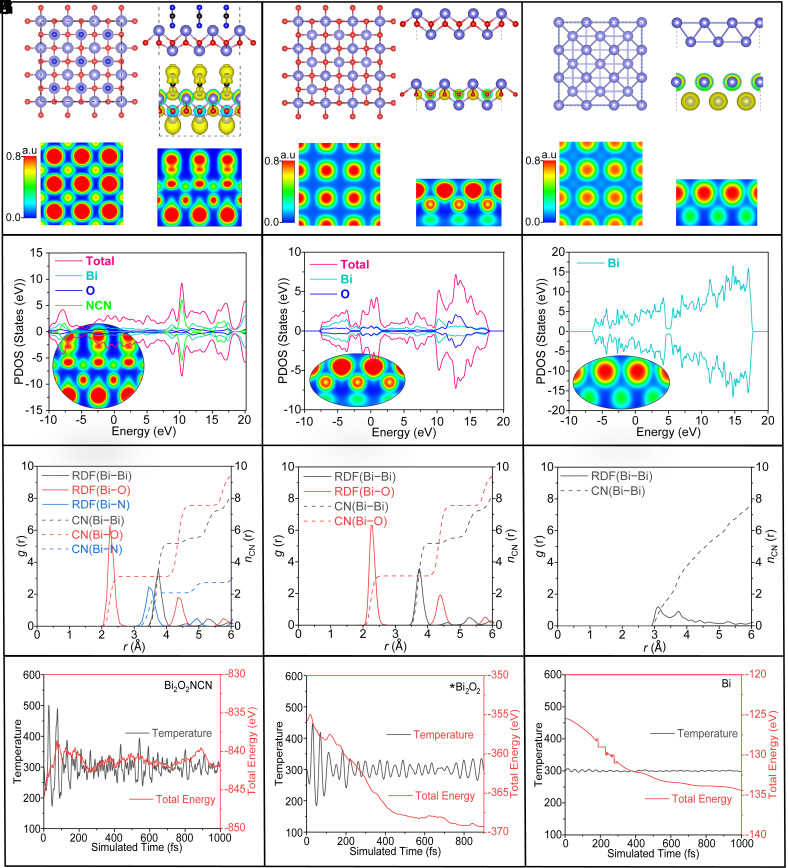
Although bismuth catalysts enable accelerated electrochemical CO2-to-formate conversion, the intrinsic active sites and forming mechanisms under operating conditions remain elusive. Herein, we prepared Bi2O2NCN, Bi2O3, and Bi2O2S as precatalysts. Among them, Bi2O2NCN-derived catalyst possesses optimum performance of electrochemical CO2-to-formate, exhibiting an upsurge of Faradaic efficiency to 98.3% at -0.6 V vs. reversible hydrogen electrodes. In-situ infrared and electrochemical impedance spectra trace and interpret the superior performance. Multimodal structural analyses utilizing quasi-in-situ X-ray diffraction, in-situ X-ray absorption near edge structure and in-situ Raman spectra provide powerful support to monitoring the catalysts' in-situ transforms to metallic Bi, identifying the formation of the active sites influenced by the chalcogenide ions-guided: Carbodiimide promotes to form of the dominant Bi(003) facet exposure, which distinguishes from sulfide- and oxide-preferred dominant Bi(012) facets exposure. Concurrently, theoretical insights garnered from multiscale/multilevel computational analyses harmoniously corroborate the experimental findings. These findings show the pivotal role of chalcogenide in tailoring bismuth electrocatalysts for selective CO2 reduction to formate, illuminating the significance of controlling structural chemistry in designing catalysts toward high-efficiency renewable energy conversion.
Keywords: CO2 reduction to formate; chalcogenide ions-guided; in-situ transform; tailored bismuth electrocatalysts.
Conflict of interest statement
Competing interests statement:The authors declare no competing interest.
Figures


References
-
- De Luna P., et al. , What would it take for renewably powered electrosynthesis to displace petrochemical processes? Science 364, 350 (2019). - PubMed
-
- Varela A. S., The benefits of cycling. Nat. Energy 6, 698–699 (2021).
-
- Duan C., Selective CO2 electrohydrogenation. Nat. Catal. 4, 264–265 (2021).
-
- Lin Z., et al. , Anti-corrosive SnS2/SnO2 heterostructured support for Pt nanoparticles enables remarkable oxygen reduction catalysis via interfacial enhancement. Adv. Funct. Mater. 33, 1–8 (2023).
-
- Peng C., et al. , Ampere-level CO2-to-formate electrosynthesis using highly exposed bismuth(110) facets modified with sulfur-anchored sodium cations. Chem 9, 2830–2840 (2023).
Grants and funding
- 2022YFA1505700/MOST | National Key Research and Development Program of China (NKPs)
- 22205232/MOST | National Natural Science Foundation of China (NSFC)
- 22475214/MOST | National Natural Science Foundation of China (NSFC)
- CASSHB-QNPD-2023-020/Talent plan of Shanghai Branch, Chinese Academy of Sciences
- 2023J06044/Natural Science Foundation of Fujian Province (Fujian Natural Science Foundation)
LinkOut - more resources
Full Text Sources
