. 2025 Apr:81:103575.
doi: 10.1016/j.redox.2025.103575. Epub 2025 Mar 1.

Dietary oxidized lipids in redox biology: Oxidized olive oil disrupts lipid metabolism and induces intestinal and hepatic inflammation in C57BL/6J mice

Affiliations

Dietary oxidized lipids in redox biology: Oxidized olive oil disrupts lipid metabolism and induces intestinal and hepatic inflammation in C57BL/6J mice

Yifan Bao et al. Redox Biol. 2025 Apr.

Abstract

Olive oil, rich in oleic acid, is often regarded as a healthier alternative to animal fats high in saturated fatty acids and plant oils rich in oxidizable polyunsaturated fatty acids. However, the redox biological implications and health effects of oxidized olive oil (ox-OO) remain underexplored. Our study investigated its impact on lipid metabolism, intestinal and hepatic inflammation, and gut microbiota. Female C57BL/6J mice were fed either a standard normal (NFD), high-fat diet (HFD), an NFD-ox-OO or HFD-ox-OO, in which ox-OO (180 °C heating, 10 min) was the sole lipid source. Inflammation was assessed using macrophage marker F4/80 immunohistochemical (IHC) staining. Gene expression of inflammatory and lipid metabolism markers (IL-10, NF-kBp65, IL-1β, TNFα, TLR4, COX2, PPARα, PPARγ, CPT1a, SCAD, MCAD, LCAD) was analyzed by qRT-PCR. Soluble epoxide hydrolase (sEH) protein expression was measured using IHC. Oxylipin and carnitine profiles were determined by LC-MS/MS. Gut microbiota was analyzed by 16S rRNA sequencing. Ox-OO disrupted redox homeostasis, leading to lipid metabolic dysfunction in the intestines and liver. In the duodenum and proximal jejunum, ox-OO decreased the levels of anti-inflammatory oxylipins and increased pro-inflammatory mediators, leading to inflammation. In the ileum and colon, ox-OO caused lipid metabolic dysregulation and inflammation. Colon inflammation was linked to inhibited mitochondrial β-oxidation and decreased short-chain fatty acid-producing microbiomes. Notably, redox imbalances were further implicated by the identification of 9,10-epoxy-stearic acid, a novel inflammatory lipid mediator oxidized from dietary oleic acid, which upregulated sEH. Ox-OO affects lipid metabolism and may contribute to inflammation in the gut and liver, raising questions about the assumption that olive oil is always beneficial and suggesting possible risks linked to oxidized oleic acid.

Keywords: 9,10-Epoxy-stearic acid; Gut microbiota; Inflammation; Lipid metabolic dysfunction; Oxidized olive oil.


Conflict of interest statement

Declaration of competing interest The authors declare no competing interests.

Figures

Image 1
Graphical abstract
Fig. 1
Fig. 1
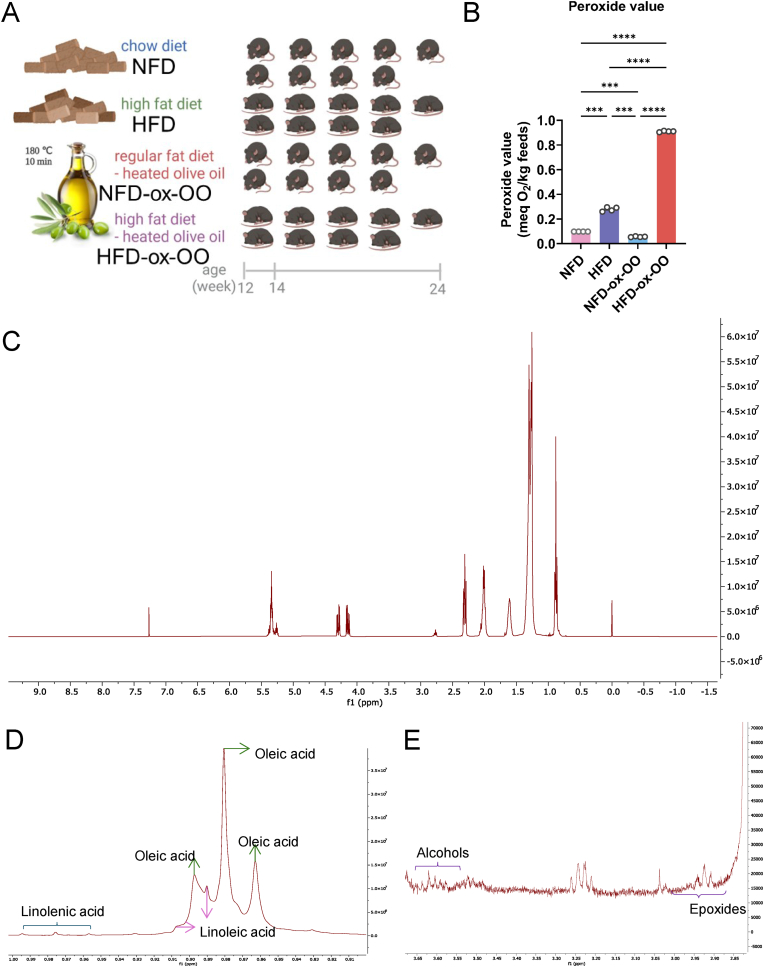
Lipid oxidation in experimental diets. (A) Experimental design for the animal study. (B) Peroxide values of diets. (C) 1H NMR spectra of lipid extracts from HFD-ox-OO. (D) Identification of unsaturated fatty acids based on 1H NMR chemical shifts of the –CH3 group. (E) 1H NMR spectral signals corresponding to epoxides and alcohols. Data are presented as mean or mean ± SEM. Statistical significance was determined by ANOVA followed by Tukey's post hoc test. ∗p < 0.05, ∗∗p < 0.01, ∗∗∗p < 0.001, ∗∗∗∗p < 0.0001.
Fig. 2
Fig. 2
Histological and morphological effects of oxidized olive oil on the intestines. (A) Photographs of the gastrointestinal tract of mice. Representative H&E-stained sections and histological scores of (B) duodenum, (C) proximal jejunum, distal jejunum, (E) ileum, (F) cecum, and (H) colon.
Fig. 3
Fig. 3
Effects of oxidized olive oil on the inflammatory responses in the intestines. (A) Representative tissue sections showing F4/80 immunostaining in intestines. (B) Quantification of the area% of F4/80 in mucosa, submucosa, and muscles in the intestinal sections. (C) Gene expression levels of IL-10, TNF-α, IL-1β, NF-kB p65, TLR4 and PPARγ in the intestines. Data are presented as mean.
Fig. 4
Fig. 4
Effects of oxidized olive oil on intestinal lipid oxygenation. (A) Oxylipin concentrations in intestines. (B) 9,10-epoxysteric acid in cecum. (C) Representative tissue sections showing sEH immunostaining in intestines. (D) Quantification of the area% of sEH in mucosa, submucosa, and muscles in the intestinal sections. (E) Area% of sEH in duodenum, ileum, cecum and colon. Data are presented as mean or mean ± SEM. Statistical significance was determined by ANOVA followed by Tukey's post hoc test. ∗p < 0.05, ∗∗p < 0.01.
Fig. 5
Fig. 5
Effects of oxidized olive oil on mitochondrial β-oxidation in intestine. (A) sPLS-DA plot showing the distribution of carnitines in distal jejunum. (B) Statistical differences in carnitine concentrations in distal jejunum among different diets. (C) Concentrations of total acylcarnitines, free carnitine, acetylcarnitine, short chain acylcarnitines, medium chain acylcarnitines, long chain acylcarnitines, saturated acylcarnitines in distal jejunum. (D) Profile of carnitines in distal jejunum. (E) Relative gene expression of PPARα in distal jejunum. (F) sPLS-DA plot showing the distribution of carnitines in colon. (G) Statistical differences in carnitine concentrations in colon among different diets. (H) Concentrations of total acylcarnitines, free carnitine, acetylcarnitine, short chain acylcarnitines, medium chain acylcarnitines, long chain acylcarnitines, saturated acylcarnitines in colon. (I) Profile of carnitines in colon. Data are presented as mean or mean ± SEM. Statistical significance was determined by ANOVA followed by Tukey's post hoc test, ∗p < 0.05, ∗∗p < 0.01, ∗∗∗p < 0.001, ∗∗∗∗p < 0.0001.
Fig. 6
Fig. 6
Effects of oxidized olive oil on gut microbiota composition. (A) beta dispersion ANOVA analysis. (B) The composition of colonic microbiota at genius level. (C) Comparison of log2 fold changes in the relative abundance of colonic microbiota between groups.
Fig. 7
Fig. 7
The effects of ox-OO on inflammatory response and lipid metabolism in liver. (A) Liver to body weight ratio. (B) Representative H&E stained liver section. (C) Expression of F4/80 in liver. (D) Relative gene expression of PPARα and COX2 in the liver. (E) Oxylipin profile in liver. (F) sPLS-DA plot showing the distribution of hepatic oxylipins. (G) Statistical differences in hepatic oxylipin concentrations among different diets. (H) 9,10-epoxystearic in the liver (I) Expression of sEH in liver. Data are presented as mean or mean ± SEM. Statistical significance was determined by ANOVA followed by Tukey's post hoc test, ∗p < 0.05, ∗∗p < 0.01, ∗∗∗p < 0.001, ∗∗∗∗p < 0.0001.
Fig. 8
Fig. 8
Proposed mechanisms of ox-OO inducing inflammation and lipid metabolic dysfunction.

References

    1. Zhou H., Urso C.J., Jadeja V. Saturated fatty acids in obesity-associated inflammation. J. Inflamm. Res. 2020;13:1–14. doi: 10.2147/jir.S229691. - DOI - PMC - PubMed
    1. Billek G. Health aspects of thermoxidized oils and fats. European Journal of Lipid Science and Technology - EUR J LIPID SCI TECHNOL. 2000;102:587–593. doi: 10.1002/1438-9312(200009)102:8/93.3.CO;2-R. - DOI
    1. Dyall S.C., Balas L., Bazan N.G., Brenna J.T., Chiang N., da Costa Souza F., Dalli J., Durand T., Galano J.M., Lein P.J., Serhan C.N., Taha A.Y. Polyunsaturated fatty acids and fatty acid-derived lipid mediators: recent advances in the understanding of their biosynthesis, structures, and functions. Prog. Lipid Res. 2022;86 doi: 10.1016/j.plipres.2022.101165. - DOI - PMC - PubMed
    1. Wang W., Wang Y., Sanidad K., Zhang J., Yang H., Johnson D., Sherman H., Kim D., Minter L., Decker E., Zhang G. Oxidized linoleic acid interacts with gut microbiota to promote colitis and colorectal cancer. Research Square. 2021
    1. Sottero B., Rossin D., Poli G., Biasi F. Lipid oxidation products in the pathogenesis of inflammation-related gut diseases. Curr. Med. Chem. 2018;25:1311–1326. doi: 10.2174/0929867324666170619104105. - DOI - PubMed

LinkOut - more resources