


Evaluation of Software-Optimized Protocols for Acoustic Noise Reduction During Brain MRI at 7 Tesla
- PMID: 40048635
- PMCID: PMC12276638
- DOI: 10.1002/jmri.29749
Evaluation of Software-Optimized Protocols for Acoustic Noise Reduction During Brain MRI at 7 Tesla
Abstract
Background: MR-generated acoustic noise may be particularly concerning at 7-Tesla (T) systems. Noise levels can be reduced by altering gradient output using software optimization. However, such alterations might influence image quality or prolong scan times, and these optimizations have not been well characterized.
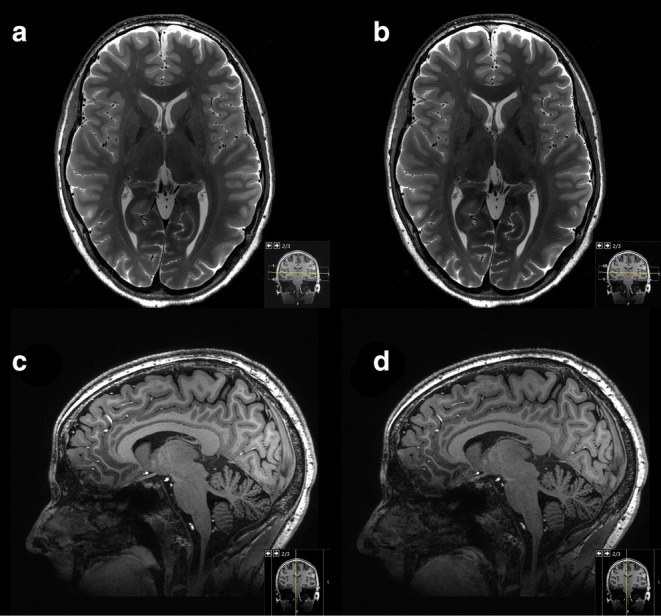
Purpose: To evaluate image quality, sound pressure levels (SPLs), and perceived noise levels when using the acoustic noise reduction technique SofTone for T2-weighted fast spin echo (T2W FSE) and three-dimensional T1-weighted turbo field echo (3D T1W TFE), and to compare with conventional imaging during 7-T brain MRI.
Study type: Prospective.
Subjects: Twenty-eight volunteers underwent brain MRI, with n = 26 for image quality evaluations.
Field strength/sequence: Conventional and SofTone versions of T2W FSE and 3D T1W TFE at 7 T.
Assessment: Peak SPLs (A-weighted decibels, dBA), participant-perceived noise levels (Borg CR10-scale), qualitative image assessments by three neuroradiologists (four-graded ordinal scales), interrater reliability, and percentage agreement.
Statistical test: Paired t-test, Wilcoxon's Signed-Rank Test, and Krippendorff's alpha; p < 0.05 were considered statistically significant.
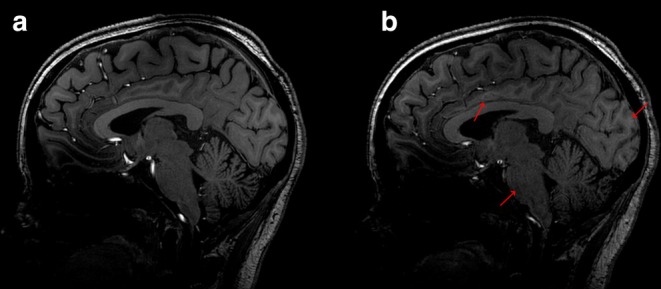
Results: SofTone significantly reduced peak SPLs: from 116.3 to 97.0 dBA on T2W FSE, and from 123.7 to 101.5 dBA on 3D T1W TFE. SofTone was perceived as significantly quieter than conventional scanning. T2W FSE showed no significant differences in image quality assessments (p = 0.21-1.00), except one radiologist noting significantly less artifact interference with SofTone. General image quality remained acceptable for 3D T1W TFE, though one radiologist scored it significantly lower with SofTone (mean scores: 3.08 vs. 3.65), and two radiologists observed significantly worse white and gray matter differentiation with SofTone (mean scores: 3.19 vs. 3.54; 2.27 vs. 2.81).
Data conclusion: SofTone can significantly reduce sound intensity and perceived noise levels while maintaining acceptable image quality with T2W FSE and 3D T1W TFE in brain MRI. It appears to be an effective tool for providing a safer, quieter 7-T scan environment.
Evidence level: 4 Technical Efficacy: Stage 5.
Keywords: MR safety; hearing protection; software optimization; ultra‐high field MRI.
© 2025 The Author(s). Journal of Magnetic Resonance Imaging published by Wiley Periodicals LLC on behalf of International Society for Magnetic Resonance in Medicine.
Figures

References
-
- Panych L. P. and Madore B., “The Physics of MRI Safety,” Journal of Magnetic Resonance Imaging 47, no. 1 (2018): 28–43. - PubMed
-
- Price D. L., De Wilde J. P., Papadaki A. M., Curran J. S., and Kitney R. I., “Investigation of Acoustic Noise on 15 MRI Scanners From 0.2 T to 3 T,” Journal of Magnetic Resonance Imaging 13, no. 2 (2001): 288–293. - PubMed
-
- Jin C., Li H., Li X., et al., “Temporary Hearing Threshold Shift in Healthy Volunteers With Hearing Protection Caused by Acoustic Noise Exposure During 3‐T Multisequence MR Neuroimaging,” Radiology 286, no. 2 (2018): 602–608. - PubMed
-
- Quirk M. E., Letendre A. J., Ciottone R. A., and Lingley J. F., “Anxiety in Patients Undergoing MR Imaging,” Radiology 170, no. 2 (1989): 463–466. - PubMed
MeSH terms
Grants and funding
LinkOut - more resources
Full Text Sources
Medical
