. 2025 Mar 6;15(1):7842.
doi: 10.1038/s41598-025-92011-x.

Evolution of the Swiss pork production systems and logistics: the impact on infectious disease resilience

Affiliations

Evolution of the Swiss pork production systems and logistics: the impact on infectious disease resilience

Francesco Galli et al. Sci Rep. .

Abstract

Livestock production systems are complex and evolve over time, affecting their adaptability to economic, political, and disease-related changes. In Europe, disease resilience is crucial due to threats like the African swine fever virus, which jeopardizes pork production stability. The European Union identifies farm production type as a key risk factor for disease spread, making it important to track changes in farm production types to assess disease risk. However, detailed production type data is often lacking in national databases. For Swiss pig farms, we used prediction and clustering algorithms to classify 9'687 - 11'247 trading farms between 2014 and 2019 by one of eleven production types. We then analyzed the pig trade network and stratified farm centrality measures (ICC and OCC) by production type. We found that 145 farms belonging to three production types have substantially higher ICC and OCC than other farms, suggesting that they could be the target of disease surveillance programs. Our predictions until 2025 show an increase both in overall pig trade network connectivity and in proportion of production types with high ICC and OCC, indicating that the structural changes in the Swiss pig production system may increase infectious disease exposure over time.

Keywords: Disease resilience; Disease surveillance; Livestock production systems; Swine infectious diseases; System evolution.


Conflict of interest statement

Declarations. Competing interests: The authors declare no competing interests.

Figures
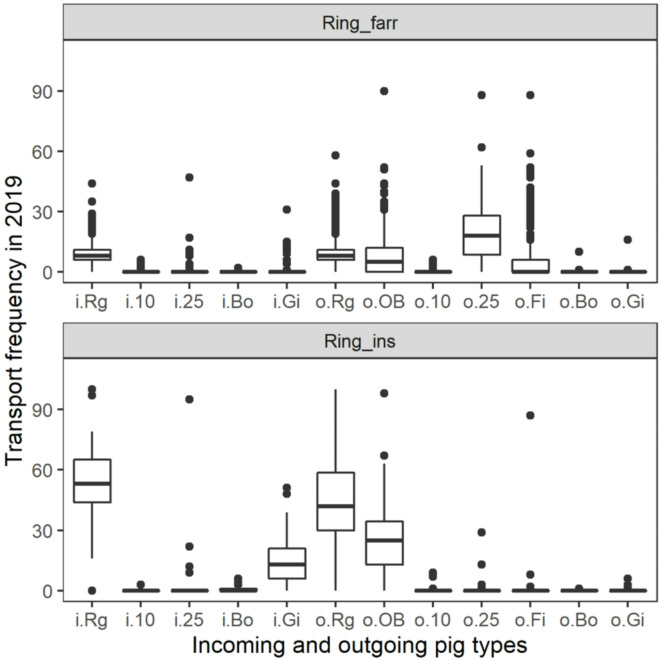
Fig. 1
Fig. 1
Two examples of cluster “fingerprints” for the clusters Ring_farr and Ring_ins, obtained by plotting boxplots of incoming and outgoing frequency of transport movements by pig type in 2019. Movement categories: “i.” = incoming, “o.” = outgoing, “Rg” = sows in a segmented piglet production ring, “10” = 10-kilogram piglets, “25” = 25-kilogram piglets, “Bo” = boars, “Gi” = gilts, “OB” = old breeding pigs, “Fi” = finisher pigs.
Fig. 2
Fig. 2
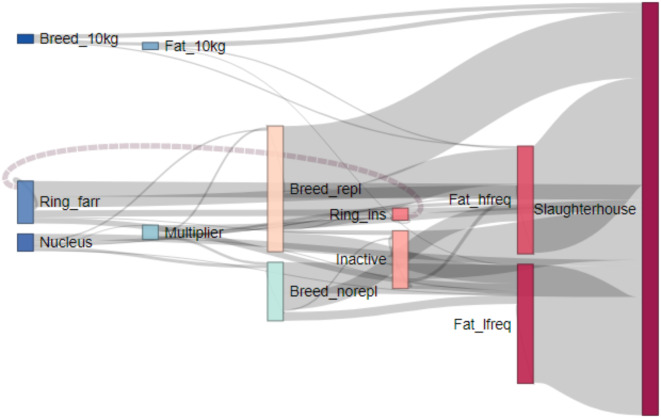
Alluvial plot displaying pig transport movements flows in 2019 between and within pig production types, as well as to slaughterhouses. For visualization purposes, movement flows of less than 250 between production types were excluded. Nucleus farms do not have any incoming transport movements and mainly send out gilts to either multiplier herds or breeding farms. Multiplier farms receive gilts from nucleus herds, multiply them and send the produced gilts to breeding farms. Breeding farms are Breed_repl and Breed_norepl. Breed_repl farms have fewer incoming transport movements than Breed_norepl farms, as Breed_repl farms do gilt replacement on-farm instead of receiving new gilts from other farms. Breeding farms typically send piglets to fattening farms once they weigh 25 kg. Instead, Breed_10kg already ship piglets out when they reach a weight of ten kilograms, to Fat_10kg farms which cover this intermediate fattening step. Fat_10kg farms then either send 25-kilogram piglets to standard fattening farms (Fat_lfreq and Fat_hfreq) or they fatten piglets until they reach slaughter weight and send them directly to slaughter. Ring_farr farms send their sows to Ring_ins farm, where insemination takes place. The sows then return to Ring_farr farms where they give birth and wean the piglets. In the figure, this back flow from Ring_ins to Ring_farr farms is represented by a dashed line. The piglets weaned in Ring_farr are then shipped to fattening farms. Fat_hfreq and Fat_lfreq farms both fatten pigs and ship them on a high and low frequency, respectively, to slaughterhouses when finished. While Fat_hfreq farms have almost the same amount of incoming and outgoing pigs, Fat_lfreq farms have fewer numbers of incoming pigs than outgoing pigs. This indicates that they also perform some on-site breeding. The Inactive cluster is constituted by farms only trading very few pigs within a year.
Fig. 3
Fig. 3
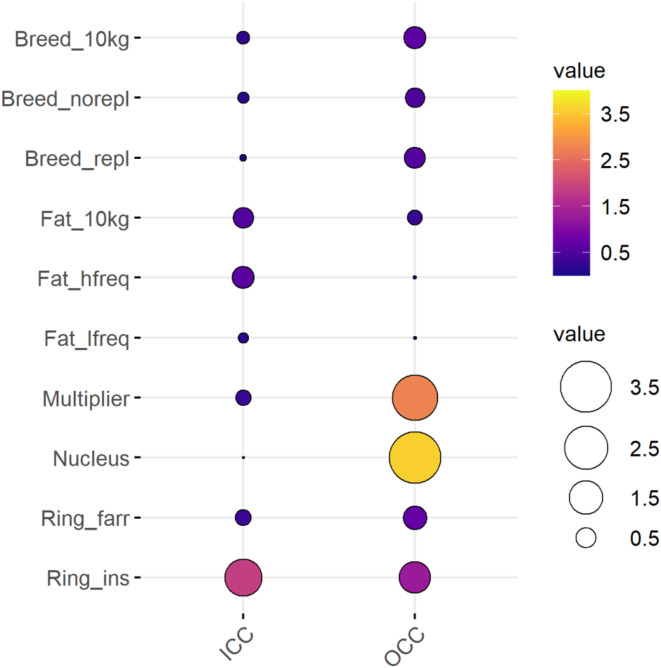
Balloon plot showing average weekly ICC and OCC values in 2019, stratified by production type. Circle size is a continuous representation of ICC and OCC values, while the color scale is a discrete representation for values 0.0 < 0.5, 0.5 < 1.5, 1.5 < 2.5, 2.5 < 3.5 and higher than 3.5.
Fig. 4
Fig. 4
Stacked bar plot showing the proportion of farms in each production type compared to the total number of farms in a year, for the period 2014–2025. Each production type is identified by a color code shown in the legend. Predicted values for the period 2020–2025 are indicated by bars with lower color opacity.
Fig. 5
Fig. 5
Time trends relative to the Swiss pig production system for the period 2014–2025. From top left to bottom right: number of farms; number of slaughtered pigs in millions; ratio of number of slaughters vs. number of farms; average weekly ICC and OCC. For the 2020–2025 predicted values, 95% confidence intervals are shown with caps for bar plots and with grey areas for line plots.

References

    1. Bellini, S. 7. The pig sector in the European Union. Understanding and combatting African Swine Fever 183–195 (2021). 10.3920/978-90-8686-910-7_7
    1. VanderWaal, K. & Deen, J. Global trends in infectious diseases of swine. Proc. Natl. Acad. Sci. U S A. 115, 11495–11500 (2018). - PMC - PubMed
    1. Relun, A. et al. Spatial and functional organization of pig trade in different European production systems: implications for disease prevention and control. Front. Vet. Sci.3, (2016). - PMC - PubMed
    1. Ståhl, K. et al. Epidemiological analysis of African swine fever in the European union during 2022. EFSA J.21, (2023). - PMC - PubMed
    1. Swiss Federal Statistics Office. Indicateurs de l’agriculture en comparaison internationale. (2024). https://www.bfs.admin.ch/bfs/fr/home/statistiques/catalogues-banques-don...