. 2025 Feb 18;18(3):sfaf009.
doi: 10.1093/ckj/sfaf009. eCollection 2025 Mar.

CD163 detection in immune check-point inhibitors-related acute interstitial nephritis

Affiliations

CD163 detection in immune check-point inhibitors-related acute interstitial nephritis

Thomas Perier et al. Clin Kidney J. .

Abstract

Background: Acute interstitial nephritis (AIN) is the most common renal immune-related adverse event after immune check-point inhibitors (ICI). We hypothesized that alternatively activated macrophages (CD163-M) could be involved in ICI-AIN and wished to evaluate the use of their soluble urinary form (us)CD163 as a non-invasive diagnostic marker.

Methods: CD163-M infiltrates were evaluated by both immune-histochemistry and multiplex immunofluorescence and imaging. usCD163 was detected with ELLA technology and evaluated together with urinary creatinine to be expressed as a ratio to creatinuria in ng/mmol. Clinical data were collected to perform correlations with renal function assessed by estimated glomerular filtration rate (eGFR).

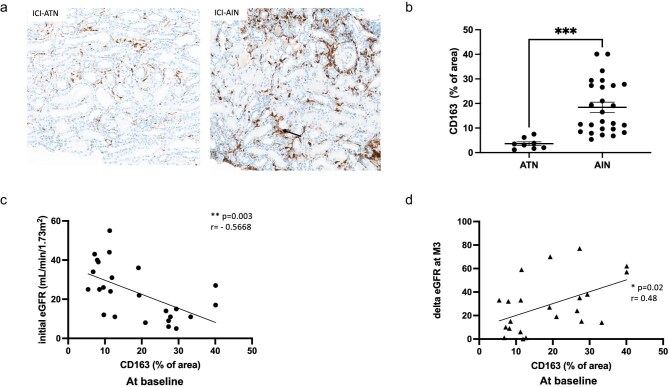
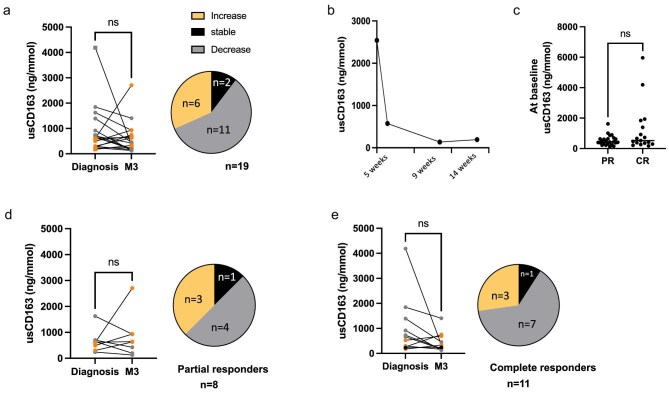
Results: A retrospective cohort of 63 ICI-exposed patients with tubular acute kidney injury profile requiring a biopsy were selected. AIN patients (n = 44) were compared to acute tubular necrosis (ATN) patients (n = 19). CD163-M staining was detectable in all ICI-AIN patients, which was significantly higher than in ATN patients (18.4% vs 3.6% of area, P = .005). CD163-M staining was restricted to the interstitial compartment. CD163-M infiltrate inversely correlated with initial eGFR (r = -0.6, P = .003), and was positively correlated with delta eGFR, reflecting a renal improvement outcome (r = 0.48; P = .02). usCD163 was well detected in urines of patients, but did not allow us to distinguish ATN from AIN patients at diagnosis. No correlation was observed, neither between usCD163 and CD163-M staining nor with renal response after 3 months of glucocorticoid tapering.

Conclusion: CD163-M are detected in ICI-AIN and correlate both with severity at diagnosis and better prognosis at 3 months. CD163-M may help us to distinguish AIN from ATN but, it does not allow us to assess ICI imputability. Although detected in urine, usCD163 is clearly not a surrogate biomarker for AIN diagnosis.

Keywords: CD163; alternatively activated macrophage; immune check-point inhibitors acute interstitial nephritis ICI-AIN; urinary soluble usCD163.


Conflict of interest statement

Dr Belliere Julie : Employer: Centre hospitalier universitaire de Toulouse; Symposia: Astellas, Sandoz, CSL-Vifor, Sanofi, Congrès Colloques Convention, AstraZeneca.

Figures
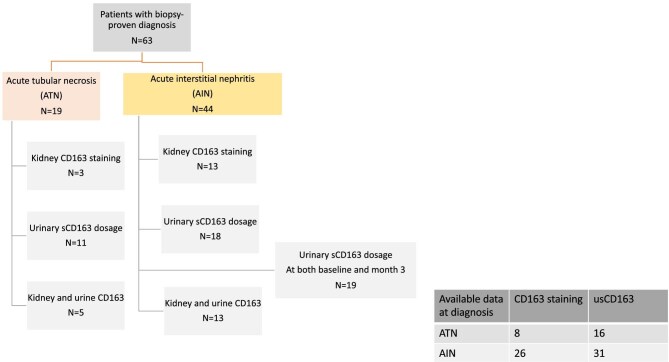
Figure 1:
Figure 1:
Flowchart of the study.
Figure 2:
Figure 2:
CD163-(M) macrophages in ICI-AIN kidney biopsies. CD163 immunohistochemistry detection in kidney biopsies. (a) A representative example is depicted for both ATN and AIN patients, in the left and right panels, respectively. (b) CD163 staining, expressed in percentage of area in each group (n = 8 for ATN and n = 26 for ICI-AIN) P = .0005. (c) CD163 infiltration was associated with severity of ICI-AIN at diagnosis (a high CD163-M staining was found to be associated with a low eGFR, n = 25, **P = .003). (d) CD163-M infiltration at ICI-AIN diagnosis was associated with a favourable delta eGFR at 3 months (delta = eGFR at 3 months; eGFR at AIN diagnosis), n = 22, *P = .02.
Figure 3:
Figure 3:
usCD163 detection in patients with ICI-AIN. (a) Albuminuria/urinary creatinine (A/C) ratio, expressed in mg/g. Threshold at 300 mg/g is indicated with horizontal line. (b) Proteinuria/urinary creatinine (P/C) ratio, expressed in mg/g. (c) usCD163 correlation with CD163 staining. (d, e, f) usCD163 correlation with degree or fibrosis and severity of AKI (initial eGFR).
Figure 4:
Figure 4:
UsCD163 kinetic across AIN evolution in patients with available samples and renal response after 3 months (M3) of glucocorticoids (n = 19). (a) Individual values are plotted at diagnosis and M3. The proportion of patients with stable, increase, or decrease values is represented in a pie chart. (b) An illustrative example is depicted for a patient with longitudinal usCD163 monitoring and complete renal response. (c) UsCD163 values are depicted at diagnosis, in patients with PR compared to CR. (d) Patients in PR only (n = 8). Individual values are plotted at diagnosis and M3. Proportion of patients with stable, increase, or decrease values is represented in pie chart. (e) Patients in CR only (n = 11). Individual values are plotted at diagnosis and M3. The proportion of patients with stable, increase, or decrease values is represented in a pie chart.

References

    1. Singh S, Long JP, Tchakarov A et al. Tertiary lymphoid structure signatures are associated with immune checkpoint inhibitor related acute interstitial nephritis. JCI Insight 2022;0–39. 10.1172/jci.insight.165108 - DOI - PubMed
    1. Pfenning MB, Schmitz J, Scheffner I et al. High macrophage densities in native kidney biopsies correlate with renal dysfunction and promote ESRD. Kidney Int Rep 2023;8:341–56. 10.1016/j.ekir.2022.11.015 - DOI - PMC - PubMed
    1. Tabei A, Watanabe M, Ikeuchi H et al. The analysis of renal infiltrating cells in acute tubulointerstitial nephritis induced by anti-PD-1 antibodies: a case report and review of the literature. Intern Med 2018;57:3135–9. 10.2169/internalmedicine.0444-17 - DOI - PMC - PubMed
    1. Tominaga K, Takeuchi K, Takakuma S et al. Immune checkpoint inhibitors associated granulomatous small vessel vasculitis accompanied with tubulointerstitial nephritis: a case report. BMC Nephrol 2023;24:48. 10.1186/s12882-023-03091-8 - DOI - PMC - PubMed
    1. Okawa S, Fujiwara K, Shimonishi A et al. Rapidly progressive acute kidney injury associated with Nivolumab treatment. Case Rep Oncol 2020;13:85–90. 10.1159/000505235 - DOI - PMC - PubMed