


Metformin therapy modifies corneal neuroimmune abnormalities in people with type 2 diabetes
- PMID: 40053106
- PMCID: PMC12069440
- DOI: 10.1007/s00125-025-06399-2
Metformin therapy modifies corneal neuroimmune abnormalities in people with type 2 diabetes
Abstract
Aims/hypothesis: Diabetic peripheral neuropathy is a debilitating microvascular complication of diabetes mellitus, with limited disease-modifying therapies to date. This study aimed to assess the effect of metformin on the corneal sub-basal nerve plexus as a peripheral neuropathy outcome measure in people with type 2 diabetes.
Methods: A cohort of 36 participants with type 2 diabetes receiving metformin therapy were recruited and underwent clinical assessment, corneal confocal microscopy and nerve conduction studies. Concurrently, 36 participants with type 2 diabetes not receiving metformin therapy were selected as disease controls and matched to participants on metformin therapy for age, sex, diabetes duration, BMI, eGFR, HbA1c, use of other oral glucose-lowering agents and therapies used for the treatment of the metabolic syndrome. Additionally, 25 healthy control participants were assessed and matched for age and sex. Medical record data over the previous 20 years were analysed for prior and current metformin use in all participants with type 2 diabetes.
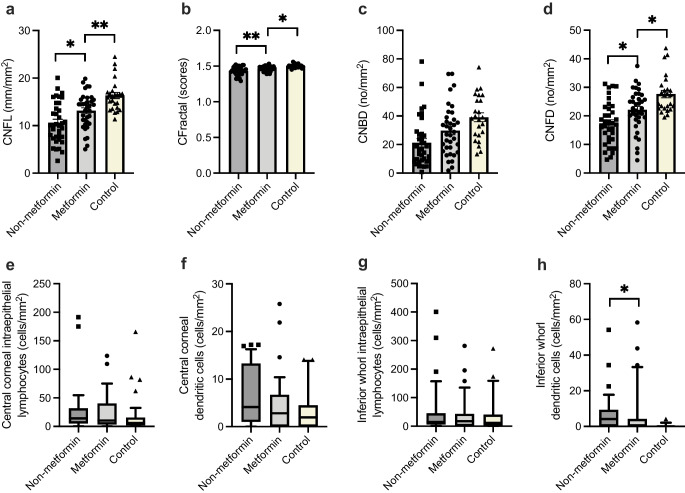
Results: Participants receiving metformin therapy had higher corneal nerve fibre density (p=0.020), corneal nerve fibre length (p=0.020) and corneal fractal dimension (p=0.003) compared with those not receiving metformin therapy. The inferior whorl dendritic cell density was significantly lower in the metformin group compared with the non-metformin group (p=0.043).
Conclusions/interpretation: Metformin treatment is associated with superior corneal nerve parameters and neuroimmune tone in the corneal sub-basal nerve plexus. This study provides further evidence that metformin may be neuroprotective in diabetic peripheral neuropathy.
Keywords: Corneal nerve injury; Diabetic peripheral neuropathy; In vivo corneal confocal microscopy; Metformin.
© 2025. The Author(s).
Conflict of interest statement
Acknowledgements: The authors gratefully acknowledge the team at the Prince of Wales Diabetes Centre for their support in participant recruitment. We would like to thank D. Cornblath and Johns Hopkins University for providing the Total Neuropathy Score to A. Krishnan. Data availability: The data that support the findings of this study are not publicly available due to institutional ethics review board restrictions (Human Research Ethics Committee of the South Eastern Sydney Local Health District HREC Ref. 14/012). Funding: Open Access funding enabled and organized by CAUL and its Member Institutions. This research received no specific grant from any funding agency in the public, commercial or not-for-profit sectors. Authors’ relationships and activities: The authors declare that there are no relationships or activities that might bias, or be perceived to bias, their work. Contribution statement: ATT was involved in recruitment, data collection, data interpretation and manuscript composition. JS was involved in data collection and data analysis. SST was involved in data collection. TI was involved in data interpretation. AMP and K-LM were the treating clinicians of recruited participants and were involved in patient recruitment and data collection. MM, RD and AVK supervised data collection, data interpretation and data analysis. AVK was involved in study design, data interpretation, manuscript composition and is the guarantor of this work. As such AVK had full access to all the data in the study and takes responsibility for the integrity of the data and the accuracy of the data analysis. All authors contributed to the drafting of the article or critically reviewed it for important intellectual content. All authors approved the final version of the manuscript.
Figures
References
-
- Vagenas D, Pritchard N, Edwards K et al (2012) Optimal image sample size for corneal nerve morphometry. Optom Vis Sci 89(5):812–817. 10.1097/OPX.0b013e31824ee8c9 - PubMed
MeSH terms
Substances
LinkOut - more resources
Full Text Sources
Medical
Research Materials
Miscellaneous
