


The Application of Preventive Medicine in the Future Digital Health Era
- PMID: 40053712
- PMCID: PMC11907169
- DOI: 10.2196/59165
The Application of Preventive Medicine in the Future Digital Health Era
Abstract
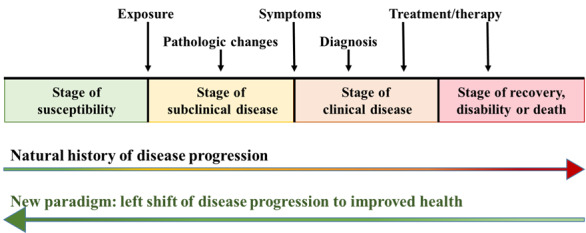
A number of seismic shifts are expected to reshape the future of medicine. The global population is rapidly aging, significantly impacting the global disease burden. Medicine is undergoing a paradigm shift, defining and diagnosing diseases at earlier stages and shifting the health care focus from treating diseases to preventing them. The application and purview of digital medicine are expected to broaden significantly. Furthermore, the COVID-19 pandemic has further accelerated the shift toward predictive, preventive, personalized, and participatory (P4) medicine, and has identified health care accessibility, affordability, and patient empowerment as core values in the future digital health era. This "left shift" toward preventive care is anticipated to redefine health care, emphasizing health promotion over disease treatment. In the future, the traditional triad of preventive medicine-primary, secondary, and tertiary prevention-will be realized with technologies such as genomics, artificial intelligence, bioengineering and wearable devices, and telemedicine. Breast cancer and diabetes serve as case studies to demonstrate how these technologies such as personalized risk assessment, artificial intelligence-assisted and app-based technologies, have been developed and commercialized to provide personalized preventive care, identifying those at a higher risk and providing instructions and interventions for healthier lifestyles and improved quality of life. Overall, preventive medicine and the use of advanced technology will hold great potential for improving health care outcomes in the future.
Keywords: artificial intelligence; digital health; digital health technology; personalized prevention; preventive medicine; telemedicine; wearable devices.
©Katherine De la Torre, Sukhong Min, Hyobin Lee, Daehee Kang. Originally published in the Journal of Medical Internet Research (https://www.jmir.org), 27.02.2025.
Conflict of interest statement
Conflicts of Interest: None declared.
Figures
References
-
- Ageing and health. World Health Organization. 2024. [2024-03-21]. https://www.who.int/news-room/fact-sheets/detail/ageing-and-health .
-
- GBD compare data visualization. Institute for Health Metrics and Evaluation. 2024. [2024-03-21]. http://vizhub.healthdata.org/gbd-compare .
-
- Ansah JP, Chiu CT. Projecting the chronic disease burden among the adult population in the United States using a multi-state population model. Front Public Health. 2022;10:1082183. doi: 10.3389/fpubh.2022.1082183. https://europepmc.org/abstract/MED/36711415 - DOI - PMC - PubMed
-
- Health spending. Organization for Economic Cooperation and Development. 2022. [2024-03-21]. https://data.oecd.org/healthres/health-spending.htm .
-
- Chen J, Zhao M, Zhou R, Ou W, Yao P. How heavy is the medical expense burden among the older adults and what are the contributing factors? A literature review and problem-based analysis. Front Public Health. 2023;11:1165381. doi: 10.3389/fpubh.2023.1165381. https://europepmc.org/abstract/MED/37397714 - DOI - PMC - PubMed
Publication types
MeSH terms
LinkOut - more resources
Full Text Sources
Medical
