Review
. 2025 Apr 11;28(4):pyaf015.
doi: 10.1093/ijnp/pyaf015.

From theory to therapy: unlocking the potential of muscarinic receptor activation in schizophrenia with the dual M1/M4 muscarinic receptor agonist xanomeline and trospium chloride and insights from clinical trials

Affiliations
Review

From theory to therapy: unlocking the potential of muscarinic receptor activation in schizophrenia with the dual M1/M4 muscarinic receptor agonist xanomeline and trospium chloride and insights from clinical trials

Jonathan M Meyer et al. Int J Neuropsychopharmacol. .

Erratum in

Abstract

Since the 1950s, understanding of antipsychotic activity in schizophrenia has been largely grounded in the dopamine (DA) hypothesis. Most antipsychotics approved for schizophrenia interact with D2 DA receptors as an important part of their mechanism of action. While antipsychotics blocking D2 DA receptors can be effective for positive symptoms of schizophrenia, none are approved by regulatory authorities for predominant negative or cognitive symptoms. Moreover, many of these agents induce a range of problematic side effects related to D2 DA receptor blockade (eg, drug-induced parkinsonism, akathisia, tardive dyskinesia, hyperprolactinemia and related sexual side effects, sedation). This has prompted the search for novel mechanisms with improved efficacy and tolerability based on evidence supporting involvement of other neurotransmitter systems in schizophrenia pathophysiology, including acetylcholine, gamma-aminobutyric acid, and glutamate. Among these options, targeting muscarinic receptors emerged as a promising treatment strategy. In September 2024, the U.S. Food and Drug Administration approved xanomeline and trospium chloride for treatment of adults with schizophrenia based on results from three 5-week, randomized, double-blind, placebo-controlled trials and two 52-week open-label trials. In the placebo-controlled trials, xanomeline/trospium reduced symptoms of schizophrenia, was generally well tolerated, and was not associated with clinically meaningful motor symptoms, hyperprolactinemia, sexual side effects, or weight gain compared with placebo. The long-term safety of xanomeline/trospium was also confirmed in two 52-week, open-label trials. This paper reviews the preclinical and clinical rationale for muscarinic receptor activation as a treatment for schizophrenia and the efficacy, safety, and tolerability profile of xanomeline/trospium.

Keywords: KarXT; muscarinic receptors; psychosis; schizophrenia; xanomeline and trospium chloride.


Conflict of interest statement

In the prior 24 months, J.M.M. has received advising, consulting, and/or speaker fees from AbbVie, Alkermes, Axsome, BioXcel, Bristol Myers Squibb, Cerevel, Delpor, Intra-Cellular Therapies, Neurocrine, Noven, Otsuka America, Relmada, Sumitomo, and Teva. K.K., S.V., and I.K. are employees of Bristol Myers Squibb. A.C.M. is a consultant to Bristol Myers Squibb.

Figures
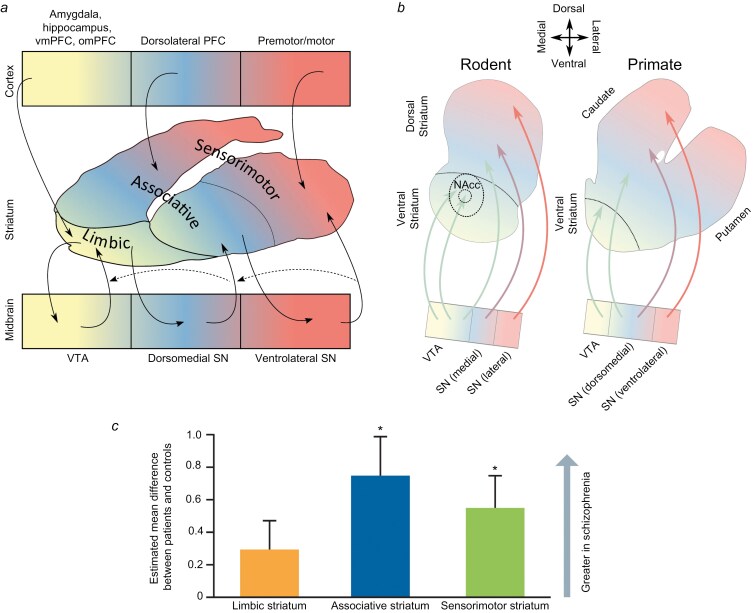
Figure 1.
Figure 1.
Recent advances in understanding of striatal connectivity. (A) Summary of primate tracing studies mapping connections between the cortex, striatum, and midbrain. Tract tracing studies showed that striatocortical connections run in 3 parallel pathways: motor areas project to the caudal putamen, dorsolateral prefrontal cortex to caudate and rostral putamen, and limbic areas to the ventral striatum. These subdivisions are termed the sensorimotor, associative, and limbic striatum. Subsequent research using retrograde tracers injected into striatum to determine midbrain connections showed that VTA projects primarily to limbic striatum, while dorsomedial/ventrolateral parts of the SN project to the associative and sensorimotor striatum, respectively. In primates, the VTA is proportionally smaller than in rodents; it innervates the ventral striatum, whereas the dorsomedial SN innervates the associative striatum, and the ventrolateral SN innervates the sensorimotor striatum. The striatum in turn has efferents projecting back to the midbrain. In addition to these reciprocal connections, feedforward striatonigrostriatal connections allow information to pass along the striatum from limbic to motor regions via the associative striatum. Human imaging studies confirm that the positive symptoms of psychosis in patients with schizophrenia are associated with increased DA activity in the associative and adjacent portions of the sensorimotor striatum that receive input from the dorsomedial SN. Importantly, dopaminergic overactivity was not seen in limbic striatum. (B) Summary of rodent–primate differences in mesostriatal connectivity. In rodents, the ventral striatum is proportionally larger than in primates. The NAcc shell is innervated by the medial VTA, the NAcc core by the central VTA, and the lateral VTA innervates a region homologous to the associative striatum. Together these connections from VTA define the mesolimbic or A10 pathway. The medial SN has connections to more dorsal aspects of the ventral striatum, while lateral SN projects to the dorsal motor regions of the striatum. (C) Modern neurochemical imaging findings suggest that it is within dorsal regions of the striatum that dopaminergic aberrations are greatest. *P < .05. NAcc, nucleus accumbens; om, orbital/medial; PFC, prefrontal cortex; SN, substantia nigra; vm, ventromedial; VTA, ventral tegmental area.
Figure 2.
Figure 2.
The probability distribution of cortical M 1  muscarinic receptor levels in people living with schizophrenia and controls. The probability distribution of cortical M1 muscarinic receptor levels measured using [3H]pirenzepine binding in 80 people with schizophrenia (blue line) and 74 controls (red line). The kernel density estimation of these binding data showed that people with schizophrenia consisted of 2 groups and the controls 1 group. One group in the schizophrenia group consisted of 26 people with a marked deficit in M1 muscarinic receptor (muscarinic receptor deficit schizophrenia: MRDS). In the second group, levels of cortical M1 muscarinic receptors were numerically lower but not statistically significantly different from controls (non-MRDS). ©2020 Dean B, Scarr E. Psychiatry Res. 2020; 288:112989. Used with permission from Elsevier.
Figure 3.
Figure 3.
(A) Hypothesized role of M 4  muscarinic receptor activation in rodent models of psychosis.  M4  muscarinic receptors.,  (B) Hypothesized role of M1  muscarinic receptor activation in rodent models of psychosis., Afferent cholinergic neurons project from the LDT to the medial VTA where they synapse onto DA neurons that project to the striatum. These DA neurons also receive input from glutamatergic pyramidal neurons originating in the PFC that are in turn regulated by parvalbumin-positive GABAergic interneurons. M4 autoreceptors are expressed presynaptically on the cholinergic projections in the medial VTA. Activation of M4 autoreceptors reduces cholinergic signaling to the VTA, inhibiting VTA DA release into the striatum and reducing positive psychotic symptoms. M1 muscarinic receptors are expressed on the parvalbumin-positive GABAergic neurons in the PFC. Activation of these excitatory receptors increases GABA-mediated inhibition of glutamatergic signaling from the PFC to the medial VTA. Decreased glutamate release reduces DA neuron activation in the VTA and DA release in the striatum. ACh, acetylcholine; DA, dopamine; GABA, gamma-aminobutyric acid; Glu, glutamate; LDT, laterodorsal tegmentum; PFC, prefrontal cortex; VTA, ventral tegmental area.
Figure 4.
Figure 4.
Hypothesized role of muscarinic receptor activation in cognitive impairment in schizophrenia. (A) M 1  muscarinic receptors: modulating excitatory/inhibitory balance in the prefrontal cortex.,,  (B) M4  muscarinic receptors: modulating excitatory/inhibitory imbalance in the hippocampus., Cognitive deficits in schizophrenia may arise from an altered balance of excitatory (glutamate) and inhibitory (GABA) neurotransmission in multiple brain regions including the PFC and hippocampus. M1 muscarinic receptors are expressed on GABAergic interneurons in the PFC that synapse onto glutamatergic neurons. Therefore, activation of these receptors increases GABA release and may normalize the excitatory/inhibitory balance in cortical areas associated with cognition. In the hippocampus, M4 muscarinic receptors are expressed on CA3 excitatory (glutamatergic) pyramidal cells that project to the CA1 area. Activation of M4 muscarinic receptors in CA3 lowers excitatory drive and is required for cholinergic suppression of neurotransmission at the CA3-to-CA1 synapse. GABA, gamma-aminobutyric acid; Glu, glutamate; PFC, prefrontal cortex.
Figure 5.
Figure 5.
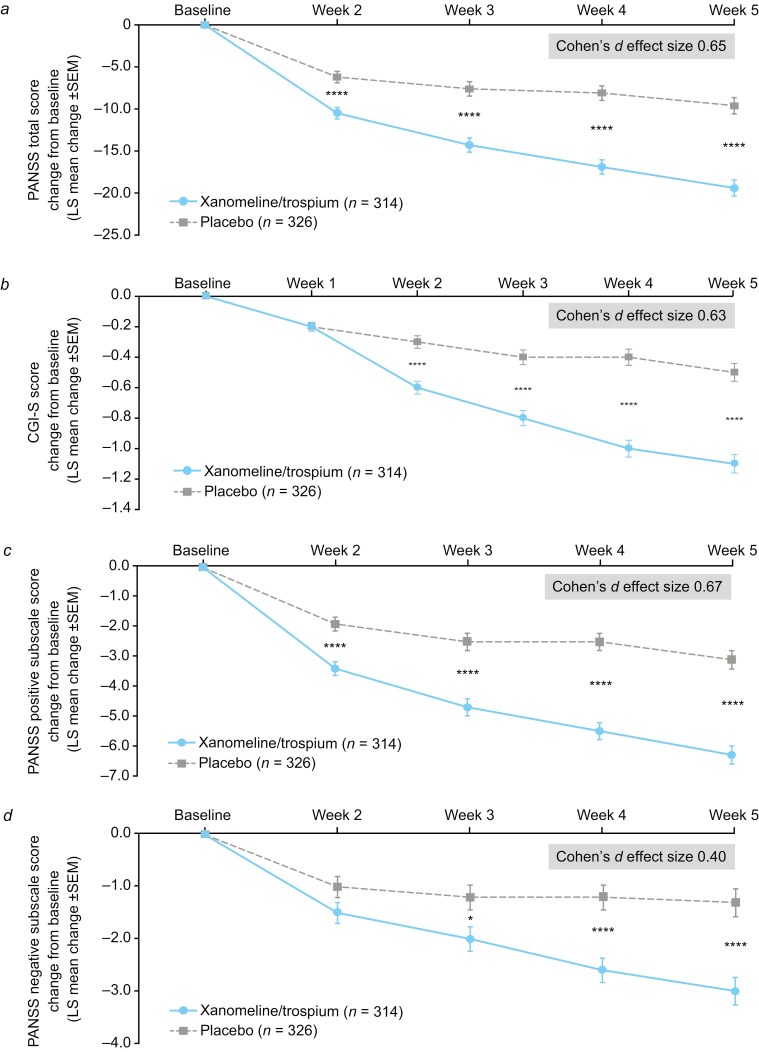
Efficacy of xanomeline/trospium in the pooled 5-week acute EMERGENT trials. (A) PANSS total score. (B) CGI-S score. (C) PANSS positive subscale score. (D) PANSS negative subscale score. Values are LS mean ± SE. LS mean difference vs placebo: *P < .05; ****P < .0001. CGI-S, Clinical Global Impression-Severity; LS, least squares; PANSS, Positive and Negative Syndrome Scale; SEM, standard error of the mean.
Figure 6.
Figure 6.
Effect of xanomeline/trospium on cognition (CANTAB composite score) in people with cognitive impairment at baseline in EMERGENT-2 and EMERGENT-3. Analysis in the subgroup of trial participants with cognitive impairment at baseline, defined as performing 1 SD below normal on the CANTAB. CANTAB, Cambridge Neuropsychological Test Automated Battery; LS, least squares; SE, standard error.

References

    1. Marder SR, Cannon TD. Schizophrenia. N Engl J Med. 2019; 381:1753–1761. https://doi.org/ 10.1056/NEJMra1808803 - DOI - PubMed
    1. Jauhar S, Johnstone M, McKenna PJ. Schizophrenia. Lancet. 2022; 399:473–486. https://doi.org/ 10.1016/S0140-6736(21)01730-X - DOI - PubMed
    1. Weye N, Santomauro DF, Agerbo E, et al. Register-based metrics of years lived with disability associated with mental and substance use disorders: a register-based cohort study in Denmark. Lancet Psychiatry. 2021; 8:310–319. https://doi.org/ 10.1016/S2215-0366(21)00029-8 - DOI - PubMed
    1. GBD 2016 Disease and Injury Incidence and Prevalence Collaborators. Global, regional, and national incidence, prevalence, and years lived with disability for 328 diseases and injuries for 195 countries, 1990-2016: a systematic analysis for the Global Burden of Disease Study 2016. Lancet. 2017; 390:1211–1259. - PMC - PubMed
    1. Olfson M, Gerhard T, Huang C, Crystal S, Stroup TS. Premature mortality among adults with schizophrenia in the United States. JAMA Psychiatry. 2015; 72:1172–1181. https://doi.org/ 10.1001/jamapsychiatry.2015.1737 - DOI - PubMed

MeSH terms