


Fluoridated silver nanocomposites for caries management: an in-vitro assessment of the cytological and antibacterial profiles
- PMID: 40059140
- PMCID: PMC11892278
- DOI: 10.1186/s12903-025-05691-2
Fluoridated silver nanocomposites for caries management: an in-vitro assessment of the cytological and antibacterial profiles
Abstract
Background: Silver nanoparticles (AgNPs) have antibacterial properties with potential applications in managing dental caries. Functionalization with fluoride may further enhance AgNPs' antibacterial efficacy. This study evaluated the impact of fluoridated AgNPs coated with various surface moieties on their safety profile and antibacterial effects against cariogenic bacteria as a potential anti-cariogenic treatment.
Methods: AgNP synthesis followed citrate and gallic acid reduction methods with polyethylene glycol (PEG) and polyvinylpyrrolidone coating. Functionalizing AgNPs with sodium fluoride (NaF) proceeded. Testing the safety of synthesized compounds was done on human gingival fibroblasts and oral epithelial cells. Meanwhile, minimum inhibitory concentration (MIC) determination against Streptococcus mutans was executed to verify antibacterial activity.
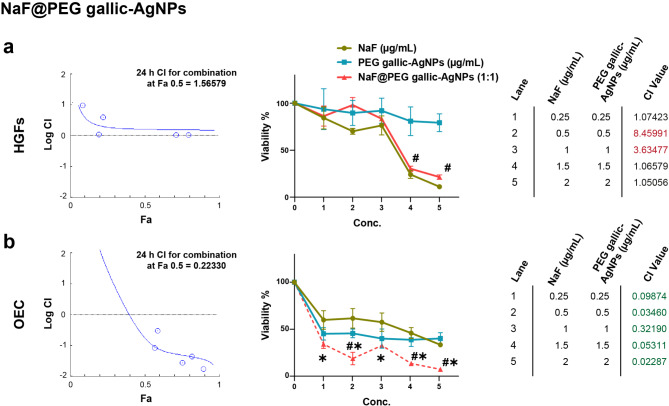
Results: Gallic-reduced AgNPs revealed higher yielding capacity than citrate-AgNPs. Cytologically, PEGylation reinforced citrate-AgNPs stability and improved IC50 range up to ∼ 4.2 × 10¹⁶ µg/mL and 64.3 µg/mL on fibroblastic and epithelial lineages. PEGylated AgNPs counteracted the cytotoxicity of free NaF with antagonistic combinational effect of NaF@PEG gallic-AgNPs on gingival fibroblasts. Microbiologically, AgNPs recorded an enhanced antimicrobial activity of ∼ 5.3 ± 2.3 µg/mL averaged MIC against Streptococcus mutans. Furthermore, fluoridation of PEG gallic-AgNPs depicted an additive antimicrobial propensity.
Conclusions: This dual action nanoplatform successfully integrates fluoride and silver components, reducing fluoride concentrations to safety range while maximizing silver's antibacterial properties. Engineered NaF@PEGylated nanosilver formulation represents promising anti-cariogenic strategy that optimizes therapeutic efficacy while maintaining biological safety.
Keywords: Streptococcus mutans; Cytotoxicity; Gallic acid; Minimum inhibitory concentration; Nano silver; Polyethylene glycol.
© 2025. The Author(s).
Conflict of interest statement
Declarations. Ethics approval and consent to participate: Experiments followed the guidelines approved by the Alexandria University Ethics Committee (IRBNO:00010556-IORG0008839). Gingival fibroblasts donors signed an informed consent form for the isolation of gingival fibroblasts. Consent for publication: not applicable. Competing interests: The authors declare no competing interests.
Figures



References
-
- Bowen W. Dental caries–not just holes in teeth! A perspective. Mol Oral Microbiol. 2016;31:228–33. - PubMed
-
- Marx DE, Barillo DJ. Silver in medicine: the basic science. Burns. 2014;40(Suppl 1):S9–18. 10.1016/j.burns.2014.09.010. - PubMed
-
- Buzalaf MAR, Pessan JP, Honorio HM, Ten Cate JM. Mechanisms of action of fluoride for caries control. Monogr Oral Sci. 2011;22:97–114. 10.1159/000325151. - PubMed
-
- Zhang J, Got S-R, Yin IX, Lo EC-M, Chu C-H. A concise review of silver Diamine fluoride on oral biofilm. Appl Sci. 2021;11:3232.
MeSH terms
Substances
LinkOut - more resources
Full Text Sources
Medical
