. 2025 Feb 4;36(1):102479.
doi: 10.1016/j.omtn.2025.102479. eCollection 2025 Mar 11.

Potential ASO-based personalized treatment for Charcot-Marie-Tooth disease type 2S

Affiliations

Potential ASO-based personalized treatment for Charcot-Marie-Tooth disease type 2S

Sandra Smieszek et al. Mol Ther Nucleic Acids. .

Abstract

Immunoglobulin mu-binding protein 2 (IGHMBP2) pathogenic variants lead to a spectrum of disorders characterized by alpha-motor neuron degeneration. We describe a compound heterozygous patient diagnosed with Charcot-Marie-Tooth disease type 2S with variants in IGHMBP2: a pathogenic missense variant acting in trans with a confirmed intronic cryptic splice site variant. This variant was shown to result in the creation of a new splice acceptor site, loss of reading frame and nonsense-mediated decay. We designed a 19-mer antisense oligonucleotide targeting this cryptic intronic variant to restore IGHMBP2 levels. ASO treatment of patient fibroblasts significantly increased the ratio of restored wild-type transcript to cryptic exon-containing transcript and resulted in over a 50% increase in IGHMBP2 protein levels. Neuromuscular junction analyses revealed high fatigue and chaotic tetanus formulation in untreated patient cells. We demonstrate rescue of NMJ function following ASO treatment, captured by a reduction in fatigue and chaotic tetanus responses. Furthermore, toxicity testing revealed that intrathecal administration of the ASO to wild-type Sprague-Dawley rats over 3 months was well tolerated. Our preclinical data support this ASO as a potential CMT2S treatment by rescuing IGHMBP2. N-of-1 ASO-based therapeutics may prove instrumental in the design of treatments for this diverse genetic disorder.

Keywords: Charcot-Marie-Tooth Disease type 2S; IGHMBP2; MT: Oligonucleotides: Therapies and Applications; RNA therapeutics; antisense oligonucleotide; exon skipping; genetic rescue; personalized treatment; splicing variants.


Conflict of interest statement

This study was fully funded by Vanda Pharmaceuticals Inc. S.S., B.P., C.T., C.J., H.B., C.M.P., G.B., and M.H.P. are employees of Vanda Pharmaceuticals Inc. M.H.P. is CEO of Vanda Pharmaceuticals Inc. J.H. is a Professor at the University of Central Florida’s NanoScience Technology Center and Co-Founder and Chief Scientist of Hesperos, Inc.

Figures

None
Graphical abstract
Figure 1
Figure 1
Origin of IGHMBP2 variants The top panel depicts the origin of the IGHMBP2 variants, including the cryptic splice site variant. Paternal allele A carries the cryptic splice site variant responsible for the decrease of IGHMBP2 protein level mediated via transcriptional NMD. Maternal allele A carries a coding SNV (IGHMBP2; p.Leu577Pro) rs1483165002. The lower panel shows the section of the predicted 3D protein structure of IGHMBP2, comparing WT with the carrier of the missense variant rs1483165002, where the position of the amino acid substitution is colored in gray. Specifically observed is a loss of two hydrogen bonds and a loss of connection to the chains.
Figure 2
Figure 2
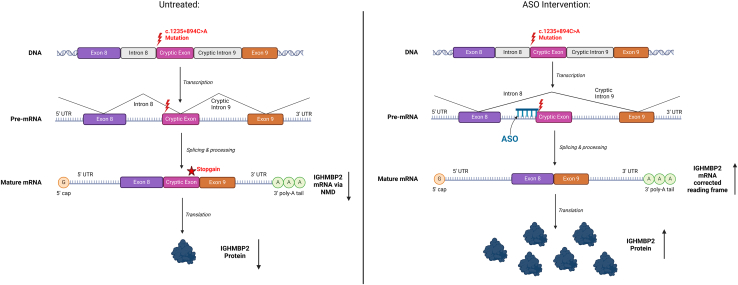
Mechanism of ASO Intervention of IGHMBP2 Variant The ASO targets IGHMBP2, the paternal splicing variant resulting in the cryptic splice site. The objective of the treatment is to increase protein levels by avoiding NMD.
Figure 3
Figure 3
VCA-894A restores IGHMBP2 (A) Relative mRNA expression of IGHMBP2 in fibroblast-grown cells following VCA-894A treatment (48-h incubation, 1 μM). The mean expression of untreated samples is 0.9968, and the mean of treated samples is 1.744. The difference between means (B − A) ± SEM is 0.7473 ± 0.05081. 95% confidence interval of 0.6063–0.8884. R squared (eta squared) is 0.9818. The expression levels are significantly higher in the VCA-894A-treated samples (unpaired t test, ∗∗∗p value < 0.001). GAPDH expression was used to normalize expression across samples. (B) Dose-response analysis was completed with VCA-894A to determine IGHMBP2 relative expression at concentrations of 0, 250 nM, 500 nM, and 1 μM. A dose-responsive increase in RNA is observed. We utilized three biological replicates/each condition and each experiment was repeated twice. The patient’s fibroblasts underwent 48-h incubation via gymnotic uptake of ASO. A one-way ANOVA test was used to calculate statistical significance (∗∗∗∗p value < 0.0001). (C) IGHMBP2 western blot results show significant protein restoration with 0.5 μM and 1.0 μM VCA-894A treatment (72-h incubation) (∗∗∗p value < 0.001).
Figure 4
Figure 4
Characterization of CMT2S iPSC-MN (A) Immunocytochemistry staining of CMT2S iPSC-MNs indicated their positivity to neuronal marker MAP2 and MN marker ChAT, confirming cell type and viability. (B) Characterization of hiPSC-MN axonal varicosity at 3 weeks. Confocal microscopy of WT-MNs at 20X emphasizing staining morphology for analysis indicating expression of MAP2 and NF. Confocal microscopy of CMT2S-MNs at 20X emphasizing staining morphology for analysis indicating expression of MAP2 and NF. Scale bar, 100 μm. Varicosities are identified by arrows. Quantification of varicosity analysis measured in varicosities per micron at 3 weeks in vitro. n ≥ 40 neurons for each genotype from at least three batches of culture were analyzed. Data represent mean ± SEM. Asterisks indicate that the condition is significantly different from the WT at the same time point: ∗p < 0.05, ∗∗p < 0.01, ∗∗∗p < 0.001.
Figure 5
Figure 5
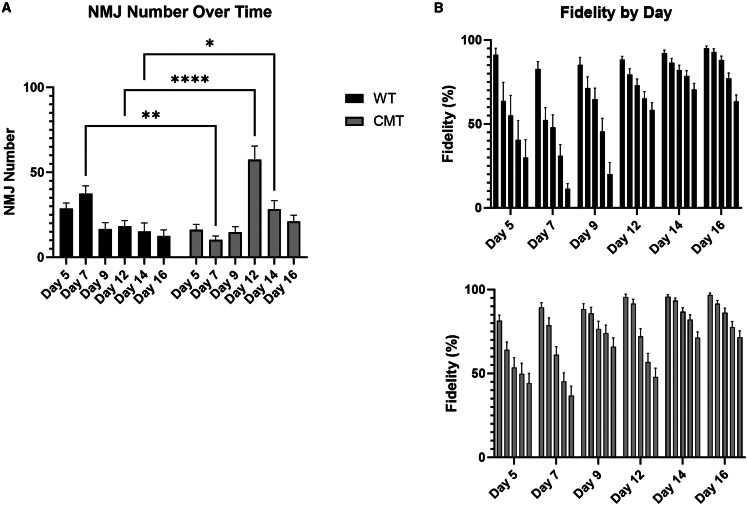
NMJ number and fidelity NMJ number is shown for both WT and CMT2S systems plated on two different timelines (Late plating – days 5, 7, and 9; Early plating – days 12, 14, and 16). CMT2S and WT systems were significantly different on individual days 7, 12, and 14 for NMJ number (two-way ANOVA with Fisher’s LSD; ∗p < 0.05, ∗∗p < 0.01, ∗∗∗∗p < 0.0001). Fidelity scores for NMJs formed at these timelines are shown as bar graphs with increasing frequency from left to right (0.33, 0.5, 1.0, 2.0, and 4.0 Hz). No significance was determined between WT and CMT2S fidelity at any time point. Means are shown as data points or bars, with error bars reporting SEM.
Figure 6
Figure 6
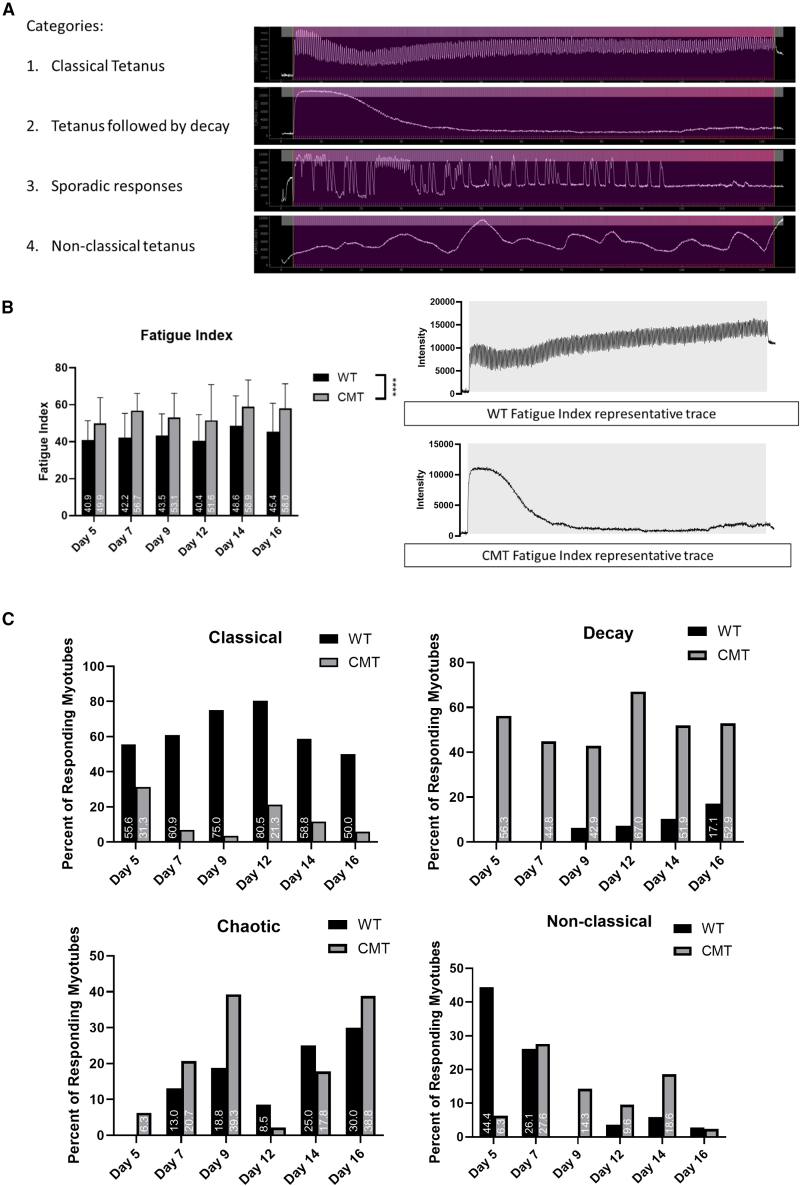
NMJ functional parameters (A) Tetanus categories: Classical tetanus, tetanus followed by decay, chaotic responses, and non-classical tetanus. (B) The FI is defined as in Equation 1. Means are shown as data points or bars, with error bars reporting standard error of the mean (SEM). Quantification of the FI showed increased fatigue in the CMT2S-NMJs on all test days, as compared with WT-NMJs (∗∗∗∗p < 0.0001). Shaded areas show a duration of 2 Hz stimulation (2 min). (C) CMT2S-NMJ systems show a high level of decay and chaotic tetanus and a low level of classical tetanus, as compared to WT-NMJs. CMT2S-NMJ systems show a higher level of non-classical tetanus, as compared with WT-NMJs.
Figure 7
Figure 7
ASO dosing NMJ functional assessment – fatigue index (A) ASO dosing experimental timeline. Two different dosing strategies were utilized for determining recovery from MNs plated on the standard timeline. Dosing Cohort 1 (day 3 dosing) and Dosing Cohort 2 (day 12 dosing) were dosed with VCA-894A according to the depicted timeline. (B) ASO dosing assessment on the Dosing Cohort 1 (left panel) and Dosing Cohort 2 (right panel). There is a significant restoration of functionality in Dosing Cohort 1 with 1 μM on day 12, 100 nM on day 14, and 10 nM and 100 nM on day 16 and day 20. There is a significant improvement in Dosing Cohort 2 systems dosed with 1 μM VCA-894A on day 14, with near significance by day 20 (p = 0.0708). Means are shown as data points or bars, with error bars reporting the standard error of the mean (SEM). ∗p < 0.05, ∗∗p < 0.01, ∗∗∗p < 0.001, ∗∗∗∗p < 0.0001.
Figure 8
Figure 8
ASO dosing NMJ functional assessment—tetanus type There is a significant change in the proportion of phenotypes in Dosing Cohort 1 systems, with 10 nM showing a significant restoration at all days except day 14, 100 nM showing significant restoration across all time points, and 1 μM showing significant differences only at day 12 and day 14. Dosing Cohort 2 systems treated with 100 nM show significance at early time points (day 12 and day 14), with 1-μM dosing showing significant effects at day 12, day 14, and day 20. One-way multiple chi-square; ∗p < 0.05, ∗∗p < 0.01, ∗∗∗p < 0.001, ∗∗∗∗p <0.0001.

References

    1. Rare Disease Database Charcot-Marie-Tooth Disease Synonyms of Charcot-Marie-Tooth Disease. https://rarediseases.org/rare-diseases/charcot-marie-tooth-disease/
    1. Cottenie E., Kochanski A., Jordanova A., Bansagi B., Zimon M., Horga A., Jaunmuktane Z., Saveri P., Rasic V.M., Baets J., et al. Truncating and Missense Mutations in IGHMBP2 Cause Charcot-Marie Tooth Disease type 2. Am. J. Hum. Genet. 2014;95:590–601. doi: 10.1016/j.ajhg.2014.10.002. - DOI - PMC - PubMed
    1. Nam S.H., Choi B.-O. Clinical and Genetic Aspects of Charcot-Marie-Tooth Disease Subtypes. Precis. Future Med. 2019;3:43–68. doi: 10.23838/pfm.2018.00163. - DOI
    1. Cassini T.A., Duncan L., Rives L.C., Newman J.H., Phillips J.A., Koziura M.E., Brault J., Hamid R., Cogan J., Undiagnosed Diseases Network Whole Genome Sequencing Reveals Novel IGHMBP2 Variant Leading to Unique Cryptic Splice-Site and Charcot-Marie-Tooth Phenotype with Early Onset Symptoms. Mol. Genet. Genomic Med. 2019;7 doi: 10.1002/mgg3.676. - DOI - PMC - PubMed
    1. Stavrou M., Kagiava A., Sargiannidou I., Georgiou E., Kleopa K.A. Charcot–Marie–Tooth Neuropathies: Current Gene Therapy Advances and the Route toward Translation. J. Peripher. Nerv. Syst. 2023;28:150–168. doi: 10.1111/jns.12543. - DOI - PubMed