


Trazodone and Risk of Orthostatic Hypotension, Syncope and Falls in Geriatric Outpatients with Hypertension
- PMID: 40067602
- PMCID: PMC12003544
- DOI: 10.1007/s40266-025-01196-3
Trazodone and Risk of Orthostatic Hypotension, Syncope and Falls in Geriatric Outpatients with Hypertension
Abstract
Introduction: In older adults, trazodone is frequently prescribed for anxiety and insomnia owing to its perceived greater tolerability in comparison with benzodiazepines. However, it may have hypotensive effects.
Aim: The aim of this study is to investigate the effects of trazodone on orthostatic blood pressure (BP) response and risk of syncope and falls in hypertensive older adults.
Patients and methods: A longitudinal observational study involving patients ≥ 75 years was conducted in two geriatric outpatient clinics in Florence, Italy. At baseline, participants underwent a 3-min active stand test, office BP measurement and home and ambulatory BP monitoring. At follow-up, syncope and falls were recorded.
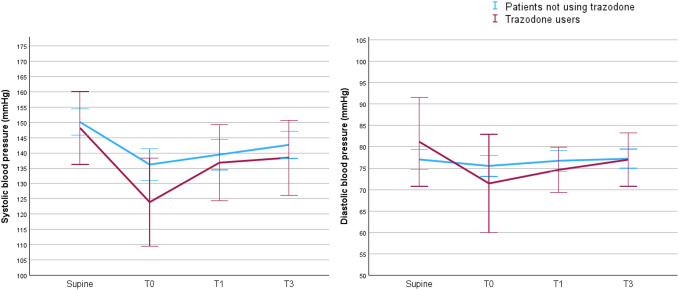
Results: Among 123 participants (mean age 81 years, 59% female), 12 (10%) reported regular trazodone use. Trazodone users showed lower office diastolic BP (71.8 versus 80.1 mmHg, p = 0.042), a greater systolic and diastolic BP reduction immediately after standing (ΔsystolicT0 23.8 versus 14.3 mmHg, p = 0.037; ΔdiastolicT0 8.9 versus 1.6 mmHg, p = 0.004) and a greater diastolic BP reduction after 1-min standing (ΔdiastolicT1 6.5 versus 0 mmHg, p = 0.029). No differences were reported for home or ambulatory BP. Incidence of syncope and falls was 25%, with a significantly higher rate in patients receiving trazodone (58.3% versus 21.2%, p = 0.001). Trazodone use predicted syncope and falls independently of age, disability and fall history. This association was not confirmed when adjusting for dementia diagnosis. BP values were not associated with the study outcome.
Conclusions: In older hypertensive outpatients, trazodone is associated with a greater orthostatic BP drop and may predispose them to an increased risk of syncope and falls.
© 2025. The Author(s).
Conflict of interest statement
Declarations. Funding: The study was supported by Fondazione Cassa di Risparmio di Firenze. We acknowledge co-funding from the European Union – Next Generation EU. Views and opinions expressed are those of the authors only and do not necessarily reflect those of the European Union or the European Commission. Neither the European Union nor the European Commission can be held responsible for them (PNRR MUR M4 C2 Inv. 1.5 CUP B83C22003920001). Conflicts of Interest: Giulia Rivasi, Marco Capacci, Lorenzo Maria Del Re, Ilaria Ambrosino, Ludovica Ceolin, Alessandra Liccardo, Maria Francesca Bisignano, Giuseppe D’Ambrosio, Greta Ceccarelli, Giulia Matteucci, Enrico Mossello, and Andrea Ungara declare that they have no potential conflicts of interest that might be relevant to the contents of this manuscript. Availability of Data and Material: The data that support the findings of this study are available from the corresponding author upon reasonable request. Ethics Approval: This study was performed in line with the principles of the Declaration of Helsinki. Approval was granted by the local research ethics committee (protocol number: 16539_oss). Consent to Participate: Informed consent was obtained from all individual participants or his/her legal representative included in the study. Consent for Publication: Not applicable. Code Availability: Not applicable. Author Contributions: Conceptualization: Giulia Rivasi, Andrea Ungar, Enrico Mossello, and Marco Capacci. Acquisition, analysis, or interpretation of data: all authors. Writing – original draft preparation: Giulia Rivasi, Andrea Ungar, Enrico Mossello, Marco Capacci, and Lorenzo Del Re. Writing – review and editing: all authors. All authors read and approved the final version.
Figures

References
-
- Italian Medicines Agency (2021) The Medicines Utilisation Monitoring Centre. National report on medicines use in older adults in Italy. Year 2019. https://www.aifa.gov.it/-/rapporto-osmed-2019 (accessed on Oct 13, 2024)
Publication types
MeSH terms
Substances
Grants and funding
LinkOut - more resources
Full Text Sources
Medical
