


Automatic multisensory integration follows subjective confidence rather than objective performance
- PMID: 40069314
- PMCID: PMC11896883
- DOI: 10.1038/s44271-025-00221-w
Automatic multisensory integration follows subjective confidence rather than objective performance
Erratum in
-
Publisher Correction: Automatic multisensory integration follows subjective confidence rather than objective performance.Commun Psychol. 2025 Aug 7;3(1):120. doi: 10.1038/s44271-025-00302-w. Commun Psychol. 2025. PMID: 40775044 Free PMC article. No abstract available.
Abstract
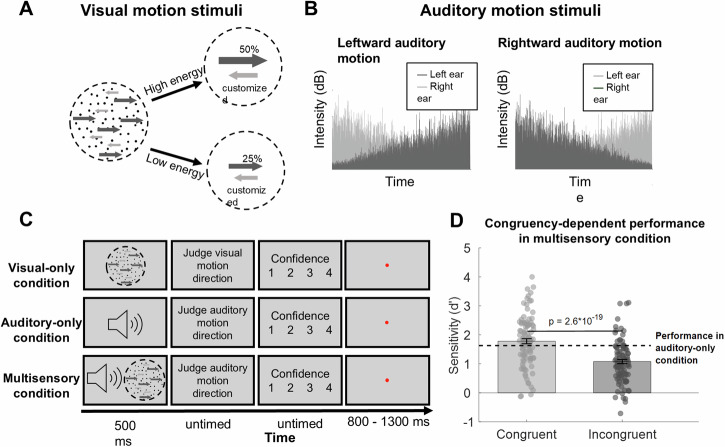
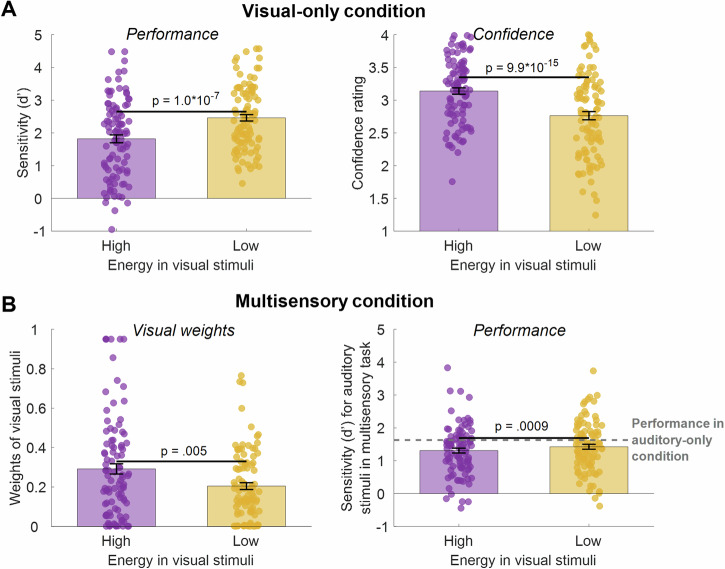
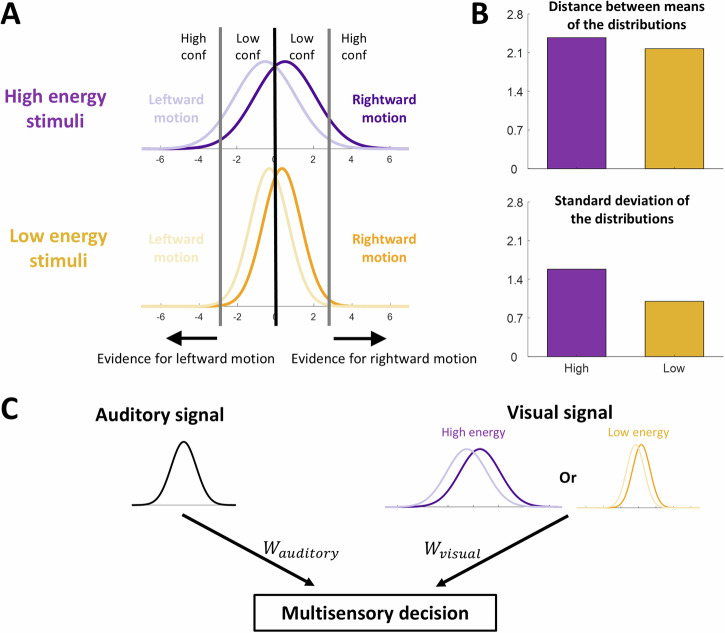
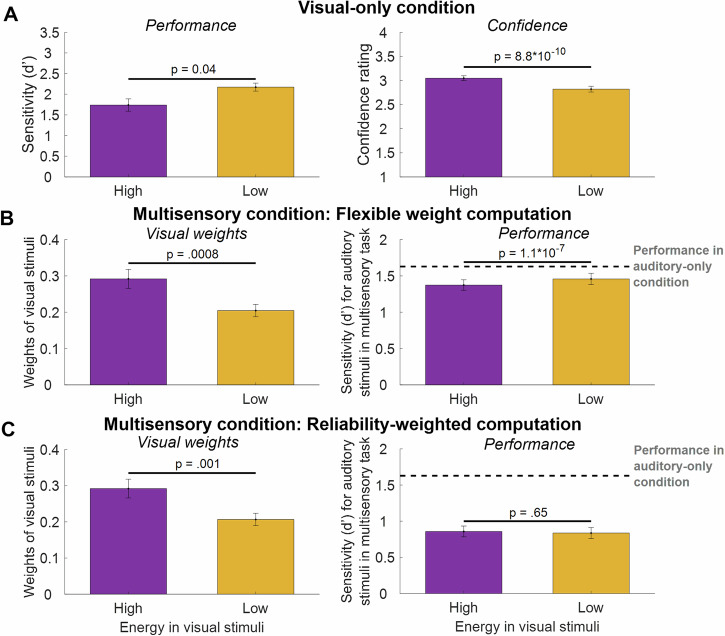
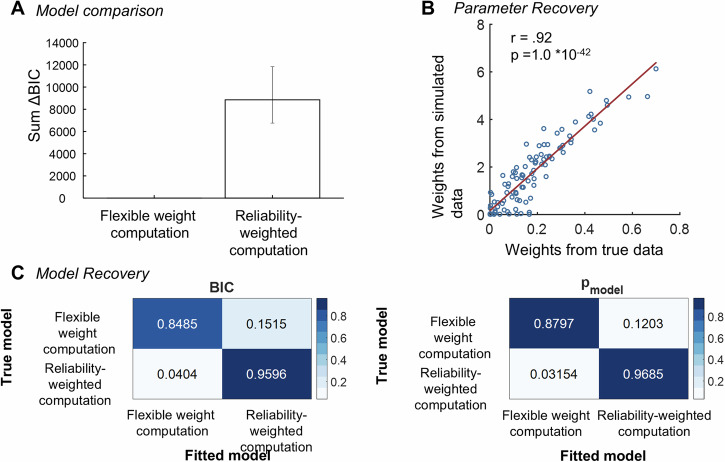
It is well known that sensory information from one modality can automatically affect judgments from a different sensory modality. However, it remains unclear what determines the strength of the influence of an irrelevant sensory cue from one modality on a perceptual judgment for a different modality. Here we test whether the strength of multisensory impact by an irrelevant sensory cue depends on participants' objective accuracy or subjective confidence for that cue. We created visual motion stimuli with low vs. high overall motion energy, where high-energy stimuli yielded higher confidence but lower accuracy in a visual-only task. We then tested the impact of the low- and high-energy visual stimuli on auditory motion perception in 99 participants. We found that the high-energy visual stimuli influenced the auditory motion judgments more strongly than the low-energy visual stimuli, consistent with their higher confidence but contrary to their lower accuracy. A computational model assuming common principles underlying confidence reports and multisensory integration captured these effects. Our findings show that automatic multisensory integration follows subjective confidence rather than objective performance and suggest the existence of common computations across vastly different stages of perceptual decision making.
© 2025. The Author(s).
Conflict of interest statement
Competing interests: The authors declare no competing interests.
Figures
Update of
-
Automatic multisensory integration follows subjective confidence rather than objective performance.bioRxiv [Preprint]. 2025 Jan 12:2023.06.07.544029. doi: 10.1101/2023.06.07.544029. bioRxiv. 2025. Update in: Commun Psychol. 2025 Mar 11;3(1):38. doi: 10.1038/s44271-025-00221-w. PMID: 37333352 Free PMC article. Updated. Preprint.
References
-
- Alais, D. & Burr, D. The ventriloquist effect results from near-optimal bimodal integration. Curr. Biol.14, 257–262 (2004). - PubMed
-
- Ernst, M. O. & Banks, M. S. Humans integrate visual and haptic information in a statistically optimal fashion. Nature415, 429–433 (2002). - PubMed
-
- Kim, R., Peters, M. A. K. & Shams, L. 0 + 1 > 1: how adding noninformative sound improves performance on a visual task. Psychol. Sci.23, 6–12 (2012). - PubMed
-
- Landy, M. S., Banks, M. S. & Knill, D. C. Ideal-observer models of cue integration. In Sensory Cue Integration (eds. Trommershäuser, J., Kording, K. & Landy, M. S.) 5–29 (Oxford University Press, 2011).
Grants and funding
LinkOut - more resources
Full Text Sources