


A new data-driven paradigm for the study of avian migratory navigation
- PMID: 40069784
- PMCID: PMC11900352
- DOI: 10.1186/s40462-025-00543-8
A new data-driven paradigm for the study of avian migratory navigation
Abstract
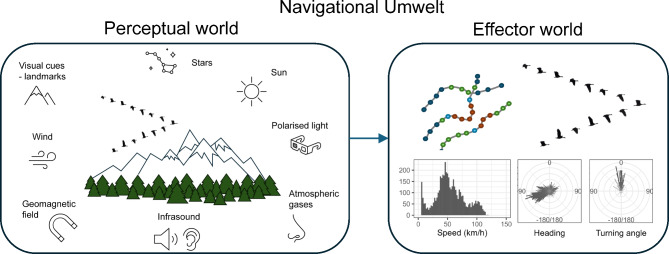
Avian navigation has fascinated researchers for many years. Yet, despite a vast amount of literature on the topic it remains a mystery how birds are able to find their way across long distances while relying only on cues available locally and reacting to those cues on the fly. Navigation is multi-modal, in that birds may use different cues at different times as a response to environmental conditions they find themselves in. It also operates at different spatial and temporal scales, where different strategies may be used at different parts of the journey. This multi-modal and multi-scale nature of navigation has however been challenging to study, since it would require long-term tracking data along with contemporaneous and co-located information on environmental cues. In this paper we propose a new alternative data-driven paradigm to the study of avian navigation. That is, instead of taking a traditional theory-based approach based on posing a research question and then collecting data to study navigation, we propose a data-driven approach, where large amounts of data, not purposedly collected for a specific question, are analysed to identify as-yet-unknown patterns in behaviour. Current technological developments have led to large data collections of both animal tracking data and environmental data, which are openly available to scientists. These open data, combined with a data-driven exploratory approach using data mining, machine learning and artificial intelligence methods, can support identification of unexpected patterns during migration, and lead to a better understanding of multi-modal navigational decision-making across different spatial and temporal scales.
Keywords: Artificial intelligence; Avian navigation; Data mining; Data-driven methods; Environmental data; Machine learning; Multi-modal navigation; Multi-scale navigation; Tracking data.
© 2025. The Author(s).
Conflict of interest statement
Declarations. Ethics approval and consent to participate: Not applicable. Consent for publication: Not applicable. Competing interests: The authors declare no competing interests.
Figures

References
-
- Holland RA. True navigation in birds: from quantum physics to global migration. J Zool. 2014;293:1–15. 10.1111/jzo.12107.
-
- Able KP. The concepts and terminology of bird navigation. J Avian Biol. 2003;32:174–83. 10.1034/j.1600-048X.2001.320211.x.
-
- Gallistel CR. The organization of learning. Cambridge, Massachusetts: Bradford Books / MIT; 1990.
-
- Guildford T, Biro D. Route following and the Pigeon’s familiar area map. J Exp Biol. 2014;217:169–79. 10.1242/jeb.092908. - PubMed
-
- Bingman VP, Cheng K. Mechanisms of animal global navigation: comparative perspectives and enduring challenges. Ethol Ecol Evol. 2005;17(4):295–318. 10.1080/08927014.2005.9522584.
Publication types
LinkOut - more resources
Full Text Sources
