


Two-Arm Crossover Randomized Controlled Trial Versus Meta-Analysis of N-of-1 Studies: Comparison of Statistical Efficiency in Determining an Intervention Effect
- PMID: 40071868
- PMCID: PMC11898578
- DOI: 10.1002/bimj.70045
Two-Arm Crossover Randomized Controlled Trial Versus Meta-Analysis of N-of-1 Studies: Comparison of Statistical Efficiency in Determining an Intervention Effect
Abstract
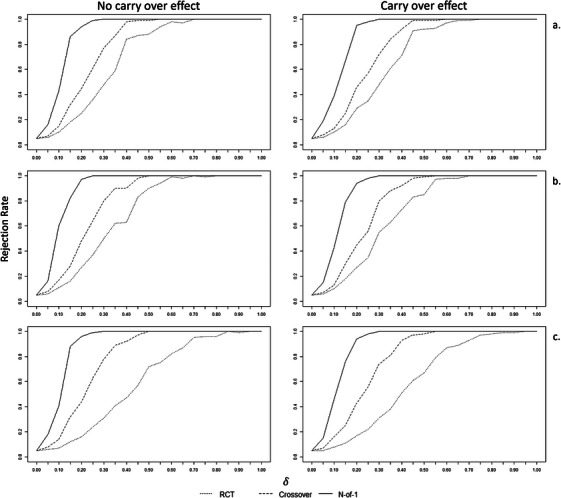
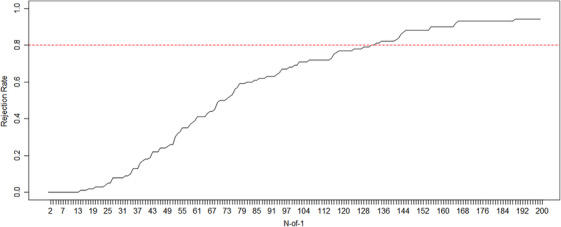
N-of-1 trials are currently receiving broader attention in healthcare research when assessing the effectiveness of interventions. In contrast to the most commonly applied two-arm randomized controlled trial (RCT), in an N-of-1 design, the individual acts as their own control condition in the sense of a multiple crossover trial. N-of-1 trials can lead to a higher quality of patient by examining the effectiveness of an intervention at an individual level. Moreover, when a series of N-of-1 trials are properly aggregated, it becomes possible to detect an intervention effect at a population level. This work investigates whether a meta-analysis of summary data of a series of N-of-1 trials allows us to detect a statistically significant intervention effect with fewer participants than in a traditional, prospectively powered two-arm RCT and crossover design when evaluating a digital health intervention in cardiovascular care. After introducing these different analysis approaches, we compared the empirical properties in a simulation study both under the null hypothesis and with respect to power with different between-subject heterogeneity settings and in the presence of a carry-over effect. We further investigate the performance of a sequential aggregation procedure. In terms of simulated power, the threshold of 80% was achieved earlier for the aggregating procedure, requiring fewer participants.
Keywords: N‐of‐1 trials; comparative effectiveness; crossover Design; meta‐analysis; two‐arm randomized controlled trial.
© 2025 The Author(s). Biometrical Journal published by Wiley‐VCH GmbH.
Conflict of interest statement
The authors declare no conflicts of interest.
Figures


References
-
- Ambrosetti, M. , Abreu A., Corrà U., et al. 2021. “Secondary Prevention Through Comprehensive Cardiovascular Rehabilitation: From Knowledge to Implementation. 2020 Update. A Position Paper From the Secondary Prevention and Rehabilitation Section of the European Association of Preventive Cardiology.” European Journal of Preventive Cardiology 28, no. 5: 460–495. - PubMed
-
- Barlow, D. H. , and Hersen M.. 1984. Single‐case Experimental Designs: Strategies for Studying Behavior Change, 2nd ed. Pergamon Press.
-
- Claes, J. , Cornelissen V., McDermott C., et al. 2020. “Feasibility, Acceptability, and Clinical Effectiveness of a Technology‐enabled Cardiac Rehabilitation Platform (Physical Activity Toward Health‐I): Randomized Controlled Trial.” Journal of Medical Internet Research 22, no. 2: e14221. - PMC - PubMed
Publication types
MeSH terms
Grants and funding
LinkOut - more resources
Full Text Sources
